First national audit comes 10 days after taking office as SMEs minister
Minister engages actively on Kosdaq delisting, tech theft issues
Breaks with FSC on delisting criteria
Unable to answer questions on next year's minimum wage
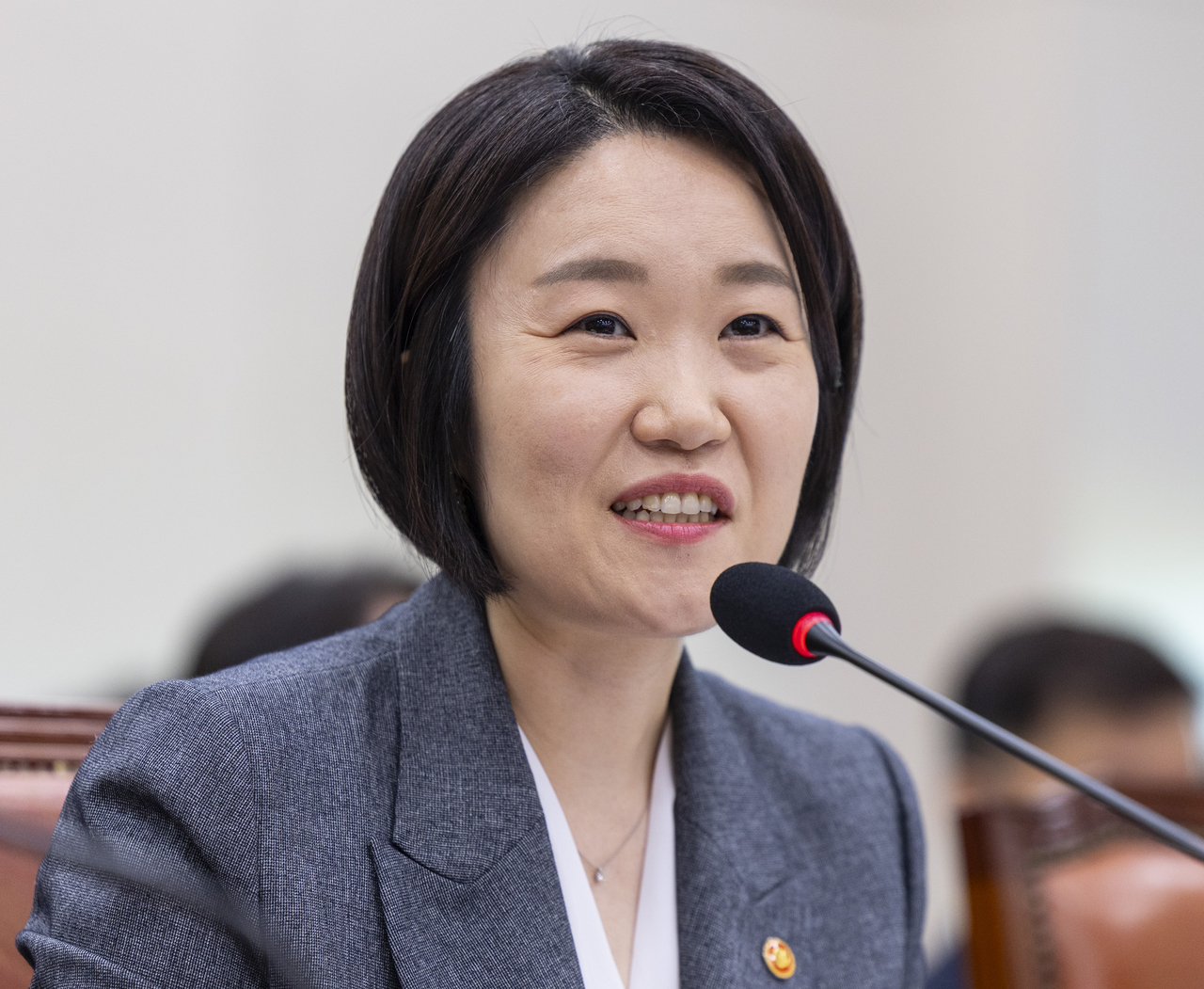
Lee So-young made a relatively smooth debut at her first national audit, just 10 days after her inauguration as minister of SMEs and Startups. She fielded lawmakers' questions with confidence and showed a willingness to assert her ministry's position even where it diverged from other government agencies — though she stumbled on some questions, including one about next year's minimum wage.
Wednesday's audit of the Ministry of SMEs and Startups by the National Assembly's Trade, Industry and SMEs Committee was notably calmer than sessions at some other committees, where ruling and opposition lawmakers clashed sharply. Opposition lawmakers did press the minister on several points, but the questioning focused largely on policy issues — Onuri gift voucher fraud, technology theft and Kosdaq delistings — rather than personal attacks on Lee. She handled most of the substantive questions without difficulty.
Lee was particularly direct in signaling a break with the Financial Services Commission over Kosdaq delisting standards. When lawmakers raised concerns that using market capitalization as the sole criterion for delisting could push out small and medium-sized enterprises and venture companies with genuine growth potential, Lee said multiple factors — including growth prospects and profitability — should be weighed together. She added that she was prepared to debate the FSC chairman directly to ensure her ministry's views were reflected in any final decision.
On technology theft, Lee signaled a push for regulatory reform. When a lawmaker noted that the current system's enforcement tools go no further than a recommendation to correct the violation, Lee said, "I find that quite surprising, and it must be improved quickly." She also expressed support for a proposal to channel fines collected under the technology protection law into a relief fund for companies that have suffered from theft.
Lee also pledged to investigate allegations of fraudulent use of Onuri gift vouchers, which emerged as a flashpoint during the audit. Democratic Party of Korea lawmaker Kim Won-i pointed out that a vegetable stall of about 13 square meters in a traditional market in Gwangju had processed 12.2 billion won ($9.08 million) in Onuri voucher transactions last year. Lee said she would "seek cooperation from the National Tax Service and other relevant agencies, not just conduct an internal probe, to investigate accurately and report back before the comprehensive audit."
On other small business issues, Lee offered concrete responses. Regarding the problem of national health insurance premiums being levied again on Yellow Umbrella mutual-aid payouts, she said the practice "appears to amount to double taxation" and pledged to take the matter up with the Ministry of Health and Welfare.
The session took a more awkward turn when the questioning shifted to the minimum wage.
People Power Party lawmaker Jo Ji-yeon asked Lee how much next year's minimum wage would be, but the minister could not answer immediately. Jo stepped in with the figure herself: "It's 10,700 won per hour. You really need to know this." The minimum wage for 2027 is set at 10,700 won ($8) per hour, up 380 won, or 3.7 percent, from this year's 10,320 won — a figure that directly affects the operating costs of small business owners who bear heavy labor expenses.
Lee also said she was unaware of a key piece of litigation involving the minimum wage. When Jo asked whether Lee knew that the Korea Federation of Micro Enterprise had filed an administrative lawsuit against the Ministry of Employment and Labor seeking to overturn the official gazette notice setting the 2027 minimum wage, Lee replied, "I did not know a lawsuit had been filed."
The federation filed the administrative suit in August, seeking cancellation of the minimum wage notice. It was the first time the group had taken legal action over the minimum wage since 2018 — nine years earlier — drawing considerable attention at the time.
Jo also took aim at the ministry's broader engagement on minimum wage policy. She noted that while the Ministry of SMEs and Startups has no voting rights on the Minimum Wage Commission, it is entitled to submit formal opinions — yet has no record of ever having done so.
Lee acknowledged the impact of minimum wage increases on small business owners. She described the issue as "a war between the vulnerable and the vulnerable," saying she recognized that rising wages could push self-employed micro-business owners to work alone without hiring any staff.
On the industry-specific differentiation of the minimum wage — a longstanding demand from small business groups — Lee was cautious, saying it was "an area that requires more careful consideration."
Overall, Lee demonstrated a solid grasp of most major issues at her first audit and was willing to stake out clear positions. But given her repeated emphasis since taking office on resolving problems facing small business owners, her apparent unfamiliarity with minimum wage developments — matters that bear directly on their operating burdens — drew criticism as a notable gap.
boo@heraldcorp.com