Support among progressives and moderates down 3–4 percentage points since before his inauguration; party insiders cite ruling-camp divisions as the cause
Shorter Supreme Council messages, shifting schedule signal change in approach: 'Time to appeal with more sincerity'
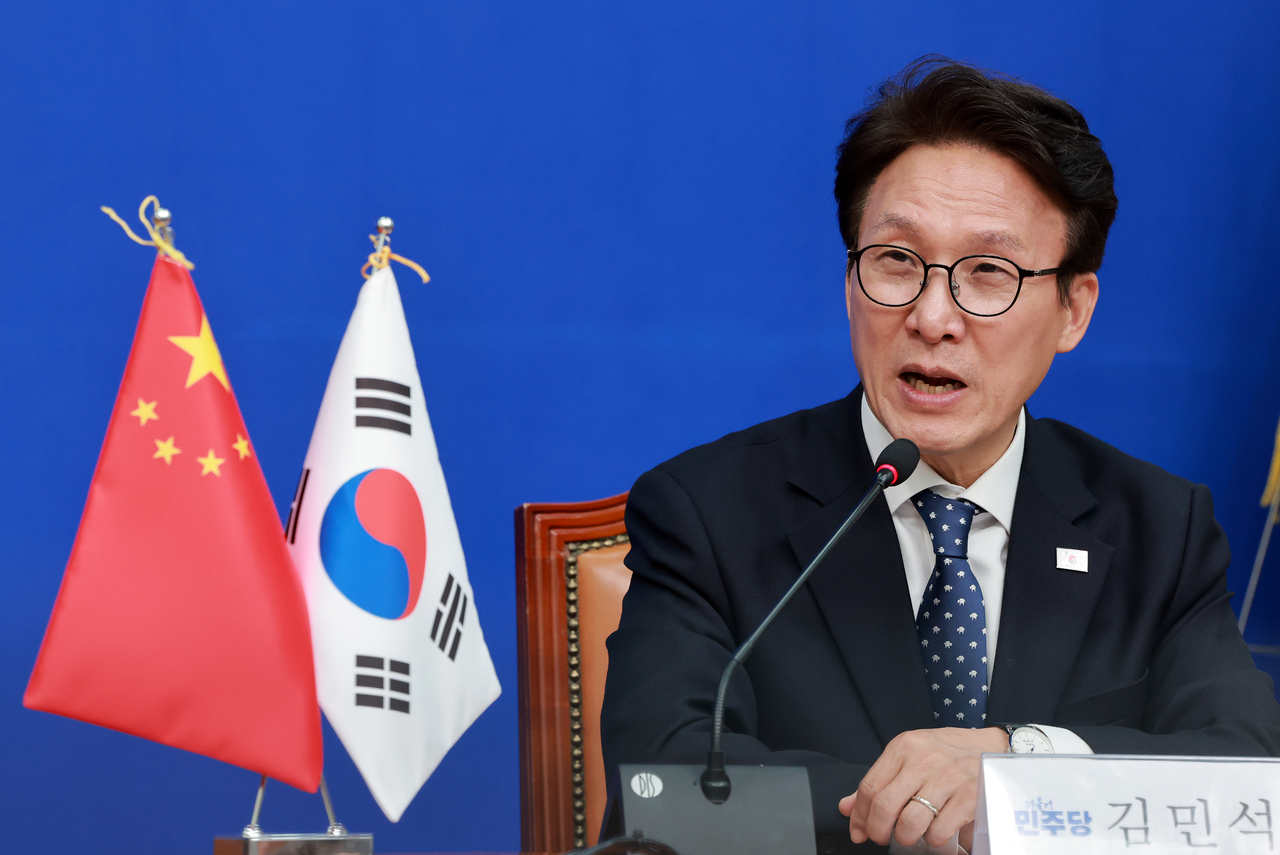
Democratic Party of Korea leader Kim Min-seok is wrestling with a polling problem as he approaches his two-month mark in office. Kim pledged at the Aug. 17 party convention to raise the Democratic Party's approval rating by 10 percentage points within 100 days of taking office, but the party has instead hit its lowest support level since President Lee Jae Myung's government took power — with no clear path to a rebound in sight. Many within the party attribute the slide to deepening divisions inside the ruling camp, a rift that first surfaced at the convention and has since widened over issues including prosecutorial reform.
Kim has won some credit for improving party-government coordination since taking office, but concerns have also emerged that his schedule and public messaging have been excessive. Against that backdrop, Kim appears to be recalibrating — trimming his public statements and leaning more heavily on grassroots outreach to find a way forward.
Gallup records new low; KSOI poll shows PPP overtaking DP within margin of error
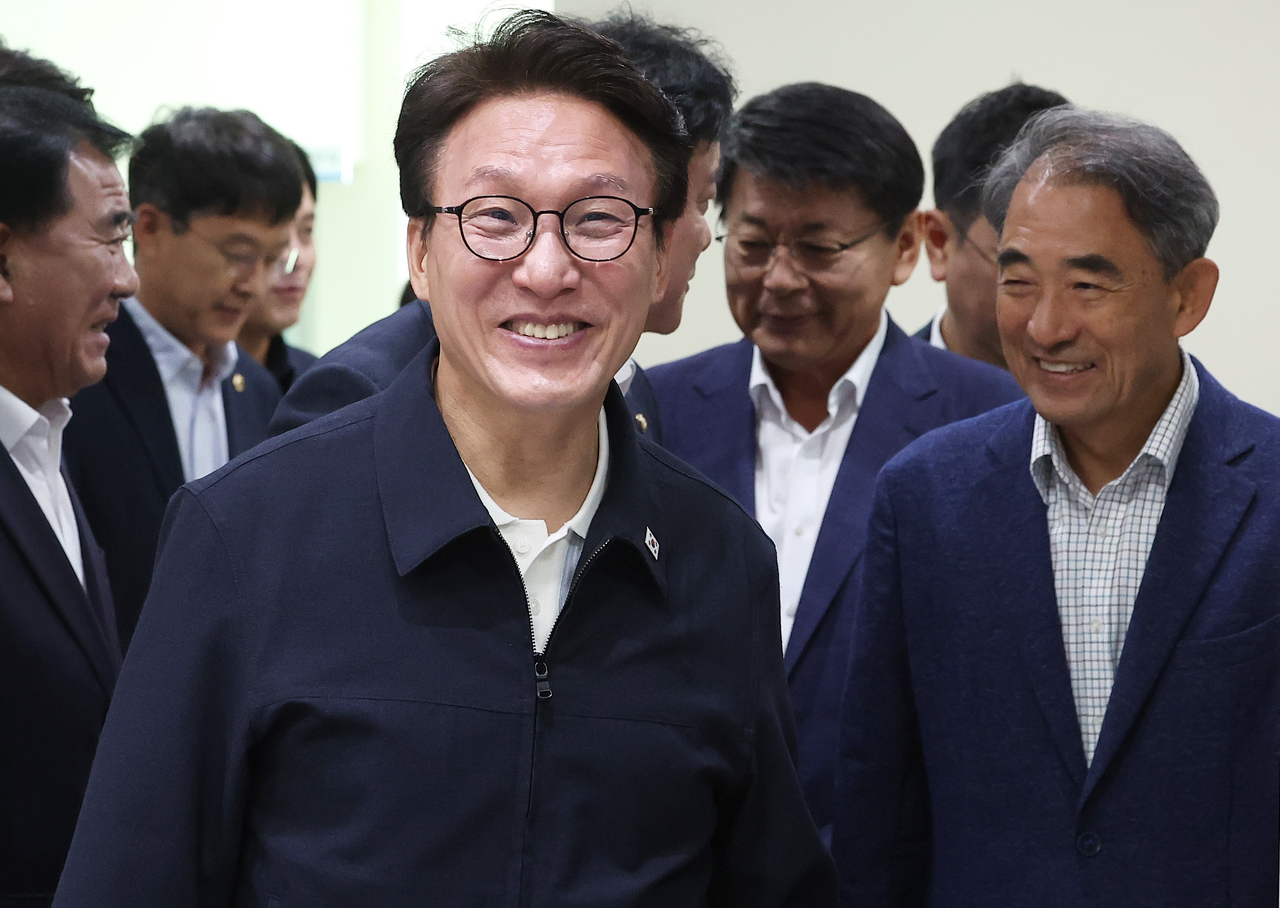
A Gallup Korea poll released Friday showed the Democratic Party's approval rating at 35 percent, down 5 percentage points from the previous survey three weeks earlier — the lowest reading since the Lee Jae Myung government took office, according to Yonhap. The figure also approaches the party's 33 percent support recorded in late November 2024, just before the emergency martial law crisis.
President Lee's job approval rating held steady at 37 percent in the same poll, matching the previous survey, while his negative rating — though still high — fell 5 percentage points.
A separate poll by the Korea Society Opinion Institute (KSOI), conducted Sept. 28–29, put the Democratic Party at 36.3 percent, unchanged from two weeks earlier.
The People Power Party, however, rose 4.5 percentage points to 37.7 percent in that survey, overtaking the Democratic Party within the margin of error of ±3.1 percentage points — the first time the PPP had led in KSOI's regular polling series.
Many within the party see unresolved divisions inside the ruling camp as the primary cause. A senior party leadership official told Yonhap that negative assessments of the government were unlikely to be the main driver, noting that the president's approval rating had held firm and his negative numbers had actually declined. "The internal controversy surrounding Kim Ji-yong, the nominee for director of the Serious Crimes Investigation Agency, could be one negative factor," the official said.
Another party official pointed to lingering fallout from the convention. "The hearts that were divided at the party convention have not come back," the official said. "It seems the split among our supporters is translating into disappointment with the party."
The numbers bear that out. In a Gallup Korea survey conducted just before the convention on Aug. 14, 73 percent of self-identified progressive respondents said they supported the Democratic Party — when the party's overall rating stood at 41 percent. The most recent survey put that figure at 69 percent.
Support among moderates also slipped, from 37 percent to 34 percent.
Some analysts caution that the timing deserves consideration: the national audit season is traditionally a difficult period for the ruling party.
"The national audit is inherently a tough stretch for the ruling party," a floor leadership official said. "It's generally in November, with legislation and the budget, that you score points."
Kim steps up field visits and outreach while scaling back messages and schedule
For Kim, the poor polling numbers are a frustrating result given the broadly positive assessments of his party-government coordination since taking office. That context makes a recent shift in his approach all the more notable: the aggressive schedule and prolific messaging that defined his early tenure appear to be giving way to something more measured.
At a Supreme Council meeting held in North Chungcheong Province on Sept. 11, Kim delivered an opening statement of roughly 4,500 characters. By Wednesday's Supreme Council session, that had shrunk to just 590 characters — a sign that he is pulling back on the volume of his public pronouncements.
Going forward, Kim plans to place greater emphasis on field visits and internal party communication. Where he had focused on directly voicing his positions to drive sweeping reforms to the party's structure and operations, he now intends to concentrate on listening to public sentiment on the ground and finding solutions there.
"Kim has recently been trying to identify problems in the field, refine policy through party-government consultations, and seek solutions to conflicts through dialogue and communication," a senior leadership official said. "Rather than raising his voice, he is looking to find practical solutions, and rather than inflaming conflicts, he wants to produce results through coordination."
That approach was on display Monday, when Kim convened an emergency closed-door party-government meeting after farmer opposition to the government's planned comprehensive farmland survey intensified. He directed Agriculture, Food and Rural Affairs Minister Song Mi-ryung to draw up measures to minimize side effects.
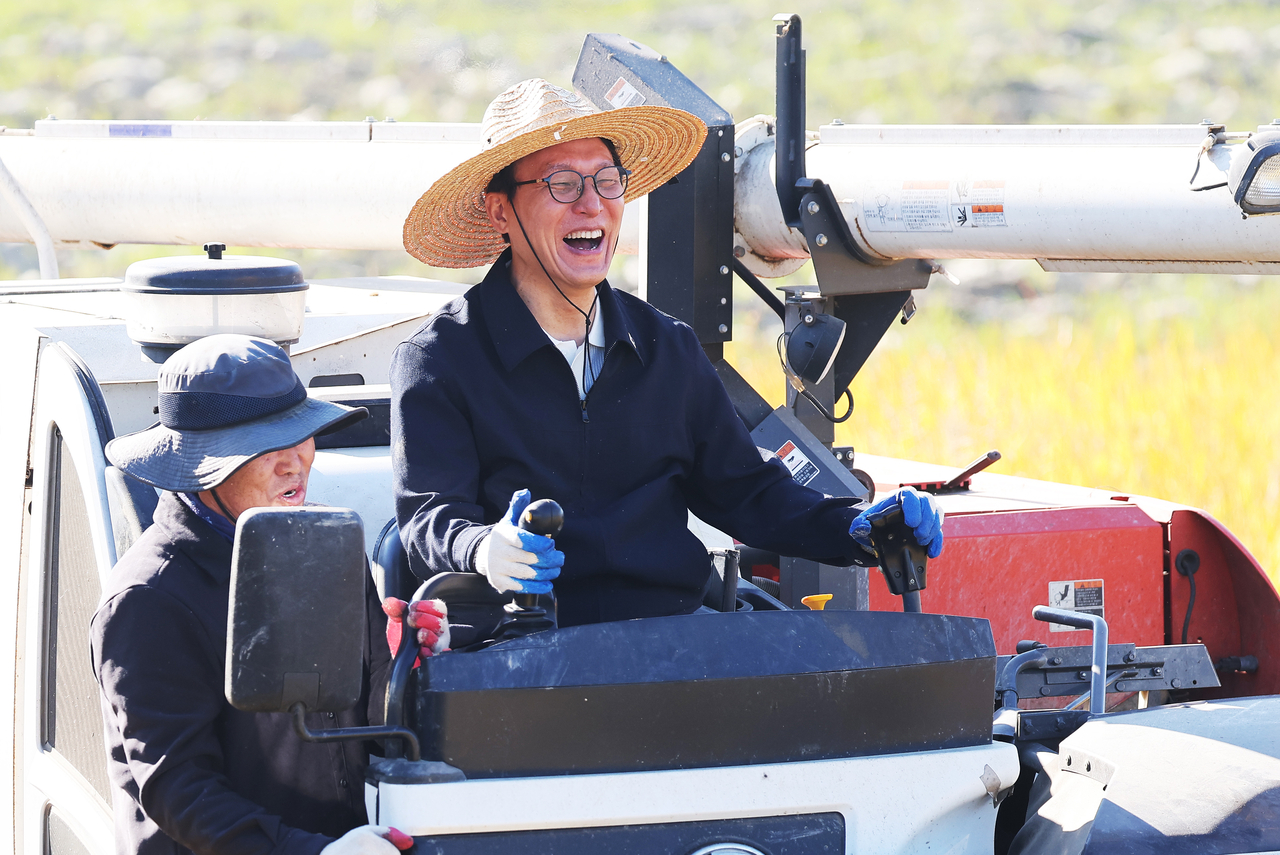
On Wednesday, Kim met with farming organizations including the Korean Peasants League, and on Thursday he visited farmland in Anseong, Gyeonggi Province, for a roundtable with farmers. When the government announced Thursday that it would not take punitive action against farmland law violations not motivated by speculation, Kim received credit for his role in shaping the policy outcome.
Kim also met twice with Lee Ji-woong, chairman of the Federation of Korean Public Service and Transportation Workers' Unions, who had been staging a hunger strike to protest the government's push to consolidate public institutions. Kim pledged to establish a joint consultative body at the National Assembly level to review the public institution reform plan.
Within the party, Kim has been holding small-group meetings organized by lawmakers' terms in office, gathering members' views on how to approach the November budget session of the Assembly. The moves are seen as reflecting internal calls for Kim to focus on inclusion and unity rather than wading directly into intraparty conflicts.
"There is a lot of reflective advice questioning whether it is appropriate for Kim to be so openly entrenched on the front lines of conflict," a party official said. "There were also opinions that certain platforms were at times stoking conflict rather than resolving it, and that this needs to be dialed back."
The official added that Kim recognizes his approval-rating pledge will be difficult to fulfill and is taking to heart advice from those around him that change is needed.
Whether a pivot to field outreach and party-government relations will be enough to reverse the polling slide remains an open question, however, given that deepening divisions within the ruling camp since the convention are widely seen as the root cause of the decline. Kim's room to maneuver is also constrained by the fact that he ran as a candidate aligned with the pro-Lee Jae Myung faction at the convention and, as leader of the governing party, is expected to support Cheong Wa Dae.
"As party leader, Kim holds decision-making authority, and he needs to be more willing to embrace differing views," a party official said. "This is a moment when the leader needs to appeal and persuade with greater sincerity."
The Gallup Korea poll cited in this article was conducted Tuesday through Thursday among 1,000 adults aged 18 and older via telephone interviews using randomly sampled virtual mobile numbers. The margin of error is ±3.1 percentage points at a 95 percent confidence level, with a response rate of 9.7 percent. The KSOI poll was conducted Sept. 28–29 among 1,001 adults aged 18 and older nationwide using automated response system calls via virtual mobile numbers provided by three telecommunications carriers, also at a 95 percent confidence level.
yckim6452@heraldcorp.com