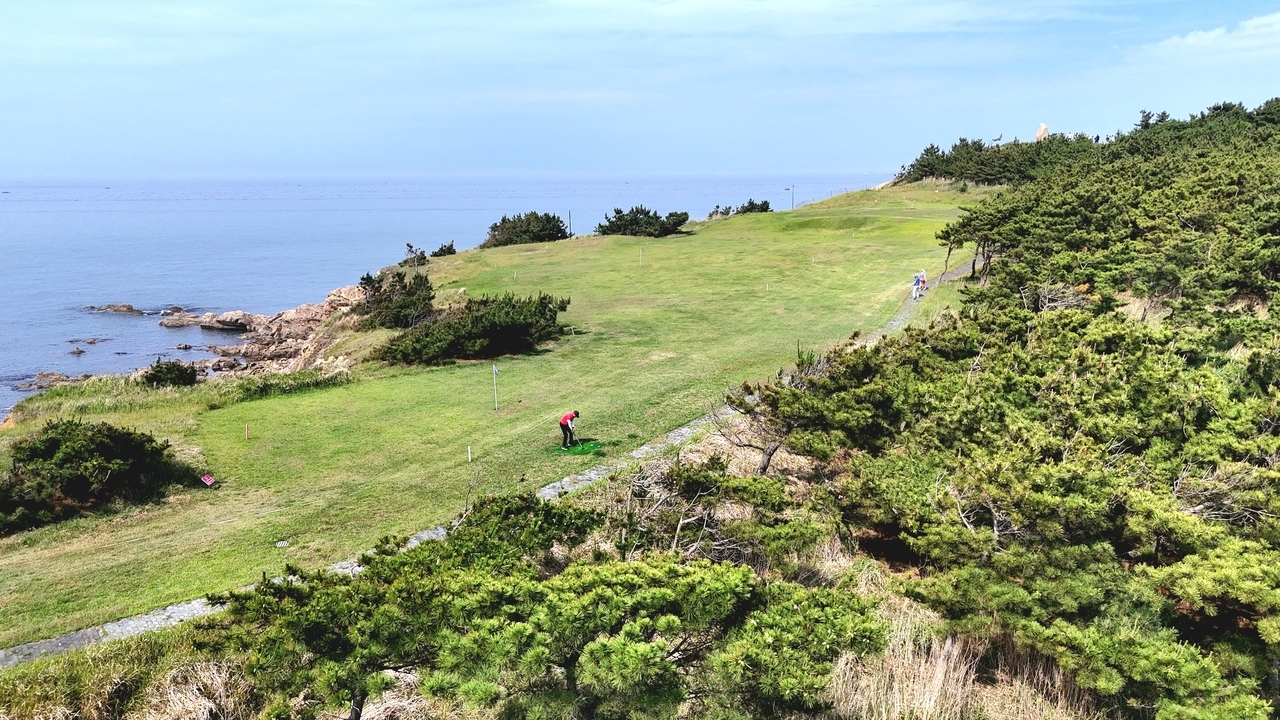
Park golf courses are springing up across South Korea — most recently in Hwacheon, Gangwon Province, which hosted the latest tournament — but safety concerns among players are mounting.
In a recent survey, roughly seven in 10 respondents said they had fallen or nearly fallen on a course, and a similar share said they had suffered physical discomfort due to extreme heat or other harsh weather. About eight in 10 said they had been struck by a ball or narrowly avoided being hit. The sample size was small, making firm conclusions difficult, but researchers expect the pattern would hold in a larger study.
In August, a pilot quality assessment known as GQXP — a park golf course quality evaluation — was conducted at two facilities in Chuncheon, Gangwon Province: the Soyang River course (36 holes) and the Seomyeon course (18 holes). The Korea Golf Industry Evaluation Institute (KGIE) carried out on-site inspections and surveyed 79 users.
According to the institute, the two facilities scored relatively well in safety and emergency preparedness, earning 4.5 to 4.6 out of 5. However, satisfaction with the course surface among Seomyeon users was limited to 2.04 out of 5. Users who had experienced a fall risk rated their satisfaction at just 1.65, far below the 2.89 recorded by those who had not.
Both facilities rank among the better park golf courses in the country. The fact that highly rated venues still draw low user satisfaction scores on safety points to a systemic problem shared by park golf courses nationwide.
Among the 27 Seomyeon users who answered questions about safety incidents, 22 — or 81 percent — said they had been hit by a ball or had a near miss.
Some 67 percent said they had fallen or nearly fallen, and 74 percent reported physical discomfort caused by extreme heat or cold. Particularly striking, 85 percent said they did not know where the automated external defibrillator (AED) was located.
When the institute checked with the National Fire Agency, it found that park golf course accidents are not tracked under a separate classification, making it impossible to compile statistics. The institute also noted that current laws governing sports facilities and the official park golf course regulations contain no specific numerical standards for protective netting height or the required distance between holes.
There is currently no basis for guaranteeing that any given park golf course is safe, and no binding benchmarks that local governments, contractors, or operators can be held to on safety improvements.
Without such standards, when accidents occur those responsible may try to quietly suppress the news, or rush out hastily drafted rules after the fact.
The financial and physical burden on park golf course operators to meet safety requirements will only grow.
It remains to be seen how many courses will meet the safety management standards the institute plans to propose, whether a nationwide wave of renovations will follow, whether some operators will simply walk away from their projects, or whether neglected facilities will begin producing a string of accidents.
abc@heraldcorp.com