Interview with Park Young-sun, chair of the Ministry of Economy and Finance's Strategic Economic Advisory Council, in Tokyo
Park calls for expanding Korea's AI competitiveness beyond memory chips
Proposes breaking down ministry silos, supporting SME AI adoption and public AI education
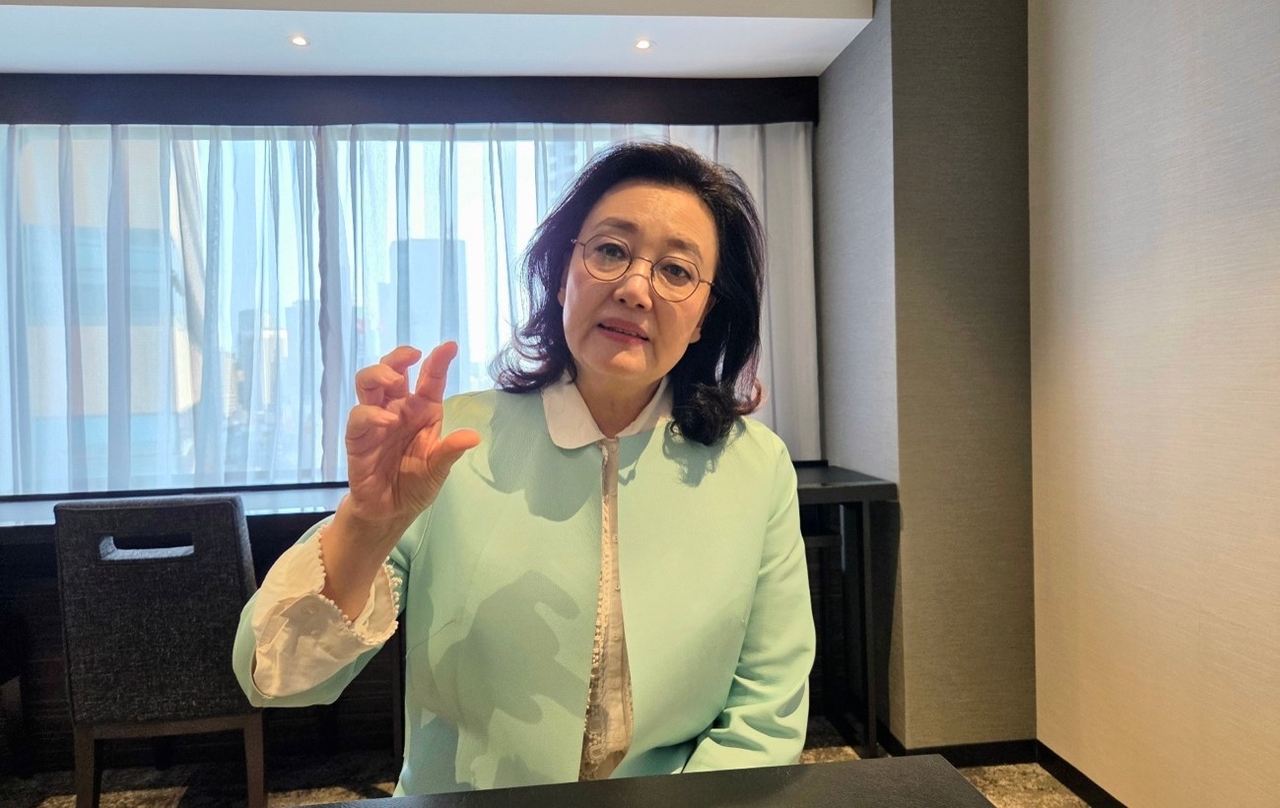
Park Young-sun, chair of the Ministry of Economy and Finance's Strategic Economic Advisory Council, has proposed joint manufacturing and medical data standardization as the starting point for South Korea-Japan AI cooperation.
Park made the case for the value of data accumulated by the two countries during an interview with The Herald Business in Tokyo on Tuesday. "Data is a core asset that embodies each side's know-how, so it is difficult to disclose or exchange," she said. "Even so, we can work together to create common data standards."
The idea is for each country to protect its own data as a sovereign asset while jointly establishing the common frameworks AI systems need to use it. Park singled out health screening data accumulated by both countries as a particularly promising area for cooperation, arguing that such collaboration could uncover opportunities that the United States and China have yet to notice.
Park traveled to Japan with her husband, attorney Lee Won-jo, to attend the 20th anniversary celebration of the Tokyo office of law firm DLA Piper, where Lee serves as Korea managing partner and heads the Korea desk. "Until now I have mostly been on the receiving end of support," she said of the trip. "This time I came to return the favor." She described charting the course of the Korean economy in the AI era as the challenge she is most focused on at present.
Park said her interest in South Korea-Japan cooperation stems from the two countries' complementary strengths. "Korea and Japan need each other," she said, adding that each side can fill the other's gaps with its own areas of leadership. She also called on policymakers in both countries to begin discussing concrete cooperation plans.
She cited robotics as Japan's key strength, saying that the country's accumulated expertise in actuators, sensors and related hardware could serve as the foundation for physical AI — systems that move and work in the real world. She noted that Japan has a strong drive to make up ground in IT through the AI era, while cautioning that South Korea must not rest on its past IT successes.
For South Korean industry, Park identified the need to extend the country's memory chip competitiveness across the broader AI sector. HBM has created an opening, she said, but dominance in a single segment is not enough to weather shifts in the supply chain.
Park said South Korea must build capabilities spanning semiconductor design and manufacturing, telecommunications, AI data centers and supercomputers. Only by leading an industrial ecosystem that stretches from chips to AI infrastructure, she argued, can the country move closer to its goal of becoming one of the world's three leading AI powers.
She also saw opportunity in overseas markets, suggesting that South Korea could position itself as an alternative for countries that need AI infrastructure but do not want to depend entirely on either the United States or China. She proposed that Korea develop the capacity to build and deliver complete AI systems to such countries.
At the same time, she warned that gaps in AI infrastructure could translate into dependency between nations — a dynamic she described as "digital colonization." She said it matters greatly where South Korea stands as this transformation unfolds.
Executing such a strategy, she said, requires changing the way government operates. She proposed keeping each ministry's baseline budget intact while allowing funds to flow across ministry boundaries for projects that involve multiple agencies.
Park also said organizational structures must adapt to a working model in which people and AI agents collaborate side by side. AI agents are AI systems that carry out tasks in pursuit of a given objective. To boost productivity through their use, she said, the walls between ministries and departments must come down and horizontal collaboration must increase.
As an immediate priority, she pointed to what she called a "K-ontology project." Ontology, she explained, is a method of systematically organizing the concepts and relationships embedded in data. The initiative would lay the groundwork in sectors such as manufacturing and healthcare so that AI can understand the meaning of data and the context in which it is used.
Park also located the core of AI sovereignty in data — not merely holding it, but building the capacity to make it comprehensible and usable for AI. Sufficient power to run AI systems, she added, is another prerequisite. On medical data, she noted that individual consent is an inherent challenge, and said people must be able to feel the tangible benefits of sharing their data — for instance through personalized health management — before they will do so.
For small and medium-sized enterprises and small business owners, she said AI agents represent a genuine opportunity. "How well they use these tools, and how effectively they collaborate with AI agents, is the single biggest question right now," she said.
Because individual businesses cannot realistically adopt and deploy AI on their own, she proposed that the government establish data standards and support the construction and operation of AI agent platforms that smaller players can use.
On broadening AI use in everyday life, Park pointed to education. "You don't need to know how to code to use AI," she said. "We need to make it possible for everyone to use AI agents — to give each person their own assistant."
Just as the public was taught how to use computers when they first became widespread, she said, opportunities to learn AI must be expanded. Given how rapidly the technology and its applications are evolving, she also proposed creating "AI tutors" to help the public keep pace.
"What matters is who starts first and who succeeds first," Park said. "We cannot afford to think only in grand terms. We need to start small and build success stories from there."
pooh@heraldcorp.com