100-day press conference marks new autonomous district's first milestone
Seven strategic pillars span healthcare, transport, advanced industry and tourism
Son Hwa-jeong says first four years will determine Yeongjong's next 40
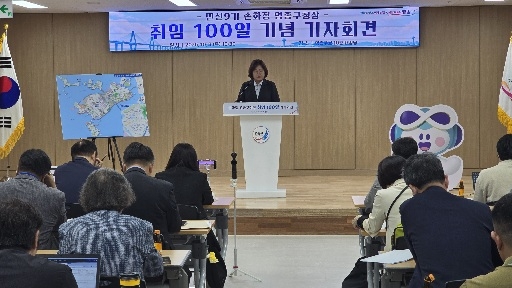
![Yeongjong District Mayor Son Hwa-jeong speaks at a press conference marking her first 100 days in office, held Thursday at the district office auditorium. [Photo = Lee Hong-seok]](https://wimg.heraldcorp.com/news/cms/2026/10/08/news-p.v1.20261008.fd8669247b994ccc8915a02b30621e11_P1.jpg)
Incheon's Yeongjong-gu, the first newly independent autonomous district in South Korea, marked its 100th day in operation Thursday by unveiling a new urban vision: to become the nation's "airport economy capital."
District Mayor Son Hwa-jeong held a press conference at the district office auditorium Thursday, reviewing the administration's achievements over its first 100 days while presenting a medium- and long-term development blueprint spanning healthcare, transport, industry, tourism, residential affairs and youth policy.
Son framed the new district's first four years as a decisive window that will shape Yeongjong's next 40, saying the goal is not merely to stabilize the administrative framework but to transform Yeongjong into a self-sustaining future city where airport functions, industry, tourism and residential life converge.
"If the past 100 days were about untangling long-standing issues and laying the groundwork for a new administration, the time has now come to deliver results that residents can feel in their daily lives," Son said.
In its early days, the district focused on minimizing administrative gaps inherent to a newly established office while addressing residents' inconveniences. It set up an integrated rapid-consultation window and built a unified "Yeongjong Ansim 24" menu on the district website to streamline public complaint handling.
The district also introduced a location-based field analysis system for processing complaints and a smart field map for drainage management to strengthen data-driven administration.
Son reinforced field-centered governance as well. During the summer, the district operated mobile cooling shelters for outdoor workers using hydrogen buses and is pursuing an ordinance to protect the rights of such workers.
When a large-scale power outage struck the Yeongjong Sky City area in July, Son visited the scene personally to meet affected residents and merchants, and demanded that Korea Electric Power Corporation identify the cause, prevent a recurrence and compensate those affected.
Improvements to transport and daily infrastructure also ranked among the key achievements. The district opened the Yongyu Community Complex, built a coastal road at Wangsan Beach and launched a smart healthcare center and a senior health center to expand everyday facilities.
To ease residents' commuting difficulties, the district added runs on metropolitan bus route M6462, introduced new city bus routes 2202 and 2251, and reorganized public bus services.
Seven pillars for Yeongjong's future development
The central message Son delivered Thursday, however, focused less on the past 100 days than on Yeongjong's future.
The district identified seven core pillars for future development: a healthcare and care safety net; transport innovation; an advanced, self-sustaining future city; neighborhood commerce and everyday cultural infrastructure; a global culture, tourism and environment city; a premium residential environment; and a youth city.
On healthcare, Son set the early ground-breaking of a public general hospital in Yeongjong as a top priority. The plan calls for expanding after-hours children's clinics and public late-night pharmacies and strengthening childcare infrastructure to build a healthcare and welfare safety net commensurate with the district's growth as an airport city.
On transport, the district flagged the expansion of wide-area rail links — including GTX-D and GTX-E lines, a second airport rail link and an extension of KTX service to Incheon International Airport — as major tasks.
Alongside expanding metropolitan bus services, the district plans to introduce demand-responsive transport and a 1,000-won taxi service in the Yongyu and Muui areas to address mobility gaps in underserved communities.
On industry, the strategy is to move Yeongjong beyond its role as a support city behind the airport and transform it into a self-sustaining city that generates its own jobs. The district aims to secure national industrial complex designation for a biotech special zone and attract advanced-industry firms in aircraft maintenance, repair and overhaul, AI and semiconductors to develop the airport economic zone into a future growth engine.
To revitalize the local economy, the district plans to introduce "Yeongjong e-eum," a locally tailored digital currency to keep money circulating in neighborhood commerce, alongside commerce-linked festivals and an expansion of community facilities including cultural centers, libraries and gymnasiums.
Pivot to a destination tourism city
The tourism strategy centers on leveraging Yeongjong's geographic strengths to shift from a transit stop to a destination where visitors stay.
The district will pursue designation as a tourism special zone and promote stopover tourism, while establishing a cultural foundation and a public-private cultural fund to build a sustainable base for the culture and tourism industry.
Alongside this, the district announced plans to pursue special management zone designation for the World Peace Forest, establish a carbon neutrality support center and develop a pet-themed park, with the aim of growing into an eco-friendly city where the airport, urban life and nature coexist.
Son also moved to formally address longstanding regulatory constraints in Yeongjong. The district's development and facility management are divided among multiple agencies — the Incheon Free Economic Zone Authority, Korea Land and Housing Corporation, Incheon Urban Corporation and Incheon International Airport Corporation — making inter-agency cooperation central to resolving local issues.
The district has accordingly formed working-level inter-agency consultations, a transport safety council and an environmental improvement TF to strengthen coordination among the relevant bodies.
The district has also submitted regulatory reform proposals to the central government, calling for amendments to the Seoul Metropolitan Area Readjustment Planning Act, improvements to the visa-free entry system for transit tourists, relaxation of height restrictions around the airport and revisions to the Airport Noise Prevention Act.
To support the construction of a public general hospital in Yeongjong, the district urged the central government to ease bed-count regulations, exempt the project from preliminary feasibility reviews, provide national funding and establish a public medical school.
Securing support from Incheon city and the central government
Son identified "regulations and inter-agency silos" as the biggest obstacles to Yeongjong's development and made clear her determination to secure more active support from both the central government and Incheon city.
The district also pledged to stabilize housing for young residents and strengthen educational infrastructure so that young people choose to settle rather than leave, while cracking down on illegal structures along the coastline, abandoned waste, unauthorized banners and illegal parking.
"The first four years of Yeongjong as a new autonomous district are the golden window that will determine the next 40 years," Son said. "If the past 100 days were about preparation and laying foundations, from now on will be a time of results that residents feel in their bones."
"Yeongjong is a gateway connecting Incheon, South Korea and the world, and a new growth engine that will lead future development," she added. "I will press forward without wavering so that the pride of being South Korea's airport economy capital becomes a source of pride for all 140,000 district residents."
gilbert@heraldcorp.com