Retail egg prices rebound in October after Chuseok discount period
Farm-gate prices fall steadily, widening gap with retail to 1,340 won
Critics call for pricing reform, warning disputes will continue otherwise
![Eggs on display at a hypermarket in Seoul. [Yonhap]](https://wimg.heraldcorp.com/news/cms/2026/10/08/rcv.YNA.20260714.PYH2026071410470001300_P1.jpg)
Retail prices for domestically produced eggs have climbed back above 7,000 won per tray. After falling for a period on the back of government discount support ahead of the Chuseok holiday, prices have rebounded — even as farm-gate costs continue to decline, widening the gap between the two.
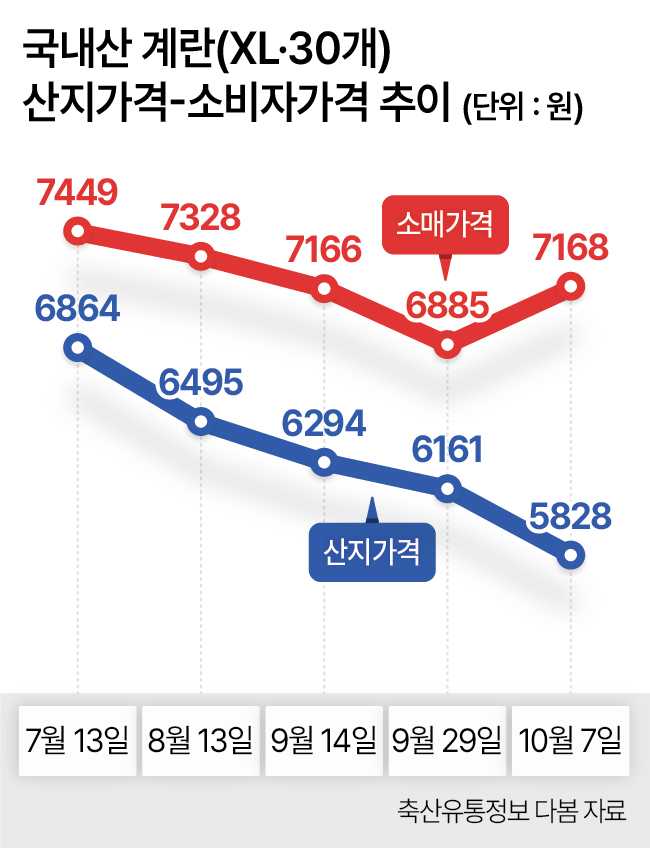
According to livestock retail data platform Dabom, the consumer price for a tray of 30 XL-grade domestic eggs stood at 7,168 won Wednesday, up sharply from 6,882 won during last month's Chuseok holiday period. Egg prices have remained elevated throughout this year compared with the same period last year, a lingering effect of the highly pathogenic avian influenza (AI) outbreak that swept the country last winter. After briefly surging to around 7,700 won in late June, prices fluctuated while trending gradually lower — but have now turned upward again as the next winter season approaches.
Farm-gate prices, by contrast, have been falling steadily. The farm-gate price for the same XL-grade tray rose to nearly 6,900 won in July before declining to below 6,000 won in October. As of Wednesday, the farm-gate price stood at 5,828 won per tray, down 4.4 percent from the same day the previous week. The gap between farm-gate and retail prices, which had been around 500 won in July, has now widened to 1,340 won.
Farm-gate egg prices are expected to keep falling for now. The Korea Rural Economic Institute said in an outlook report that the average farm-gate price for XL eggs in early October is forecast to fall 60 to 80 won per 10 eggs from the previous period. A rise in the number of laying hens aged six months or older is expected to push average daily egg output to about 50.31 million — roughly 0.6 percent more than a year earlier.
Opaque pricing practices are widely cited as the main driver of the widening price gap. Unlike other agricultural products, eggs have no wholesale market to establish a benchmark price, allowing entrenched pricing habits to persist. Eggs typically pass through four to five distribution stages — including grading, packaging and logistics — between the farm and the consumer, and the costs incurred at each step remain largely invisible.
The egg distribution structure also came under scrutiny at Wednesday's national audit session of the National Assembly's Agriculture, Food, Rural Affairs, Oceans and Fisheries Committee. Kwon Ik-seop, a director at the Korea Egg Grading and Packing Industry Association who appeared as a reference witness, explained that when businesses enter prices into systems run by bodies such as the Korea Institute for Animal Products Quality Evaluation, they do not yet know how prices will settle at the end-of-month reconciliation. As a result, they routinely cite producer data published by the laying hen association as a rough estimate of where prices will likely land. "Once that data is collected and published, it becomes a lagging indicator," he said. He added that as long as businesses are simply asked to report what they traded at, the data will inevitably lag. "Unless we find a way to track prices in real time, disputes over egg prices will keep coming up," he said.
One proposed remedy is to strengthen the price-setting function at the egg grading and packing center (GP) stage of distribution. In a report published ahead of the national audit, the National Assembly Research Service said government policy and support have been concentrated solely on the production stage of the egg supply chain. "There are growing calls pointing out that fair price formation at the distribution stage is inadequate and that unfair trading practices are becoming entrenched," the report said, adding that the focus of debate is shifting toward improving the efficiency of egg distribution and rationalizing the regulatory regime.

soho0902@heraldcorp.com