Press briefing marks 100 days since launch of the 9th elected administration
Mayor outlines ABC+E future industries, bid for 2028 G20 summit, and East-West Peace Logistics Highway
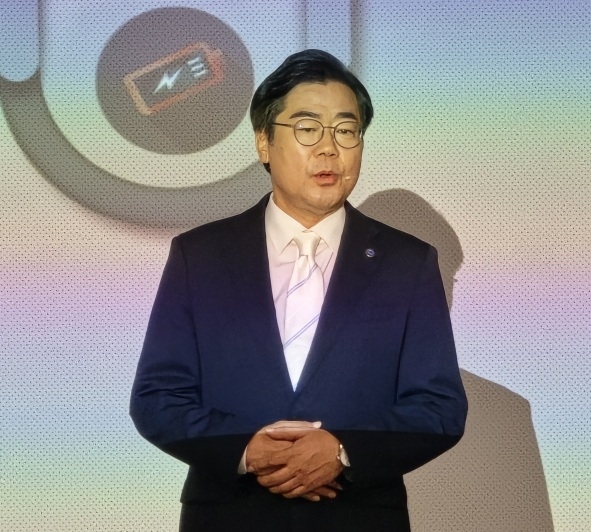
Incheon Mayor Park Chan-dae has officially unveiled what he calls an "Incheon re-rating" strategy — a plan to fundamentally reposition the city's competitive standing — as the 9th elected city administration marks its first 100 days.
Speaking at a press briefing held Wednesday at Incheon City Hall, Park said Incheon is "an undervalued blue-chip asset" with an international airport, a major seaport, a thriving biotech industry and 3.05 million residents. "Incheon has long been undervalued because of Seoul-centric metropolitan logic and its status as a border region," he said. "I intend to reclaim the true worth of this city."
The term "re-rating" is borrowed from financial markets, where it refers to a reassessment of a company's value that drives a revaluation of its share price.
Park said he is applying the concept to city governance as the defining direction for the four-year term of the 9th elected administration.
His Incheon re-rating vision is built around three pillars: a city that claims its true worth, a South Korea that grows together, and residents who find life worth living.
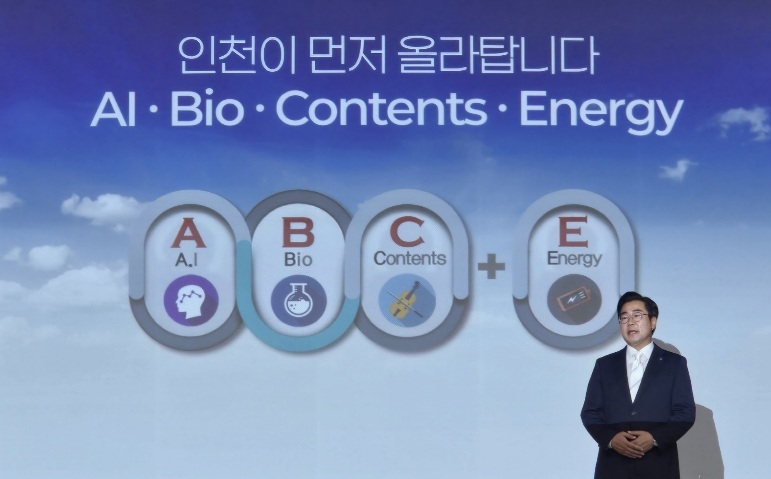
The first pillar centers on raising Incheon's growth value through future industries. The city plans to intensively develop what it calls "ABC+E" industries — AI, biotech, content and energy — layered on top of its existing industrial base of airports, seaports and industrial complexes.
Intensive development of ABC+E future industries
In AI, the city has already launched the Incheon Logistics AX Alliance to drive an AI transformation of airport and seaport logistics, and is accelerating efforts to attract a global AI hub to Songdo.
The biotech sector is set to expand from a production-focused model into a full ecosystem encompassing research and startup incubation. The city plans to develop Songdo into a world-class biotech research and production hub through initiatives including the K-Bio Lab Hub and the Incheon Institute of Bioscience and Technology.
"We will build future industries on top of Incheon's solid foundation of airports, seaports and industrial complexes," Park said. "The goal is to attract corporate investment, create quality jobs and raise residents' incomes."
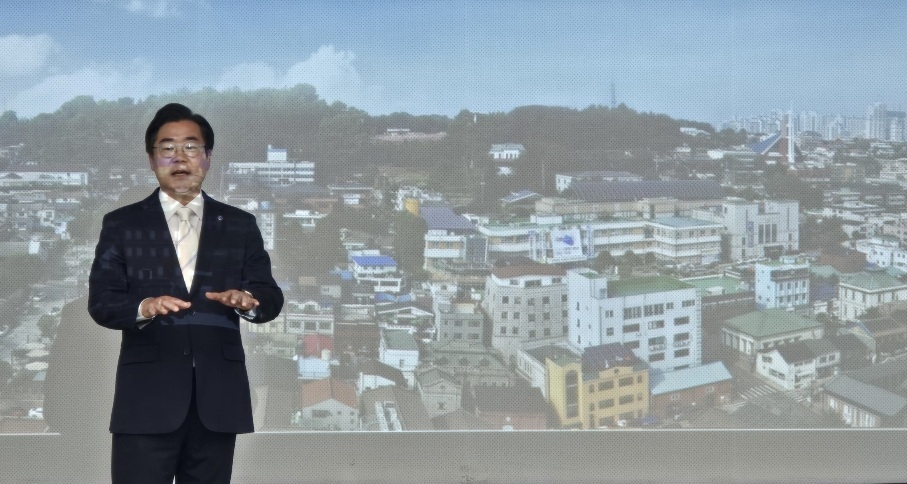
Park also put forward a series of large-scale projects aimed at winning international recognition for Incheon. The most prominent is a bid to host the 2028 G20 summit.
Park formally declared Wednesday that the city would pursue the G20 summit. He cited Incheon International Airport, the Songdo Convensia convention center and other international conference infrastructure as key strengths, along with an industrial base aligned with major G20 agenda items — biotech, AI, energy and supply chains — and the city's track record hosting major international events including the Asian Games, the Asian Development Bank annual meeting and APEC-related conferences.
He proposed a "distributed hosting" model that would involve not just Incheon but also local governments along the West Sea coast, rather than Incheon staging the event alone.
Beyond the leaders' summit itself, the G20 presidency entails more than 100 ministerial and working-level meetings over the course of a year. Park's strategy is to spread those meetings across Incheon and neighboring regions to showcase the city's industries, tourism and Korean culture to the world and to extend the economic benefits of hosting beyond the city itself.
Spreading the benefits of a successful G20 to the region
The city assembled a citywide G20 bid support TF in September, and plans to form both a private-sector bid committee and a broader civic committee.
Park also outlined a plan to turn the structural constraints and sacrifices imposed on Incheon's border areas into new engines of growth.
He proposed building an "Inter-Korean East-West Peace Logistics Highway" linking Yeongjong — home to Incheon International Airport — through Sindo and Ganghwa to northern Gyeonggi Province and Goseong in Gangwon Province.
The roughly 249-kilometer corridor would connect the West Sea and the East Sea as a logistics axis, with a further extension to Sokcho envisioned to link Incheon Airport and Incheon Port with East Sea ports in a new freight network.
The 3.2-kilometer Sindo Peace Bridge connecting Yeongjong to Sindo opened in July, and the city plans to build on that by constructing the Sindo–Ganghwa section and working jointly with Gyeonggi Province and Gangwon Province to have the full highway incorporated into the national expressway construction plan.
Park also said the city would pursue a free economic zone covering about 6.27 million square meters on the southern tip of Ganghwa Island, while seeking designation of a peace economy special zone on the island's northern end, with the aim of developing the border area into a national hub combining peace and economic activity.
"Incheon should not be a peripheral outpost of Seoul but the apex from which two roads for South Korea begin," Park said. "To the south, we will open a path of diplomacy and industry toward the world; to the east, a path of peace that lifts the shadow of division."
Sharpening focus on future strategic industries
Park also presented the administration's achievements over its first 100 days.
The city has been working to identify future strategic industries including semiconductors, drones and robots. It also secured the designation of the Namdong Industrial Complex as a government-selected culture-leading industrial complex, laying the groundwork for a total investment of 58.7 billion won — including 32.7 billion won ($24.3 million) in national funds — over four years.
The city filed for a permit to develop an offshore wind power cluster project under public leadership, and the redevelopment of Piers 1 and 8 at Incheon's inner harbor — a project delayed for nearly two decades — received implementation plan approval.
More than 16,000 households were selected as pilot districts under the aging planned-city renewal program, the largest number ever designated to a single local government.
To stimulate the local economy, the city also launched a cooperative initiative to ensure that contracts and jobs from large construction projects in Incheon flow to local firms and workers.
In welfare, Incheon's first city-run dementia-dedicated care facility is set to open by year's end, and additional hospitals have been designated under a program providing pediatric care on nights and holidays.
The city also expanded a no-application, no-income-verification food and daily essentials support program to all districts and counties across Incheon, strengthening a community-level welfare safety net for vulnerable residents.
Securing stable finances a priority
On the fiscal front, the city formed a fiscal and budget reform TF immediately after the administration took office and conducted a comprehensive review of city finances.
The city mapped out a plan to redesign cash-transfer programs and free up funds for future investment. The national government's budget proposal also reflected 7.09 trillion won in central government funding for Incheon — the first time in the city's history the figure has exceeded 7 trillion won ($5.21 billion).
Building on that foundation, Park said he intends to use future industries and major national projects over the four-year term to improve not only the city's physical growth but also residents' quality of life.
"The fruits of Incheon finding its true worth and growing must flow entirely back into the lives of its residents," Park said. "Re-rating is not about waiting for someone else to raise Incheon's value — it is about Incheon proving that value itself."
"A company's value is set by the market, but a city's value is set by its people," he added. "Incheon's value will be properly recognized only when residents say, 'Life in Incheon is worth living.'"
"Over the four years of the 9th elected administration, I will fulfill the promise of an Incheon that claims its true worth, a South Korea that grows together, and residents who find life worth living — and make Incheon known by its own name," he said.
gilbert@heraldcorp.com