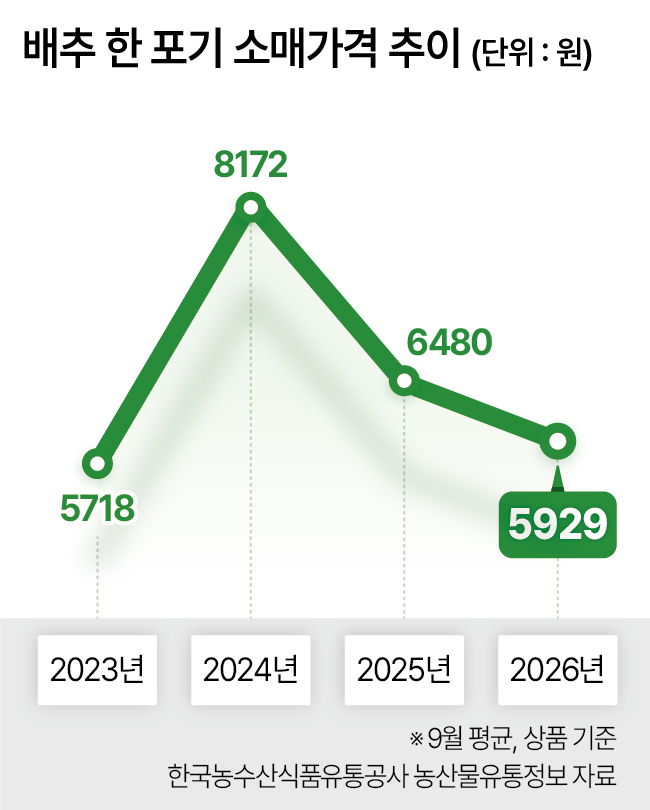
A head of napa cabbage averages 5,929 won, down 8.5% from a year ago
Kimchi-making cabbage purchases down 16.4% over five years
Packaged kimchi sales rise as retailers expand product lines
![Packaged kimchi products on sale at a hypermarket in Seoul. Cabbage prices have continued to fall ahead of the kimchi-making season, but home production is declining as more consumers opt for store-bought kimchi. [Herald DB]](https://wimg.heraldcorp.com/news/cms/2026/10/07/news-p.v1.20261007.d6362b619c8e49738e23213640ffc869_P1.png)
"Buying it is better than making it yourself. You can get just as much as you need." (Consumer A)
The kimchi-making season is about a month away, but the tradition of preparing kimchi at home is fading. Cabbage prices have fallen from a year ago, yet fewer households are making their own kimchi — and packaged kimchi is filling the gap, with retailers moving to expand the market.
According to data released Wednesday by the Korea Agricultural Marketing Information Service (KAMIS) under the Korea Agro-Fisheries and Food Trade Corporation, the average retail price of a head of napa cabbage last month was 5,929 won — down 8.5% from a year earlier and 12.7% below the historical average of 6,790 won. Wholesale prices were also low: the average wholesale price of 10 kilograms of cabbage (about three heads, premium grade) last month was 17,551 won, down 15.2% from the same month last year and 23.8% below the historical average.
Cabbage supply is expected to grow further this month. Late-harvested summer cabbage is entering the market, and autumn cabbage output is forecast to increase. The Korea Rural Economic Institute projected this month's cabbage shipments would rise 2.1% from a year ago and 5.5% above the historical average. Autumn cabbage production this year is forecast at 1.222 million metric tons, up 19.3% from last year and 3.2% above the historical average.
Despite stable prices and supply, the scale of home kimchi-making continues to shrink. According to a report published last year by the institute on consumer kimchi-making intentions and vegetable supply, the average amount of cabbage purchased for kimchi-making by a four-person household fell from 21.9 heads in 2020 to 18.3 heads in 2025 — a 16.4% decline over five years. Last year's figure was also down 1.1% from the previous year and 13.6% below the historical average.
The share of households making kimchi at home is also declining. Last year, 62.3% of households said they make their own kimchi, down 2.2 percentage points from 64.5% the year before. Meanwhile, the share buying packaged kimchi rose 3.0 percentage points over the same period, from 29.5% to 32.5%. The most common reason cited for buying packaged kimchi was the ability to purchase only as much as needed, at 39.5%, followed by the inconvenience of making kimchi at home, at 33.1%.
Packaged kimchi sales are rising. Lotte Mart said its packaged kimchi sales for the first nine months of this year were up about 5% from the same period last year. Small-volume products are gaining popularity as single- and two-person households become more common. E-mart said sales of packaged kimchi in portions of 1 kilogram or less rose 6.6% year-on-year through September.
Online grocer Kurly said packaged kimchi transaction volume for the three months from July through last month rose 35% from the same period a year earlier. Sales of small-portion products ranging from 100 grams to 1 kilogram grew 39% year-on-year, outpacing mid-size portions of 2 to 4 kilograms, which rose 26%, and large portions of 5 to 10 kilograms, which rose 18%.
Retailers are also expanding their premium kimchi offerings. Hyundai Department Store will debut 12 varieties of kimchi under its in-house traditional food brand "Myeongin Myeongchon" at the food hall of its Apgujeong flagship store on Tuesday. The lineup includes 10 everyday varieties — napa cabbage kimchi, young radish kimchi and stuffed cucumber kimchi among them — along with two specialty varieties: turnip kimchi and mustard leaf kimchi.
Prices start at 30,000 won per kilogram for napa cabbage kimchi and 32,000 won ($23) per kilogram for turnip kimchi. Hyundai Department Store said it used premium ingredients sourced from artisans identified through the Myeongin Myeongchon program — not only cabbage and radish but also salt, fermented seafood paste and red pepper powder. The company plans to expand sales to major branches including its Trade Center and Pangyo locations and to broaden the product range.
Hotel groups are also building out their kimchi businesses. Joseon Hotel & Resorts' "Joseon Hotel Kimchi" brand posted a 22.5% increase in sales for the first nine months of this year compared with the same period last year. Last year's kimchi sales reached 54 billion won, accounting for about 7% of the company's total annual revenue of 777.2 billion won. To meet growing demand, the company opened the "Joseon Hotel Premium Kimchi Center" in Seongnam, Gyeonggi Province, in January — a facility about 2.5 times larger than its previous one. Its kimchi sales target for this year is 62 billion won.
Lotte Hotels & Resorts, which entered the kimchi market in 2023, is also expanding. Its kimchi sales rose 42% last year from the year before, and were up about 15% in the first half of this year. In June, the company launched a subscription service allowing customers to receive kimchi deliveries on a schedule of their choosing.
"Buying kimchi as needed, rather than making it at home, is becoming the norm," a retail industry official said. "We are expanding our product lineup by diversifying portion sizes, quality tiers and price points to meet a wider range of consumer needs."
![A vendor mixes kimchi at the "Seoro Jangter" market held at Seoul City Hall Plaza on Sept. 15. [Yonhap]](https://wimg.heraldcorp.com/news/cms/2026/10/07/rcv.YNA.20260915.PYH2026091511990001300_P1.jpg)

korean@heraldcorp.com