Fruit Fly Trader (3): Simulated trading pits AI against a virtual fruit fly brain — with opposite results
The release of a complete wiring map of the fruit fly brain has sparked a wave of attempts abroad to build "virtual fruit flies" inside computers — running games and simulations on them has become something of a trend. The Herald Business is publishing a series documenting a reporter's experiment in which a virtual fruit fly brain, modeled on the published connectome, was put in charge of cryptocurrency trading. All trades were simulated; this series is not intended as investment advice. — Editor's note
![[AI-generated image]](https://wimg.heraldcorp.com/news/cms/2026/10/06/news-p.v1.20261006.c002773183c449e9a7dfd3a0067ad1f7_P1.png)
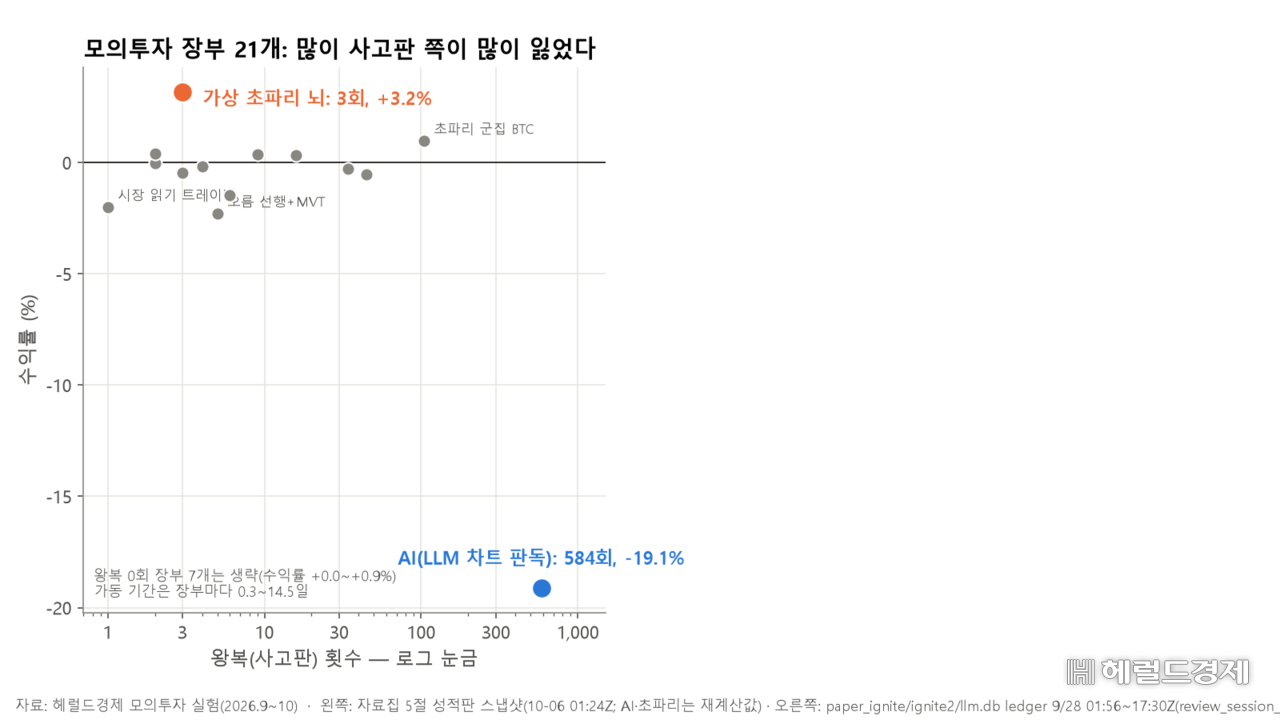
When an AI was put in charge of bitcoin trading, it bought and sold 584 times over four days and lost 19.1%. Over the same period, a virtual fruit fly brain made only three trades across 14 days — yet returned 3.16%, outperforming a simple buy-and-hold strategy by 2.2 percentage points.
The virtual fruit fly brain used in the experiment was built by running the fruit fly connectome — a complete wiring map of the insect's brain completed by scientists in 2024 — as a functional simulation on a personal computer. Price data were converted into odor signals the fly could process, and the fly's approach or avoidance responses to those signals were read as buy or sell orders. A lookup table mapping each odor to the fly's expected reaction was prepared in advance, and trades were executed accordingly.
The results do not straightforwardly show that the fruit fly brain read the market better than the AI. When compared against human-designed trading rules, every strategy that attempted to predict 15-minute price moves — whether run by the fly, a human, or the AI — was already in the red before fees. The more trades a strategy made, the more it lost; none correctly called the market's direction.
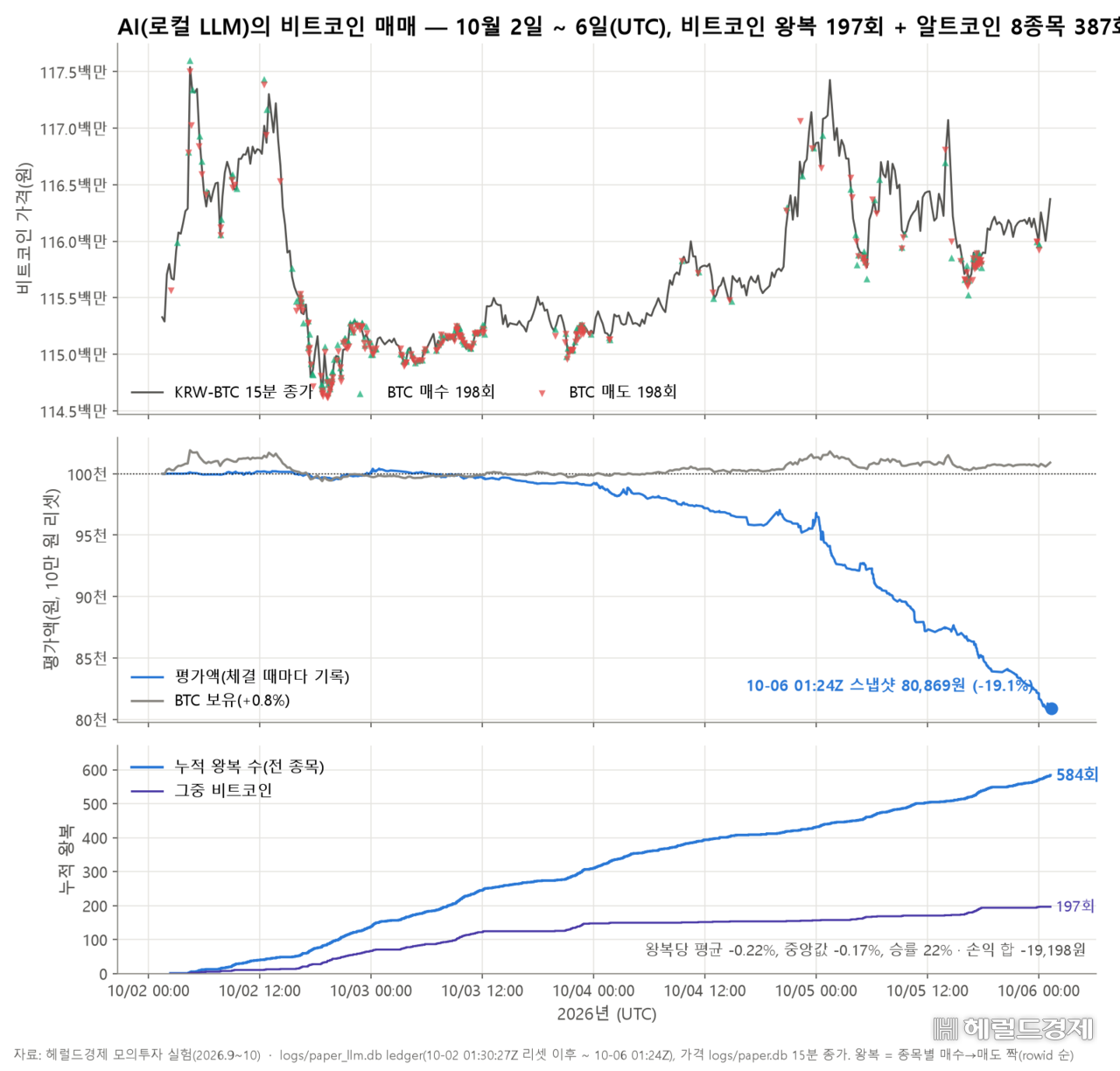
Did a virtual fruit fly beat an AI that traded 584 times?
The AI used for trading was a locally run model that operates on a home PC without an internet connection — specifically a 15-billion-parameter model small enough to run on a single consumer machine. The reporter showed the AI a bitcoin price chart and asked it to decide whether to buy and at what probability the price would rise, then executed trades based on its answers.
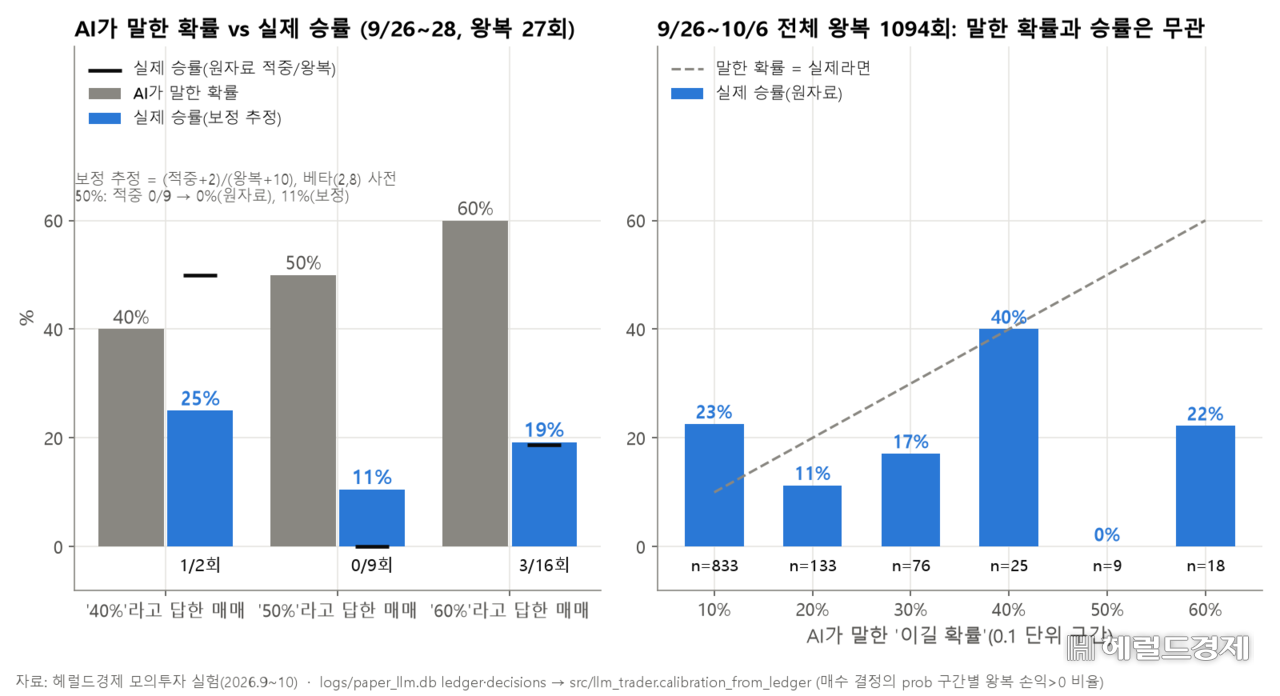
When the AI said the probability of winning a trade was 50%, the actual rate at which those trades made money was 11%. When it said 60%, the real win rate was 19%. Across 584 trades over four days, the strategy lost an average of 0.21% per trade, for a total loss of 19.1%.
When the AI was asked to design its own trading conditions and build a profitable strategy, the criteria it set were so stringent that many days passed without a single trade signal being triggered.
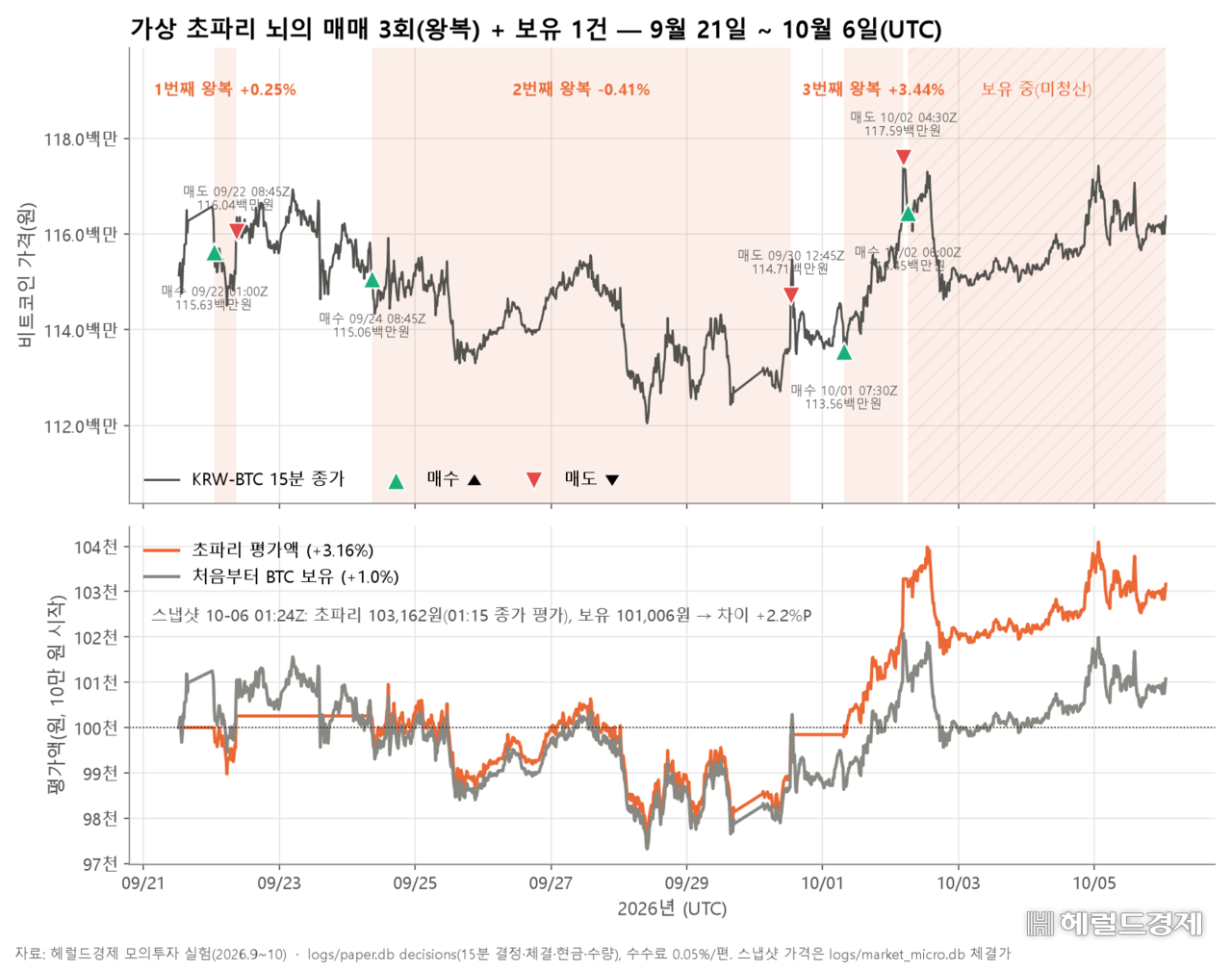
The virtual fruit fly brain's gains, by contrast, came from just three trades. The average return per trade was 1.1%, though the median was 0.25% — a single large gain pulled the average up.
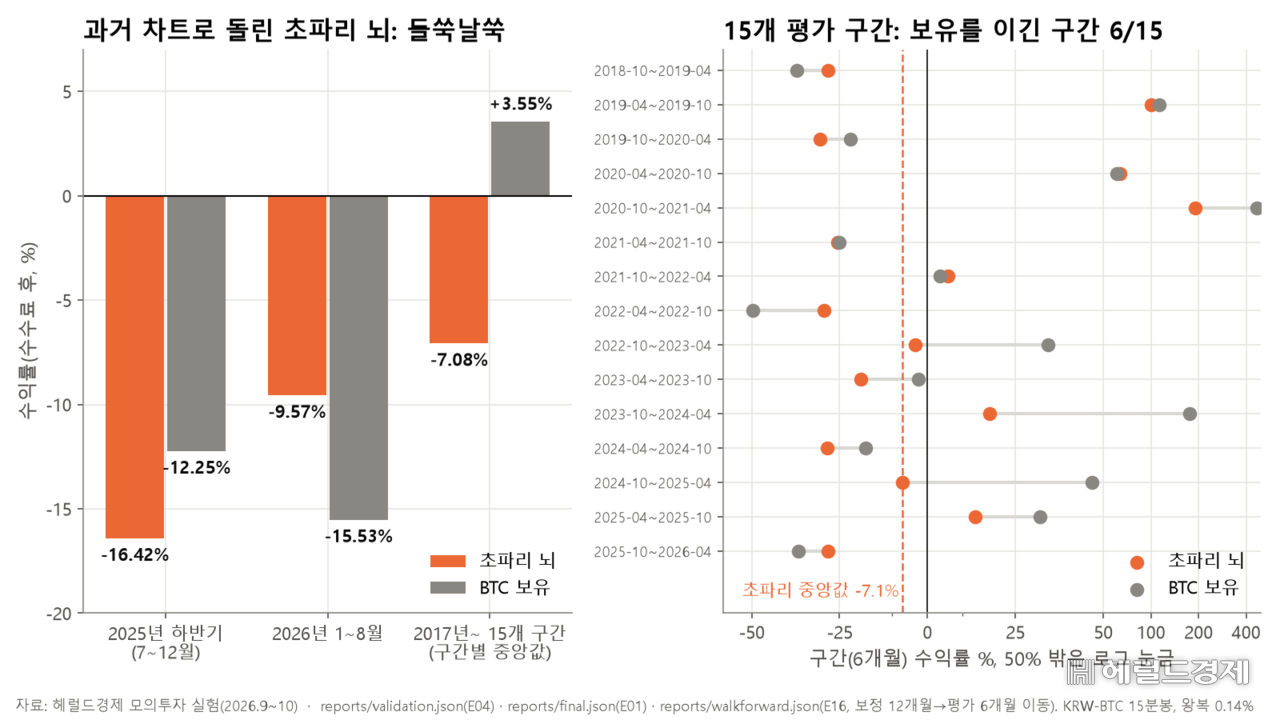
Running the same fruit fly brain model against historical price data produced inconsistent results. Backtesting against charts from the second half of 2025 produced a loss of 16.42%, worse than simply holding bitcoin over the same period, which would have lost 12.25%.
Against charts from January through August 2026, the fly lost 9.57% — better than holding, which would have lost 15.53%. When the full chart history since 2017 was divided into 15 segments and tested, the median return across segments was −7.1%.
Human-designed strategies also struggle to turn a profit
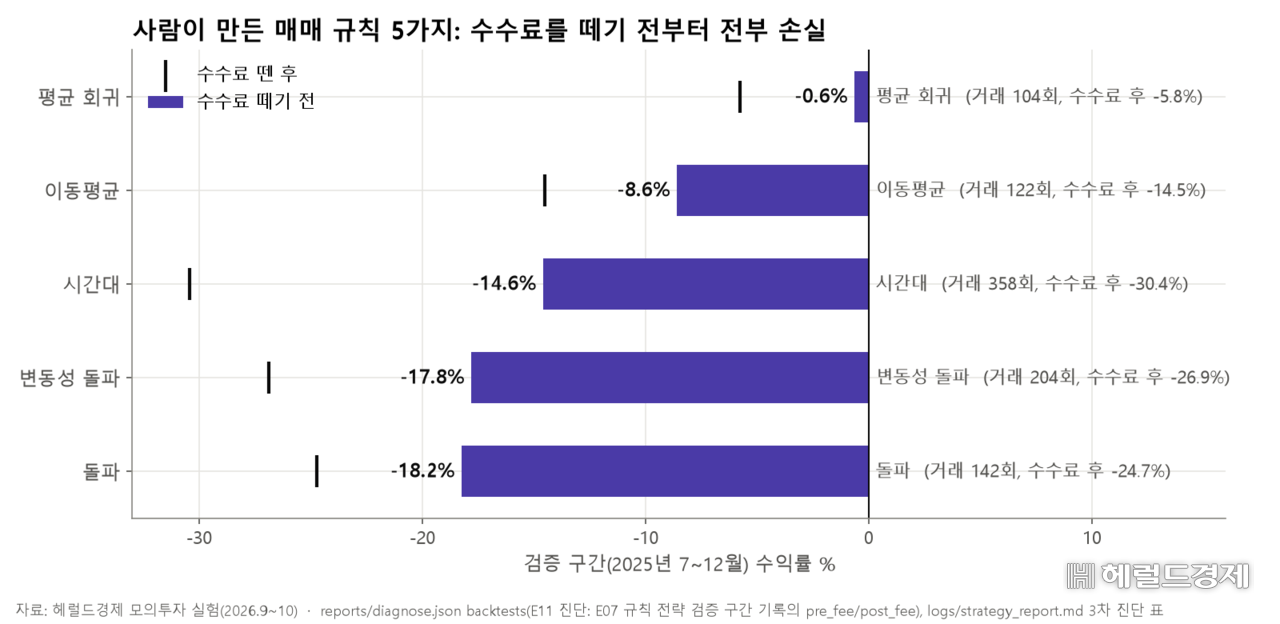
Five trading rules commonly used by investors were also tested in simulated bitcoin trading. These included a moving-average strategy that buys when the price crosses above its average, a breakout strategy that buys when the price exceeds a recent high, and a mean-reversion strategy that buys after a sharp decline on the assumption of a bounce.
All five strategies were in the red even before fees. The moving-average strategy lost 8.6% and the breakout strategy lost 18.2%; the best performer, mean reversion, still lost 0.6%.
Technical indicators were also put to the test. Fifteen indicators commonly watched by investors — including the Relative Strength Index — were used to construct rules of the form "buy when this indicator exceeds this value," generating 12,345 possible combinations in total. Not a single combination outperformed both random trading and a simple buy-and-hold strategy.
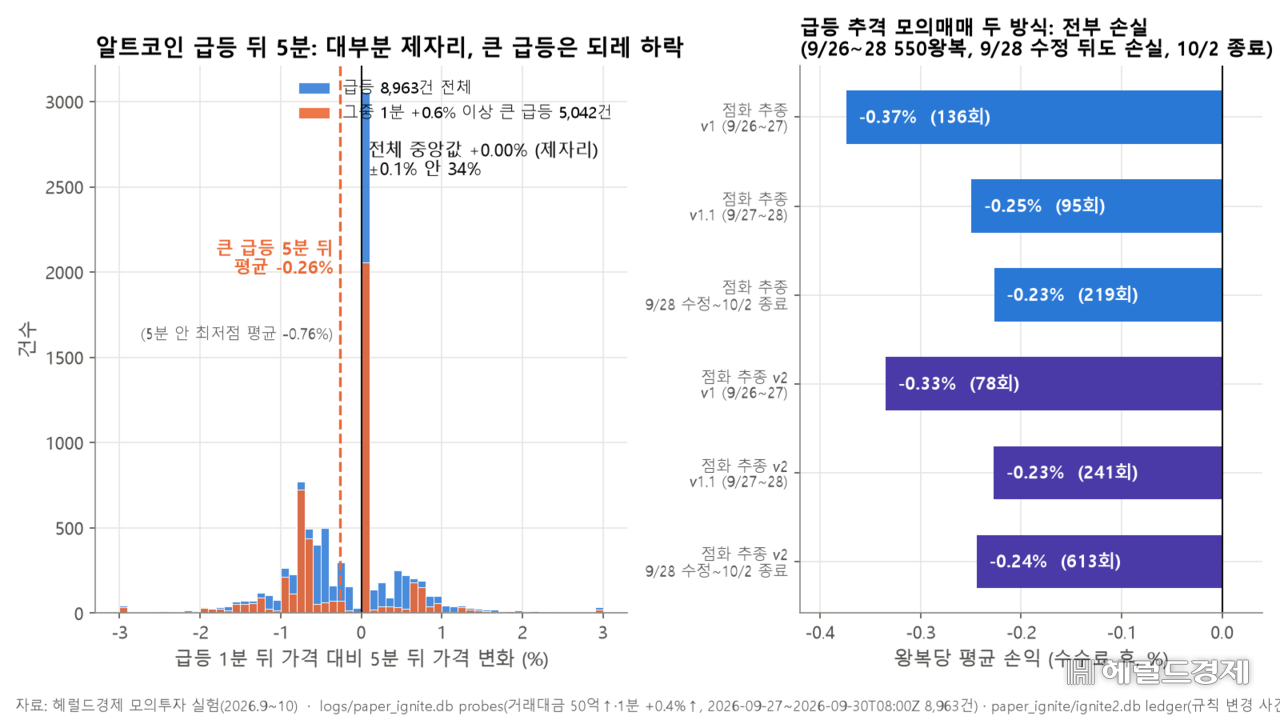
A "momentum chasing" strategy — buying altcoins as they spike sharply in a short period — was tested in two variations, executing more than 500 trades combined, and lost an average of 0.22% to 0.37% per trade. An analysis of 8,963 recorded altcoin spikes found that prices were mostly flat five minutes after the surge; spikes of more than 0.6% within a single minute were followed, on average, by a 0.65% decline five minutes later.
By the time a spike was spotted and a buy order placed, the move had already run its course.
More frequent trading means steeper losses
Breaking down the losses recorded in 21 simulated trading logs run since Sept. 28 into pre-fee and post-fee components showed that 78% to 81% of losses came from the trading results themselves — before fees were even applied.
The AI's far larger loss compared with the fruit fly brain owed less to worse judgment than to the sheer difference in trade count: 584 trades versus three.
A 2021 Korea Capital Market Institute study analyzing the trading records of 204,004 retail investors found that they bought and sold an average of 6.8% of their holdings each day — nearly five times the overall market average of 1.4%.
Intraday trades — buying and selling the same stock within a single day — accounted for 55.4% of total trading volume among retail investors; for investors in their 20s and younger, that share reached 80.8%.
Over the study period, 42% of retail investors recorded a loss. Among investors who entered the market after the COVID-19 pandemic, 60% lost money.
The researchers found that more frequent trading, a higher share of intraday trades, and more frequent stock switching all correlated with lower returns relative to the market and a wider performance gap between investors.
Overseas attempts using fruit fly brains also fell short
Attempts to trade bitcoin using a fruit fly brain have also emerged abroad. Alex Wormuth, a software engineer at a US cryptocurrency exchange, entrusted $100 to a virtual fruit fly he named "Stonkfly." The system converts bitcoin price data into images fed to the neurons corresponding to the fly's eyes, and stimulates dopamine neurons — which signal reward — when a trade is profitable. The reported gain was $1.
A foreign website that ran the same fruit fly brain model against seven and a half years of bitcoin price data reached a starker conclusion. The fly grew $1,000 into $4,231 — but simply holding bitcoin over the same period would have turned $1,000 into $11,904.
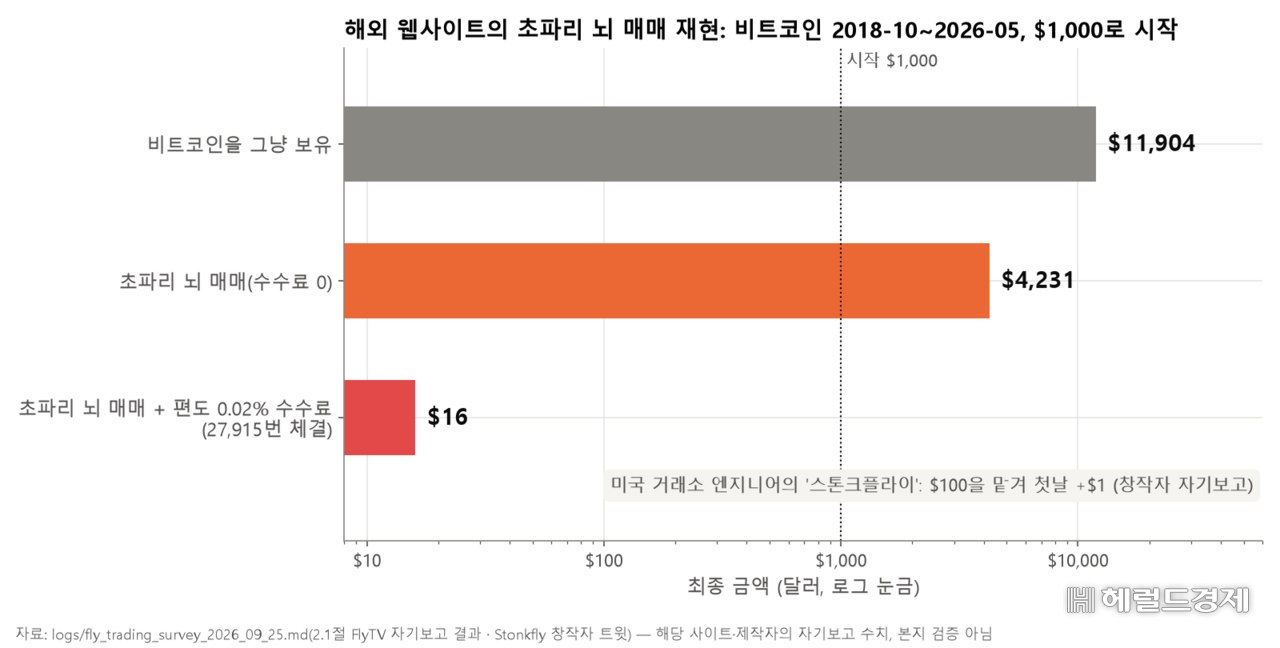
The fly executed 27,915 orders during that period; at a fee of just 0.02% per trade, the initial $1,000 would have quickly shrunk to $16. The site's creator concluded that while the fly appeared profitable on paper, it was not in practice.
Meanwhile, after 15-minute market-prediction attempts failed across the board — for the fruit fly, human strategies, and the AI alike — the experiment was redesigned. The next phase will model how a real fruit fly actually searches for food, having the virtual fly treat each individual trade as an odor signal and respond on a second-by-second basis.
A four-week Saturday–Sunday series documenting a reporter's experiment putting a virtual fruit fly brain — built from the published connectome — in charge of cryptocurrency trading.
dbsdn1110@heraldcorp.com