2026 Severely Disabled Persons' Products Fair held Tuesday and Wednesday at aT Center in Seoul; one-on-one purchasing consultations connect public institutions with production facilities
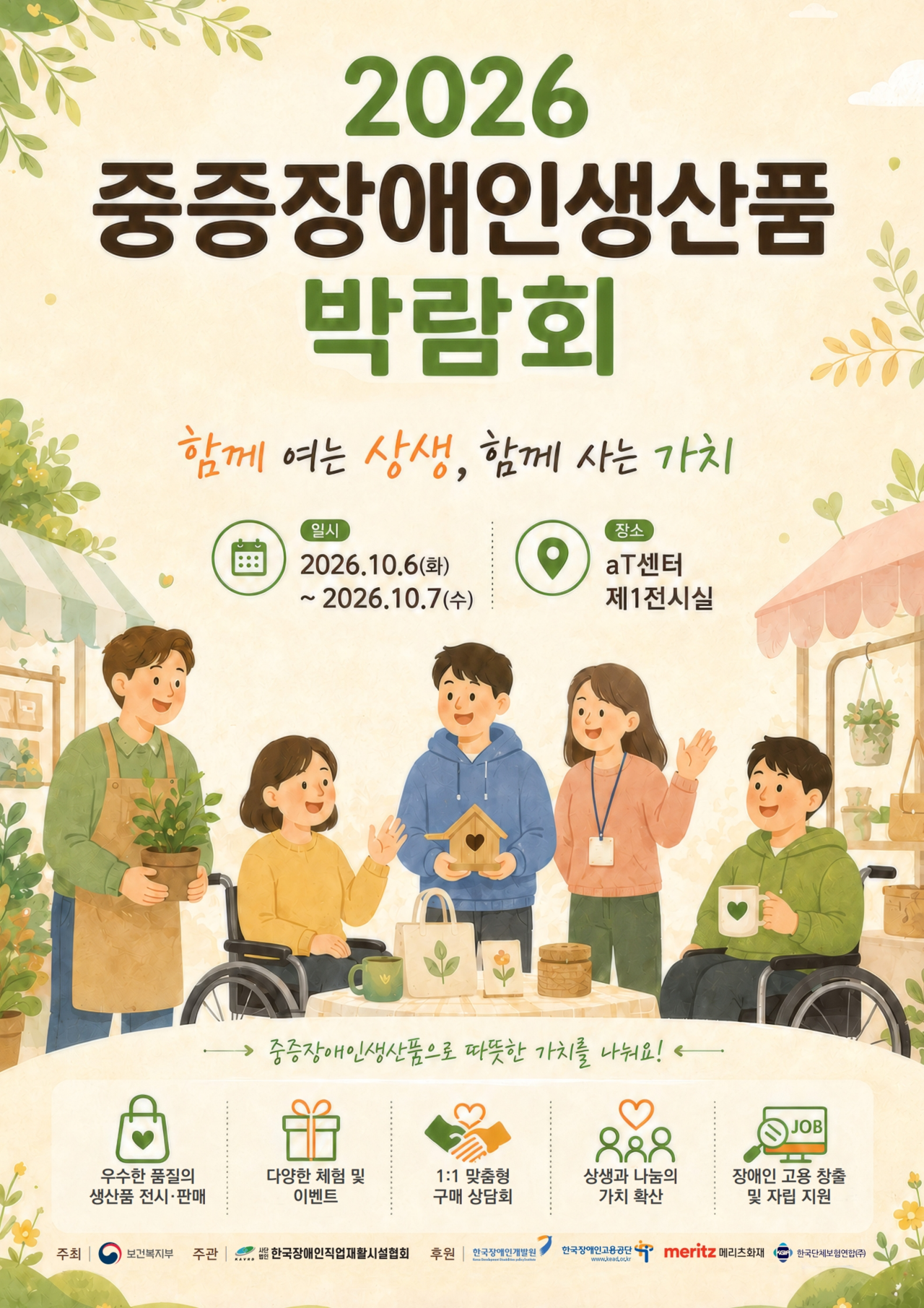
The Ministry of Health and Welfare is holding the 2026 Severely Disabled Persons' Products Fair at Exhibition Hall 1 of the aT Center in Yangjae-dong, Seoul, Tuesday through Wednesday.
Now in its third year, the fair aims to highlight the diversity and quality of products made by people with severe disabilities and to spread awareness of the social value created when purchasing those products — namely, employment and greater independence for people with disabilities.
Under the priority purchase regime for products made by people with severe disabilities, public institutions are required to spend at least 1.1 percent of their total procurement budget on such products, services and supplies — a policy designed to create jobs and secure income for people with severe disabilities who face barriers to competitive employment.
Based on 2025 figures, 1,030 public institutions achieved a priority purchase rate of 1.12 percent, and 819 production facilities employed 15,682 workers with disabilities, including 14,297 with severe disabilities.
A total of 105 production facilities are participating in the fair, showcasing food items such as baked goods, processed foods, and coffee and tea, as well as eco-friendly household products, electronics, and professional services including cleaning, home-appliance washing and disinfection. Visitors can examine, try out and purchase products firsthand to see their quality and variety for themselves.
To help public institutions meet their mandatory priority purchase obligations, one-on-one purchasing consultations between public institutions and production facilities are also being held.
Organizers gathered advance information on the types of products public institutions wish to buy and their budget ranges, then matched them with suitable production facilities. Consultations cover product and service specifications, prices and delivery conditions in detail. A total of 59 public institutions and 76 production facilities took part, generating about 240 consultation sessions.
Through this process, organizers plan to directly connect public institutions that have real purchasing needs with production facilities, supporting the conclusion of actual purchase contracts and helping facilities secure new sales channels.
Meanwhile, 30 citations from the minister of health and welfare were presented Tuesday to individuals and institutions recognized for their contributions to promoting the priority purchase regime for products made by people with severe disabilities.
Based on 2025 performance, the Korea Council of Social Welfare (8.05 percent), Seoul Medical Center (6.07 percent), Suwon in Gyeonggi Province (4.57 percent) and the Korea Occupational Safety and Health Agency (4.01 percent) received top honors for their priority purchase rates and spending amounts.
The National Museum Cultural Foundation and the Northeast Asian History Foundation, which significantly improved their priority purchase performance, also received excellence awards, as did the National Tax Service and Gunpo in Gyeonggi Province for exceeding their mandatory purchase targets for five or more consecutive years.
During the fair, organizers are also running a vocational rehabilitation experience and job-matching consultation for people with disabilities, a showroom where visitors can experience products made by people with severe disabilities in a real-life setting, an international video conference and best-practice presentations, and priority purchase education sessions for public institutions.
"A single product we choose can become an opportunity for a person with a severe disability to work, and can further serve as a foundation for independence and social participation," said Eun Seong-ho, director general of the ministry's Population and Social Services Policy Bureau. "I hope this fair gives people a chance to experience the quality and value of these products firsthand, and that value-driven consumption — choosing products made by people with severe disabilities — continues to grow."
thlee@heraldcorp.com