Analysis of 24,256 emergency department restriction messages by specialty in the first half of 2026
Pediatrics led with 2,985 cases, followed by surgery at 1,766 and otolaryngology at 1,737
Lawmaker So Byung-hoon calls for securing specialists who can treat patients after hospital transfer
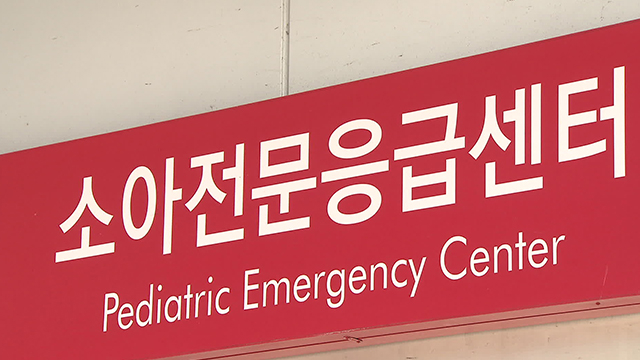
Despite the government's intensive support for pediatrics and obstetrics as priority areas under its essential medicine policy, pediatrics recorded the highest number of emergency department restriction messages among all specialties at hospitals nationwide in the first half of this year, an analysis has found.
According to data submitted to Democratic Party of Korea lawmaker So Byung-hoon of the National Assembly's Health and Welfare Committee by the National Medical Center, a total of 24,256 specialty-specific emergency department messages were registered on the integrated emergency medical information intranet by regional emergency medical centers, local emergency medical centers and local emergency medical institutions from January through June 2026.
The data were compiled by specialty and reason under a new emergency department message classification system that took effect Oct. 29, 2025.
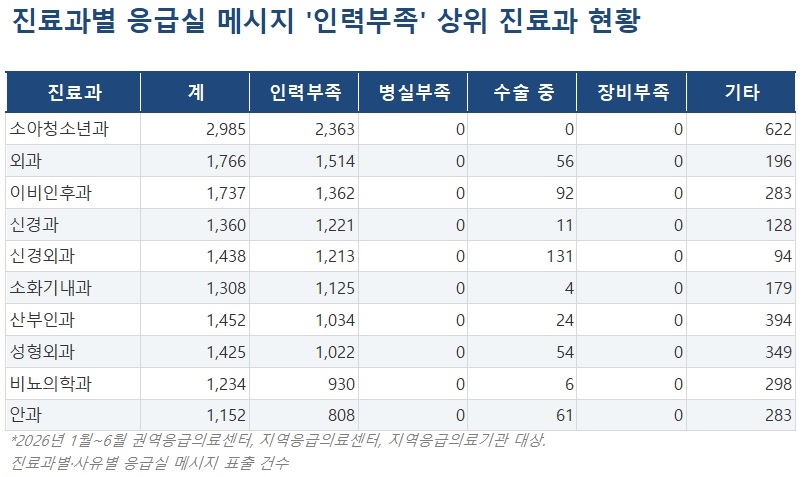
By specialty, pediatrics recorded the most messages at 2,985.
Surgery followed with 1,766, then otolaryngology with 1,737, obstetrics and gynecology with 1,452, neurosurgery with 1,438, plastic surgery with 1,425, neurology with 1,360, gastroenterology with 1,308, urology with 1,234 and ophthalmology with 1,152.
Particularly notable were the figures for pediatrics and obstetrics and gynecology — the two specialties the government has designated as priority areas under its essential medicine support plan. Together, the two specialties logged 4,437 emergency department messages in the first half of the year.
Averaged over the 181 days of the first half, that works out to roughly 24.5 cases per day.
Of the messages from those two specialties, staffing shortages accounted for 2,363 cases in pediatrics and 1,034 in obstetrics and gynecology, for a combined total of 3,397.
Across all 24,256 messages, staffing shortages were cited in 18,664 cases, or 76.9 percent of the total. Ongoing surgeries accounted for 653 cases, with other reasons making up the remaining 4,939.
Staffing shortage messages were also concentrated in specialties where follow-up care — including surgery and specialized treatment — is critical, not just initial emergency room care.
In surgery, 1,514 of 1,766 total messages cited staffing shortages; in neurosurgery, 1,213 of 1,438; and in neurology, 1,221 of 1,360.
Even if the government improves the emergency patient transfer system, patients cannot receive definitive treatment if the receiving hospital lacks surgeons and specialists to carry out operations and follow-up care — pointing to the need for more precise management of backup medical personnel.
"Emergency medicine policy must shift its focus beyond simply finding a hospital willing to accept a patient, toward ensuring that each specialty has the attending physicians, surgeons and backup care staff actually needed to treat patients," So said. "The government should use the accumulating specialty-level data to analyze vulnerable departments and recurring staffing gaps, and incorporate those findings into its essential medicine workforce policy."
thlee@heraldcorp.com