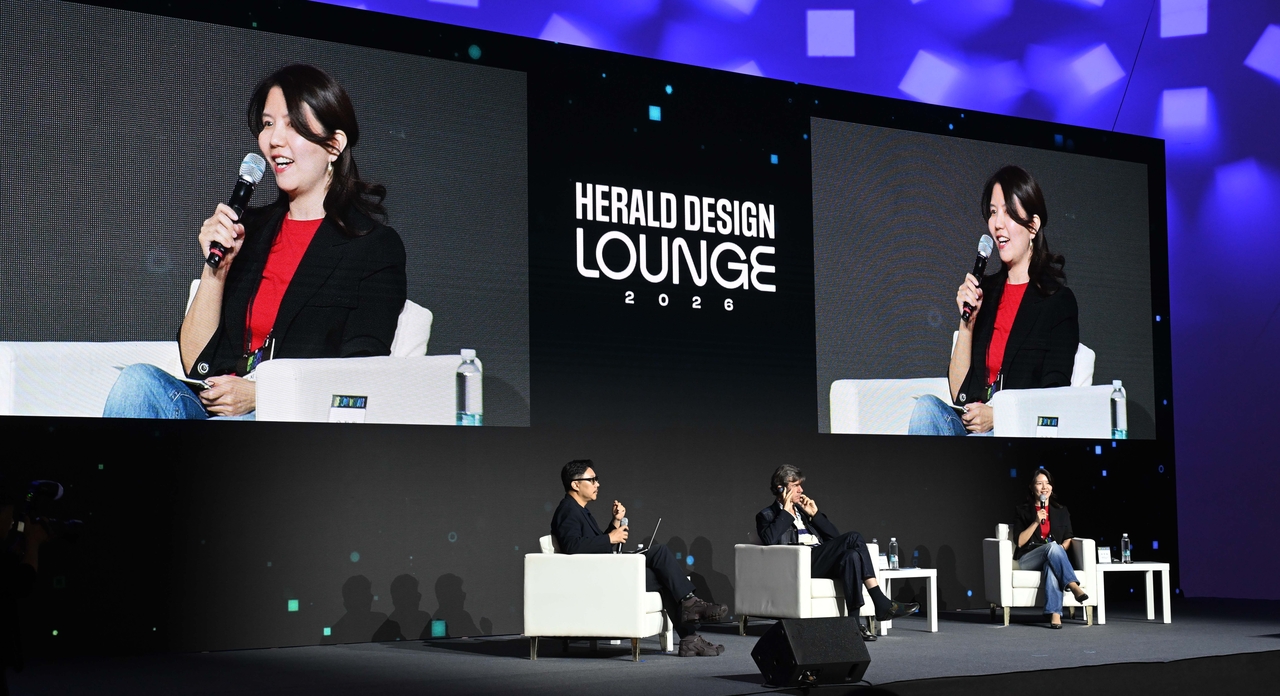
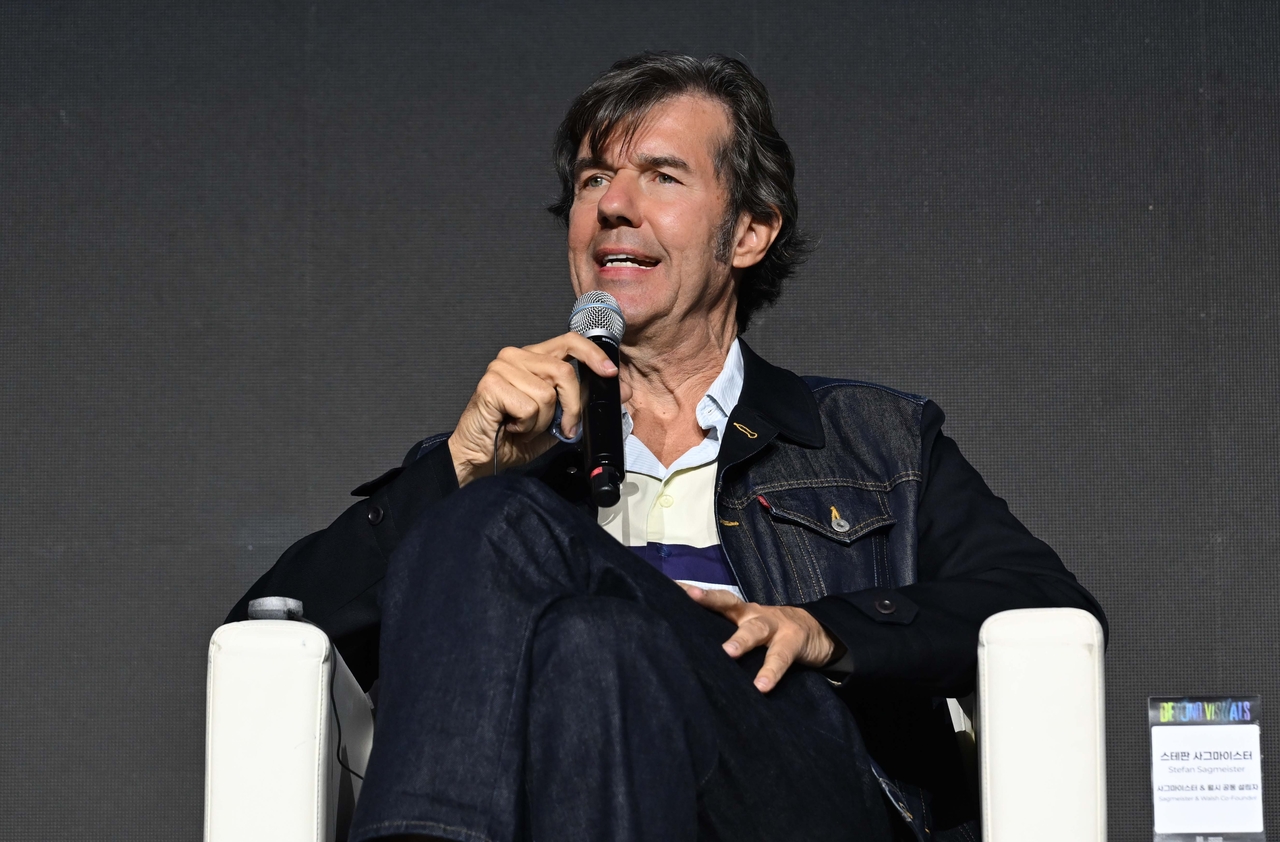
Stefan Sagmeister and Yu Ji-won in panel talk at Herald Design Lounge 2026
Beyond the flood of flawless pixels, a case for 'the resistance of the hand'
'Time, discernment and accountability are what machines cannot replicate'
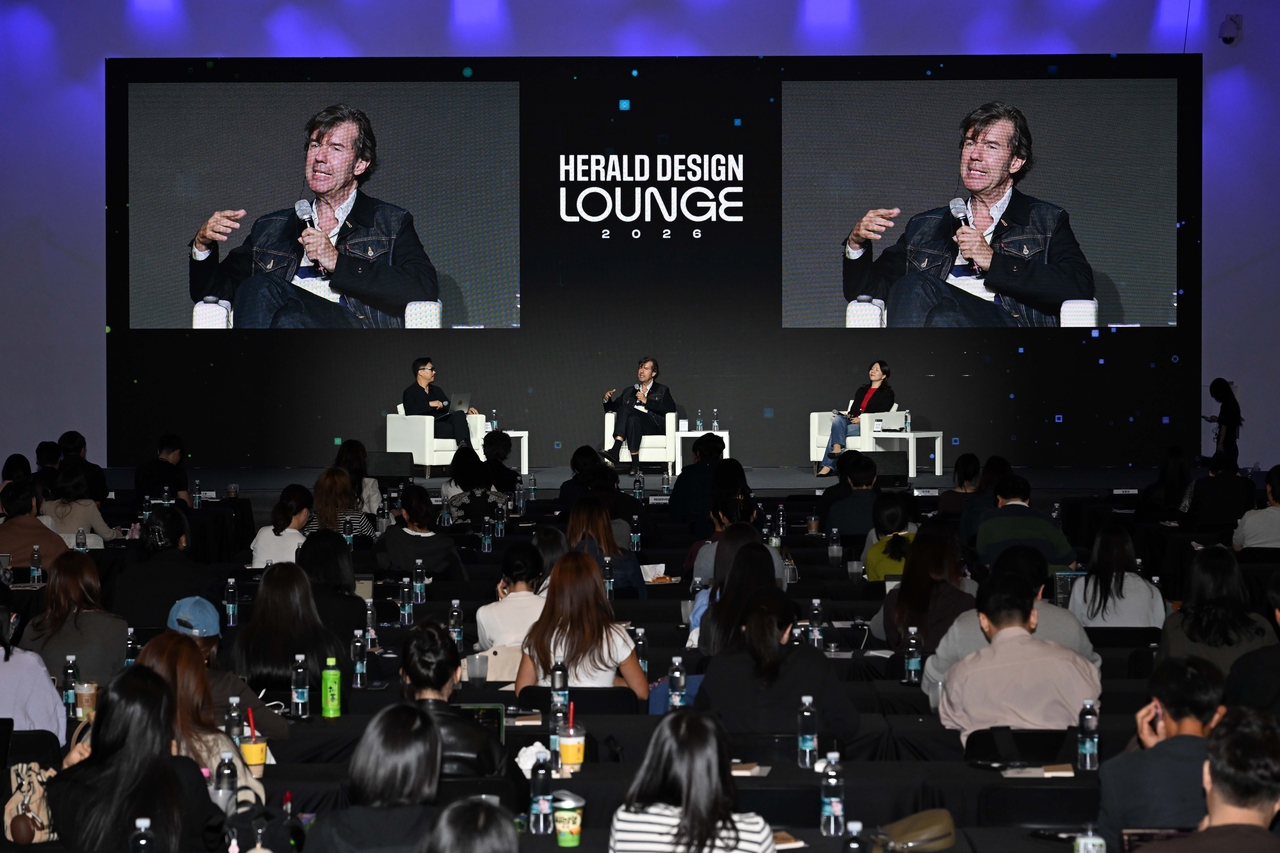
"Anyone on a motorcycle can go far faster, yet we still cheer wildly for Usain Bolt running 100 meters in under 10 seconds. Even knowing a machine would be quicker, we place value on the effort of a human being running on two legs alone. Design is no different. No matter how far technology advances, the place of human care and labor will not easily disappear."
The conviction of world-renowned graphic designer Stefan Sagmeister was unequivocal. His insight: in the face of a machine-driven race for efficiency, the physical sweat and hard labor of human hands remain the last proof of artistic originality.
Typographer Yu Ji-won, director of the Geulmunhwa Research Institute, echoed the same idea. "A smooth pixel rendered on a digital screen and a drop of ink bleeding across rough paper give us entirely different sensations," she said. "Ink tries to spread, and the fibers of the paper resist it like a dam — and in that microscopic collision, a kind of vitality blooms." She added that the warmth analog work provides "is not nostalgic longing for the past, but a sensation born from real physical materials touching and reacting to each other."
In an era when a few lines of a prompt can produce a flawless, high-resolution image in seconds, visual output risks collapsing into disposable clutter — what some call AI slop. As technology reshapes creative work, the desire to reclaim the value of physical resistance and bodily effort through the hands has never been stronger.
The panel talk, held Friday at Dongdaemun Design Plaza in Jung-gu, Seoul, was part of Herald Design Lounge 2026. KAIST Professor and media artist Lee Jin-joon moderated the session, which centered on the question: in an age when technology is transforming the way we design, what remains uniquely human?
Living amid a flood of images, people feel a range of emotions toward what machines produce. Sagmeister said the public is growing rapidly fatigued by the effortless output AI generates. "People have quickly grown tired of content mass-produced by machines without effort," he said. "Just a few years ago, AI-generated images seemed astonishing — now even a 12-year-old dismisses them with a glance, saying 'a machine made that.'"
He recalled using AI to draft emails during his time on Adobe's board of directors. "The idea of letting my machine talk to the other person's machine is absurd," he said. The machine wrote the emails as instructed, he explained, but the results sounded nothing like him and were terrible. For Sagmeister, communication has meaning only when it is a direct encounter between people — not a calculation between machines.
The conversation grew intellectually charged when it turned to the nature of beauty itself. Sagmeister argued that beauty is not merely subjective but an objective reality. "Research shows that people worldwide prefer the color blue and circular forms, and that aggression decreases when people are in a beautiful space like Grand Central," he said. "There is a universal consensus around beauty, and the visual environment genuinely changes human behavior."
Yu pushed back, warning against the "trap of words" when trying to define the essence of beauty. "If we treat the clean geometry of modernism as the absolute standard, then intellectually sophisticated forms like the Arab mashrabiya or the Indian jali — developed in response to climate and ways of life — risk being dismissed as irrational decoration," she said. "Human beings are not fixed entities; we are relational beings in constant interaction with our environment and materials."
Both panelists agreed, however, that the one domain machines can never encroach upon is the human mind. Yu, who researches typography for dementia patients, said that even when memory and cognition have completely collapsed, "the single thing a human being holds onto until the very end is the desire to be happy." She urged designers not to be confined by the convenience of technology but to step outside it and observe human life. Even virtual images on a screen, she said, acquire warmth only when they connect with the senses of a finite, embodied human being.
The panel also exchanged insights on what will keep creators relevant in an age when technical production ability has been leveled. Sagmeister said rendering skills have already lost their value — just as the invention of photography in the 19th century instantly devalued the craft of realistic depiction. He cited producer Rick Rubin, who cannot play an instrument yet has crafted landmark albums, and designer Tibor Kalman, who famously claimed to know nothing about layouts or Helvetica yet became a legend. "What matters is a powerful sense of taste — knowing what you love — and the charisma to actually realize your work," he said. "What is absolutely necessary is a creator's clear vision of what to do with this powerful technology, not technical proficiency."
Yu proposed going beyond individual charisma, offering "critical reading of data" and "community-based solidarity" as ways to fill the gaps left by vast systems. She introduced a new project concept — "Daneoui Gunjari-deul," an examination of the voids within large language model datasets — in which she maps the absences within LLM data. "When you look at the full dataset, you see gaping voids where language is desperately lacking — and those voids always belong to the socially marginalized," she said. "Finding those places of absence and writing poetry in the blank spaces of language that does not yet exist — that is the designer's role." She added that the gap between vast systems and the individual must be bridged through what she called a "human-scale community" built with fellow creators.
Creators navigating this era of change grow more anxious each day, seeing technology's convenience as both an advantage and a threat. Moderator Lee closed the session with a pointed observation. "What machines can never imitate is the time earned through lived experience, the discernment to recognize what others lack, and the attitude of taking responsibility for one's choices," he said. "The imperfect space where human sweat and deliberation reside, beneath the smooth surface of technology — that is the most dignified territory design must ultimately defend."
shee@heraldcorp.com