"Reversal of Money: 2027 Economic Outlook" by Kim Gwang-seok (Eden House) — The author, who set out to publish an annual economic outlook series through 2050, has released his ninth installment. His first volume, "Post-Corona: 2021 Economic Outlook," published in 2020, explored ways to find new opportunities amid the chaos of the COVID-19 pandemic. Now, Kim identifies "reversal" as the keyword for next year, arguing that AI is generating a powerful countercurrent even as global economic indicators deteriorate under the weight of excessive debt and war. The book asks who will prevail in the collision between a technology-driven reversal and a mainstream current rooted in debt and conflict. Kim maps the uncertainty across 20 trends and offers alternatives for each issue. He forecasts that next year will be when people begin to feel in their daily lives the changes AI is bringing, while at the same time preparing for a tomorrow sharply different from the past. He also warns that "imbalance" and "low growth" will be the defining themes of next year — a period in which a semiconductor boom continues yet fails to lift the broader economy — and that it is time to shed the illusion of prosperity.
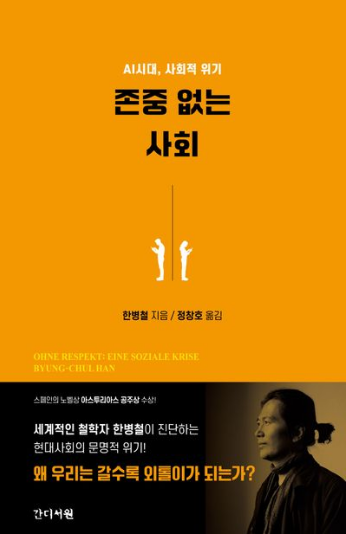
"A Society Without Respect" by Han Byung-chul, translated by Jeong Chang-ho (Gandhi Seowon) — The Germany-based Korean philosopher argues that the disappearance of respect from contemporary society is a symptom of the neoliberal achievement society. In a society defined by performance, human dignity is measured not by inherent worth but by money, status and accomplishment. To earn respect, individuals must constantly prove their abilities and value, driving society into endless competition and eroding civic spirit and community bonds in the process. Han also contends that modern society's tendency to treat differing views as those of an "enemy" makes democratic dialogue and compromise impossible, because people cannot separate their opinions from their identities and experience disagreement as a threat to who they are. Drawing on Hannah Arendt's concept of "true friendship," he calls for a recovery of "listening and care" — the recognition of others as independent beings different from oneself. He further argues that to repair digital spaces that have lost their function as a public sphere, people must abandon emotionally driven candor and instead cultivate the gestures of beautiful appearance and courtesy proposed by Nietzsche and Alain.
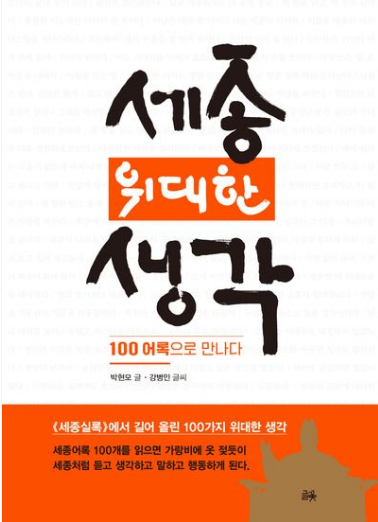
"Sejong's Great Thoughts: 100 Sayings" written by Park Hyeon-mo and rendered in calligraphy by Kang Byeong-in (Geulkkot) — To mark the 100th anniversary of the designation of Hangul Day, the author — who has spent 26 years researching the Annals of King Sejong — has selected 100 sayings of King Sejong and rendered them in decorative calligraphy. Readers may be surprised to learn that familiar maxims of daily life — "Personnel is everything," "The answer lies at the scene," and "Together we go farther and last longer" — were principles Sejong himself practiced while governing Joseon. One episode reveals his character as a wise ruler: in the third year of his reign, when drought and epidemic brought suffering to the people, he declared "In the hardest times, go to the lowest place" and moved into a small thatched cottage built between Sajeongjeon and Gyeonghoeru. Another passage shows his shrewdness: Sejong, famous for his love of meat, subsisted for months on only vegetable banchan after the death of the previous king — using his own table as a means of communication, conveying both care for subjects suffering through a poor harvest and a warning to his ministers not to let their guard slip in governing the country.
carrier@heraldcorp.com