Direct labor costs including wages and bonuses reach 5.29 million won, up 4.1% from a year earlier
Labor costs at firms with 300-plus workers rise 6.9% while smaller firms see just 1.4% growth
Welfare spending gap stands at 157,000 won vs. 480,000 won by company size

The average monthly cost of employing a full-time worker in South Korea reached 6.68 million won ($4,920) last year, up 5.0% from the previous year, though the gap between large and small companies widened. Labor costs at firms with 300 or more workers grew 6.9%, while those at smaller firms rose just 1.4%. Welfare spending on meals, housing and children's tuition support at firms with fewer than 300 workers was limited to about one-third the level at larger companies.
According to the Ministry of Employment and Labor's 2025 corporate labor cost survey released Wednesday, the average monthly labor cost per worker at companies with 10 or more full-time employees was 6.68 million won — an increase of 320,000 won from the prior year. The rate of labor cost growth has accelerated in recent years, rising from 1.9% in 2023 to 3.8% in 2024 and 5.0% last year.
Labor costs represent the total amount a company bears in employing workers, encompassing not only wages but also severance pay, the employer's share of social insurance premiums and welfare expenditures.
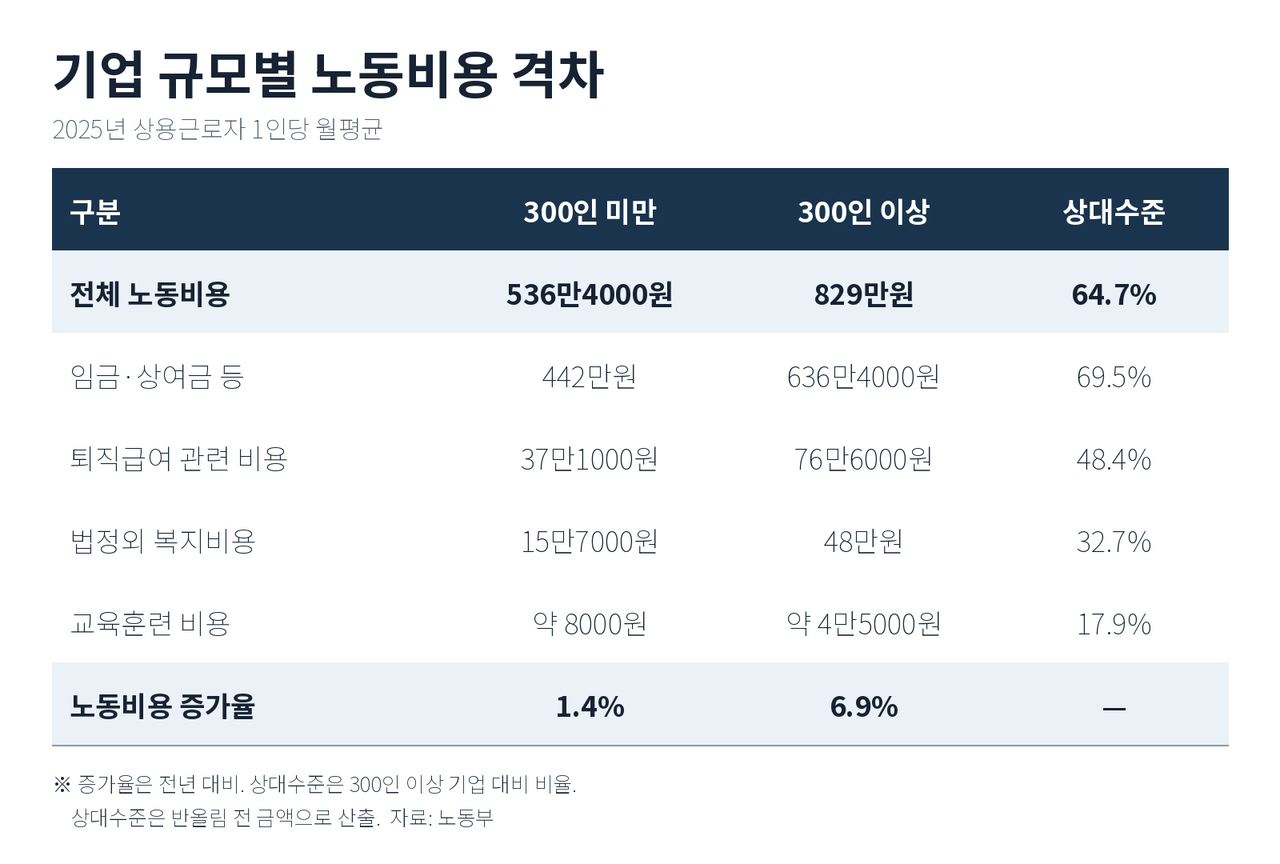
By company size, firms with 300 or more workers spent an average of 8.29 million won per month on labor, up 538,000 won from the previous year. Firms with fewer than 300 workers spent 5.36 million won, an increase of just 72,000 won. As a result, smaller firms' labor costs as a share of larger firms' fell from 68.3% in 2024 to 64.7% last year, a drop of 3.6 percentage points.
Breaking down by more granular size categories, firms with 1,000 or more workers recorded the highest monthly labor cost at 9.08 million won. They were followed by firms with 500 to 999 workers at 6.87 million won, 300 to 499 workers at 6.47 million won, 100 to 299 workers at 5.81 million won, 30 to 99 workers at 5.33 million won, and 10 to 29 workers at 5.01 million won. Labor cost growth at the smallest firms — those with 10 to 29 workers — was limited to just 0.4%.
The size-based gap was even more pronounced in non-wage costs. Direct labor costs — combining wages, bonuses and other cash compensation — stood at 4.42 million won at firms with fewer than 300 workers, equivalent to 69.5% of the level at larger firms. Indirect labor costs, which include severance pay, social insurance premiums and welfare spending, were 944,000 won at smaller firms versus 1.93 million won at larger ones, meaning smaller firms spent less than half what larger counterparts did.
The disparity was particularly stark in discretionary welfare spending. Firms with fewer than 300 workers spent an average of 157,000 won per month on non-statutory employee welfare — just 32.7% of the 480,000 won spent by larger firms. The gap was relatively narrow for meal subsidies, where smaller firms reached 83.2% of the larger-firm level, but was far wider for health and medical benefits at 15.5% and children's tuition support at 16.1%. Training and education costs at smaller firms amounted to roughly 8,000 won per month, only 17.9% of the level at larger companies.
Trends in severance-related costs also diverged. Firms with 300 or more workers saw such costs rise 32.1% year on year to an average of 766,000 won per month, while firms with fewer than 300 workers saw a 5.4% decline to 371,000 won. These costs include lump-sum severance payments, mid-term settlements, annual contributions to retirement pension plans and advance notice pay for dismissals.
Looking at the overall cost breakdown, direct labor costs averaged 5.29 million won per month, up 4.1% from the previous year. Fixed and overtime wages combined came to 4.47 million won, a 3.8% increase, while bonuses and performance pay rose 5.9% to 821,000 won.
Indirect labor costs rose 8.6% to 1.39 million won. Severance-related costs climbed 15.8% to 549,000 won, while statutory labor costs — including national pension and national health insurance premiums — increased 4.7% to 503,000 won. Non-statutory welfare costs grew 4.4% to 303,000 won.
By industry, the finance and insurance sector recorded the highest monthly labor cost at 12.1 million won, followed by the electricity, gas, steam and air conditioning supply sector at 10.63 million won and manufacturing at 7.63 million won. The business facility management, support and rental services sector had the lowest at 3.36 million won, while accommodation and food services came in at 4.15 million won.
The survey covered approximately 3,600 incorporated companies with 10 or more full-time employees. Agriculture, forestry and fisheries, public administration, educational services, and health and social welfare services were excluded. The 300-worker threshold used in the survey does not correspond to the legal definition distinguishing small and medium-sized enterprises from large companies.
fact0514@heraldcorp.com