Managing factory maintenance, repair and operations — the lifeblood that keeps manufacturing running
iMarketKorea moves beyond simple procurement to offer tailored solutions for Korean manufacturers
One-stop permitting, procurement and logistics support anchored at Taylor, Texas
Korea's only listed MRO company builds self-sustaining model on accountability
Vertical integration completed through acquisitions of Anyeon Care, B2L Logistics and Valuepoint
Solid 3 trillion won revenue base; operating profit jumped 110% in the first half of this year
![Gradiant Technology Park, a large-scale industrial complex being developed on an approximately 858,000-square-meter site in Taylor, Texas, to support Korean companies entering the US market. [iMarketKorea]](https://wimg.heraldcorp.com/news/cms/2026/09/30/news-p.v1.20260929.4559cd485ce641d28360b57b8e0fff0c_P1.jpg)
The resources companies consume every day just to produce goods and keep factories running are staggering in their variety. From the small bolts, nuts, bearings and piping that go into the production lines of massive semiconductor and advanced manufacturing plants, to the cleanroom suits and specialized gloves worn by workers, to the computers and servers in the office and even ordinary copy paper — the categories number in the millions.
Excluding the core raw materials that go directly into finished products, every tangible and intangible resource needed to keep a factory and its equipment running — covering Maintenance, Repair and Operations — is collectively known in industry as MRO, or maintenance, repair and operations supplies.
Seemingly mundane, MRO is in fact the critical artery that keeps the heart of manufacturing and advanced industry beating. If a single essential component is not delivered on time, a production line worth trillions of won grinds to a halt. If a worker's safety supplies run out, an entire facility faces the risk of shutdown.
Yet having individual companies track down suppliers, negotiate contracts and inspect deliveries for tens of thousands of different materials wastes enormous administrative resources and drives up unnecessary transaction costs. Buying materials separately also makes it nearly impossible to achieve the economies of scale needed to bring unit prices down. The company that stepped in to handle all of this in one place — positioning itself as a kind of "corporate butler" — is iMarketKorea, a specialist in industrial materials procurement services.
iMarketKorea's identity is captured in its slogan: "You Imagine, We Supply." The promise is that while client companies focus entirely on developing innovative ideas, products and core business strategy, iMarketKorea handles everything else on their behalf — sourcing raw and consumable materials, negotiating the best prices, inspecting quality, managing delivery schedules and arranging logistics from end to end.
![Kim Hak-jae, CEO of iMarketKorea. [iMarketKorea]](https://wimg.heraldcorp.com/news/cms/2026/09/30/news-p.v1.20260929.7ca5df17715f4c1ab5285c390db24f5d_P1.jpg)
Gradiant Technology Park in Taylor, Texas — 120 soccer fields of base camp for Korean manufacturers
The arena where this B2B all-rounder has most recently captured the attention of the global industrial community is, perhaps unexpectedly, the heart of Texas. On an approximately 858,000-square-meter site in Taylor, Texas, the development of Gradiant Technology Park — the first large-scale industrial complex built specifically to help Korean companies enter the US market — is moving at a rapid pace. Equivalent in area to roughly 120 soccer fields, the project marks a sweeping territorial expansion for a company that began as an industrial materials distributor, now building out an entire overseas production-base infrastructure.
The push comes amid a broader reshaping of global supply chains. According to the US Department of Commerce, new foreign direct investment into the United States reached $232.2 billion last year, a 49.5% jump from the previous year, with manufacturing accounting for 52.5% of that total. Texas, with no corporate income tax, a flexible regulatory environment and abundant energy resources, has rapidly emerged as the second-largest destination for investment in advanced manufacturing in the country.
For small and mid-sized Korean companies, however, establishing a US production base involves far more than simply buying a plot of land. Unfamiliar local permitting processes, astronomical site-preparation costs, securing power and water infrastructure, the absence of established procurement networks and logistics bottlenecks all form formidable barriers to entry.
Gradiant Technology Park takes direct aim at each of those obstacles. Situated roughly 8 kilometers from Samsung Electronics' Taylor semiconductor fab — about a 10-minute drive — and approximately 40 kilometers from its Austin chip plant and 55 kilometers from Tesla's Gigafactory, the park offers one-stop support covering permitting, government liaison, legal and accounting consulting, and basic utility infrastructure including power, water and sewage. Build-to-suit facilities tailored to individual tenants, along with shared production spaces such as cleanrooms, are designed to dramatically reduce the upfront sunk costs companies would otherwise face.
Layered on top of that is iMarketKorea's core business: local MRO procurement and logistics infrastructure, woven organically into the park's offering. The model creates a complete end-to-end supply chain in which components manufactured at Korean factories cross the Pacific through international shipping networks, arrive at a warehouse in Taylor and are delivered directly to tenant companies' production lines through iMarketKorea's systems.
Global logistics firm Hana One Way has already signed a tenancy agreement after evaluating the park's transport routing and warehouse efficiency, and inquiries from Korean advanced equipment and components suppliers are arriving in a steady stream. The first phase — covering 297,000 square meters of the total 858,000-square-meter site and centered on spec buildings for high-tech tenants — is on track for completion by the end of this year, with the full three-phase development scheduled to wrap up by 2031.
![The groundbreaking ceremony for Gradiant Technology Park held in Taylor, Texas on Nov. 17, 2025 (local time). [iMarketKorea]](https://wimg.heraldcorp.com/news/cms/2026/09/30/news-p.v1.20260929.dbad24db0aa949a19839f35bcd323989_P1.jpg)
Korea's only listed MRO company — 26 years of staying power
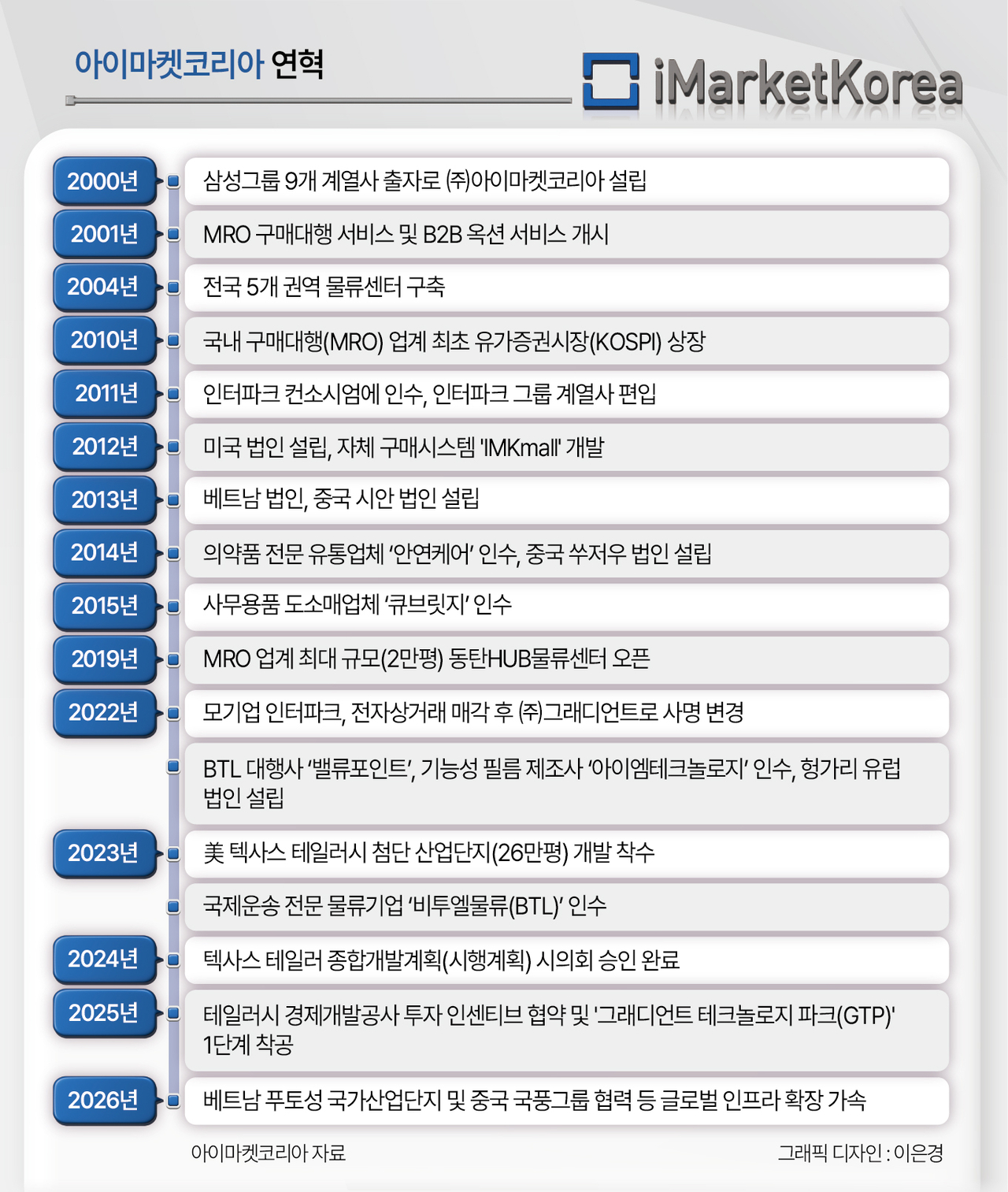
The "full-stack infrastructure developer" model that resolves in one stroke the biggest challenges Korean small and mid-sized companies face when expanding overseas did not emerge overnight. It is grounded in 26 years of supply chain coordination at the front lines of Korean industry since the company's founding in December 2000.
Launched with joint investment from major Samsung Group affiliates at the dawn of B2B e-commerce, iMarketKorea successfully introduced a professional procurement outsourcing system into what was then largely uncharted territory in Korea. The digitization of supply chains, cost reductions through bulk purchasing and the standardization of procurement processes delivered a jolt of fresh thinking to a domestic manufacturing sector long mired in chronic inefficiency.
The company subsequently expanded its client base beyond Samsung affiliates and, in July 2010, became the first procurement outsourcing firm in Korea to list on the Kospi. While major MRO subsidiaries of other large Korean conglomerates ran into regulatory barriers, scaled back their operations or were sold to private equity funds, iMarketKorea stands alone in having secured independent listed-company status and passed the transparent scrutiny of the capital markets.
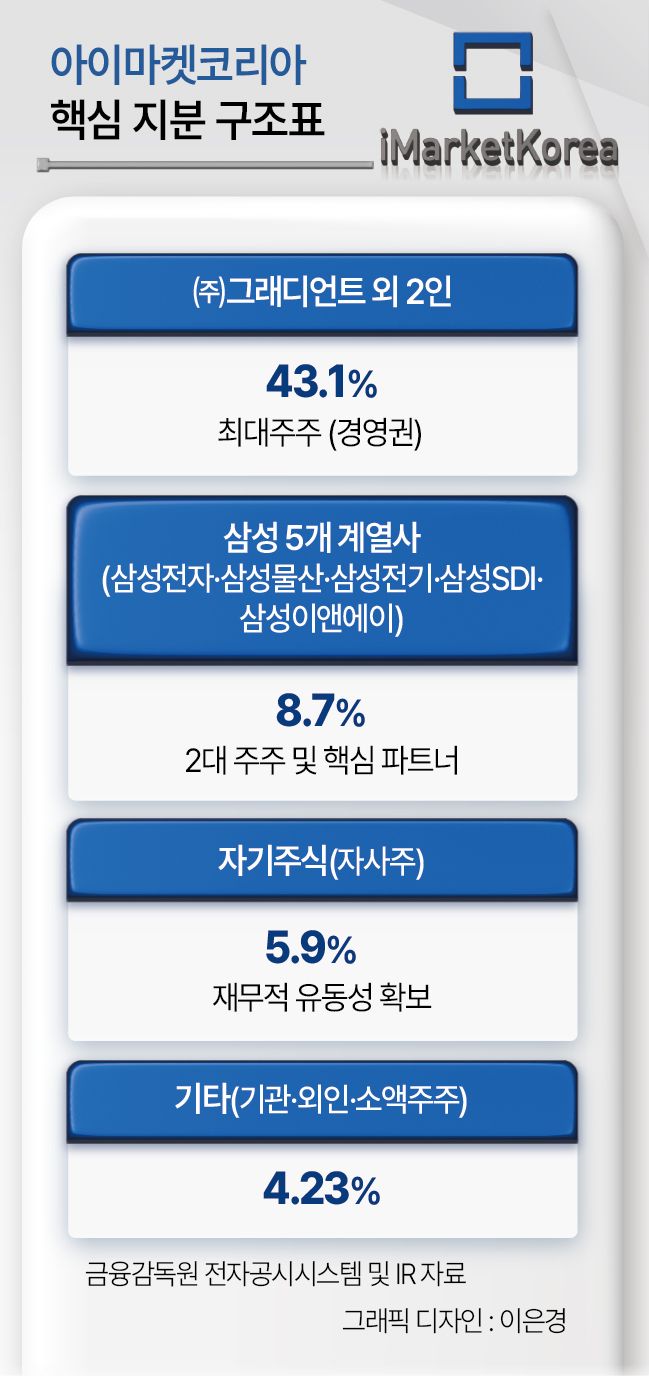
Being acquired by the Interpark consortium in late 2011 proved a decisive turning point that fundamentally transformed the company's character. Under the firm accountability of controlling shareholder Gradiant, which holds a 43.1% stake, iMarketKorea secured its independence while maintaining stable strategic partnerships with Samsung affiliates that retained minority stakes. Unlike other MRO companies that remained content to rely on intra-group transactions, iMarketKorea built its own capacity to stand alone — both in its shareholder structure and its business model.
A 3 trillion won cash engine — operating profit posts V-shaped turnaround with 110% surge in first half
Twenty-six years of accumulated expertise translate into a commanding scale that generates trillions of won in annual transactions. The company operates a vast catalog of about 5.4 million items and a network of roughly 47,000 partner suppliers, producing a steady and robust cash flow. This 3 trillion won ($2.21 billion) cash engine has funded bold global infrastructure investments such as the Gradiant Technology Park in Taylor, Texas.
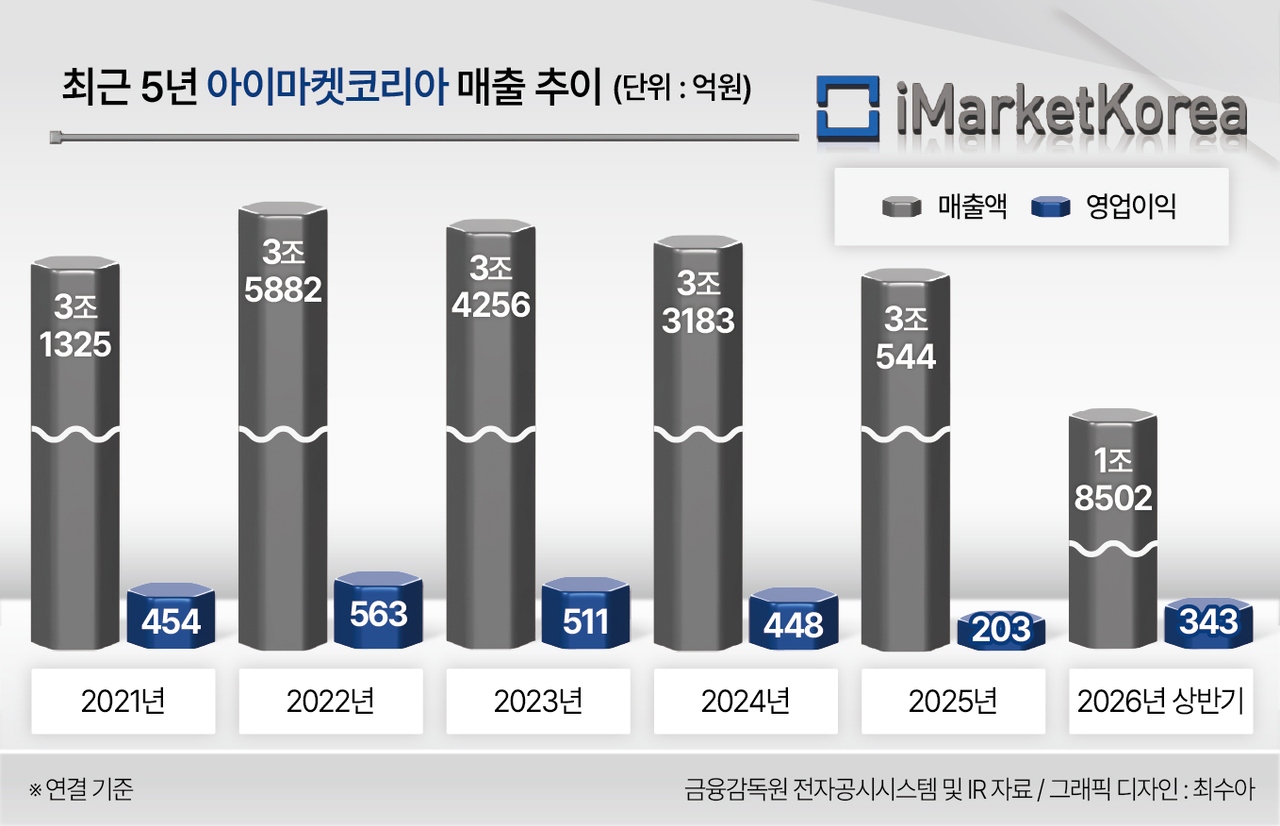
On a consolidated basis, annual sales came in at 3.43 trillion won in 2023, 3.32 trillion won in 2024 and 3.05 trillion won in 2025, holding firmly in the 3 trillion won range throughout. A temporary earnings plateau last year, caused by a slowdown in the semiconductor industry and reduced capital expenditure by upstream customers, has given way to a sharp rebound this year.
According to filings on the Financial Supervisory Service's DART system, iMarketKorea's cumulative consolidated sales for the first half of 2026 reached 1.85 trillion won, up 24.8% from the same period a year earlier. Profitability improvements were particularly striking: consolidated operating profit for the first half jumped 110.8% year on year to 34.3 billion won, while net profit for the period rose 57.1% to 31.8 billion won over the same stretch.
The operating profit earned in the first half alone — 34.3 billion won — already surpassed the company's full-year operating profit of 20.3 billion won last year by nearly 70%. The recovery reflects a resumption of advanced semiconductor facility investment at home and abroad, driving a rebound in customer-supplied materials and MRO volumes, alongside a growing earnings contribution from the company's higher-margin business portfolio.
![The carousel system at iMarketKorea's Dongtan logistics center. [iMarketKorea]](https://wimg.heraldcorp.com/news/cms/2026/09/30/news-p.v1.20260929.f15f79debbdd4774b4c927e59ba084bf_P1.jpg)
Taking a different path — building a three-pillar portfolio
Large domestic MRO companies are typically trapped in a structural low-margin model, with operating profit margins of around 1 to 2 percent. Companies that cannot break out of the limitations of simple intermediary trading — buying goods and reselling them for a distribution margin — find their top-line growth stagnating and their profitability increasingly difficult to defend.
iMarketKorea's path out of that trap has been clear: use the stable cash flow from its core business as a foundation, add a next-generation growth engine in the form of Korean industrial park infrastructure development to support companies expanding overseas, and complete a vertically integrated distribution, logistics and marketing operation through strategic acquisitions — a three-pillar strategy.
The first pillar, the existing cash-generating core, has been deepened in expertise and logistics capability. The company has deployed more than 120 Certified Professional in Supply Management (CPSM)-qualified staff to diagnose and improve clients' procurement practices. It operates the Dongtan Hub — a 66,000-square-meter facility in Hwaseong, Gyeonggi Province, the largest single logistics center in the industry — along with key regional hubs nationwide, enabling same-day dispatch. The company has also internalized specialist distribution of construction materials and IT hardware worth hundreds of billions of won annually, expanding its weight as a distribution platform.
![Large-format digital printers and hot-air dryers at Valuepoint, a business process outsourcing company. [iMarketKorea]](https://wimg.heraldcorp.com/news/cms/2026/09/30/news-p.v1.20260929.1497d8ba8b8f4344abdb2acce233ffcd_P1.jpg)
The second pillar is the expansion of a high-margin, high-capability portfolio through acquisitions. A prime example is Anyeon Care, a specialist pharmaceutical distributor acquired in 2014. Anyeon Care delivers prescription drugs and advanced medical supplies directly to major tertiary hospitals, generating sales of more than 210 billion won per quarter and serving as a high-quality earnings driver that lifts the company's overall profitability.
B2L Logistics, an international freight specialist brought into the fold in 2023, covers ocean and air cargo, customs clearance and multimodal logistics, extending the company's operational reach across the entire global supply chain. The direct-delivery capability that allows iMarketKorea to connect Korean companies' raw and component materials all the way to production lines at the Taylor, Texas park in a single seamless flow comes directly from B2L Logistics.
Rounding out the portfolio, Valuepoint — a business process outsourcing firm acquired in 2022 — creates distinctive synergies in below-the-line marketing, bringing clients' marketing concepts to life in physical form across exhibitions, events, pop-up stores and interior fit-outs. The integration of office supplies wholesaler and retailer Cuberidge last year completed a full-stack B2B marketing capability linking corporate promotional goods with MRO.
Beyond materials supply — taking flight as an industrial infrastructure developer
iMarketKorea, which began as a procurement service for industrial MRO supplies, has now completed a full transformation into what it describes as a total solutions provider for Korean industrial infrastructure — spanning manufacturing, healthcare, global logistics and industrial park development.
"Gradiant Technology Park is a project that extends the procurement, logistics and supply chain capabilities iMarketKorea has built over more than 20 years into the global market," CEO Kim Hak-jae said. "We will support Korean companies in entering new markets stably and growing there, and we will build a global business foundation that grows alongside our clients."
If iMarketKorea can use the Gradiant Technology Park in Taylor, Texas as a bridgehead to link a global production belt — and successfully establish related industrial park projects in overseas locations such as Phu Tho Province in Vietnam — the company's enterprise value is expected to be comprehensively re-rated, moving well beyond the metrics of a simple distributor to be recognized as a global supply chain developer and a true all-rounder.
Built on 26 years of accumulated procurement expertise and now fitted with a new growth engine, iMarketKorea's ambitions are being delivered as a tangible reality that is reshaping the map of global industry.

silverpaper@heraldcorp.com