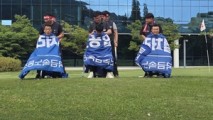
![Third-year students from Yeungjin University's Global Systems Convergence Department, who have received job offers from Japanese AI and IT companies, pose with department head Jeong Yeong-cheol (far right) in a classroom. [Yeungjin University]](https://wimg.heraldcorp.com/news/cms/2026/09/24/news-p.v1.20260924.a7bb952438624e2180fb1192c136c54d_P1.jpg)
The Global Systems Convergence Department at Yeungjin University is drawing attention for its strong job placement results in Japan's AI and IT sector, just as it prepares to send out its first graduating class.
According to the university, 14 of the 15 students from the department's inaugural graduating cohort who sought employment in Japan have secured job offers from Japanese AI and IT companies. The three-year program, established in 2014, is set to graduate its first class in February next year, with 17 students completing their studies.
Of the remaining graduates, one has confirmed domestic employment and another plans to transfer to a four-year university — meaning nearly every student who targeted Japan has locked in a position before graduation.
The results stand out not only in numbers but also in the caliber of employers. Eight of the 14 Japan-bound students — 57.1 percent — received offers from companies listed on the Tokyo Stock Exchange or from subsidiaries of listed financial groups.
The placements include one student at freee, a Japanese cloud accounting firm; one at AI company ExaWizards; two at Kiraboshi Bank; two at MIC; one at Members; and one at Aiful.
The department's curriculum is built around depth over breadth.
Each semester focuses on three to four core subjects, giving students ample time for coursework and projects. The program builds skills progressively — from Python fundamentals through machine learning, AI agents and LLM fine-tuning.
All year groups participate in capstone design projects, allowing students to build a portfolio of work each year. The department also offers intensive courses during school breaks and keeps its practice labs open around the clock to help students continuously strengthen their technical skills.
"We designed the curriculum by analyzing how Japanese companies recruit, so that students would have the right skills at the right time," said Jeong Yeong-cheol, head of the Global Systems Convergence Department.
He added that summer internships in the second year serve as a critical first gateway, particularly at major venture companies where internships frequently lead to full-time offers. "We connected major coursework, Japanese language study, project work and job preparation into a single flow so that students can reach that gateway within about a year of enrolling," he said.
kbj7653@heraldcorp.com