![Units 3 through 6 of the Hanbit Nuclear Power Plant in Yeonggwang, South Jeolla Province [Korea Hydro & Nuclear Power]](https://wimg.heraldcorp.com/news/cms/2026/09/23/news-p.v1.20260923.1ee0ab05a2e845d9a8ec5152011dfc7d_P1.jpg)
South Korea's prospects for entering the US nuclear power market are growing as the country pursues a plan to build eight large reactors in the United States as its second major investment project there. The two countries are reviewing a plan that would include six Westinghouse AP1000 reactors and two South Korean APR1400 units.
However, building South Korean-designed reactors in the United States would require paying Westinghouse around $2 billion per unit in technology licensing fees, nuclear fuel costs and related charges. Combined with the risk of construction delays driving up costs — a persistent feature of nuclear projects — and the challenge of securing a long-term skilled workforce, ensuring the project's commercial viability has emerged as the central concern.
The Ministry of Trade, Industry and Energy briefed the National Assembly on Tuesday on a "Korea-US nuclear framework" containing these details, according to political and government sources. The framework envisions building large reactors in the United States through a Korea-US investment fund and includes a proposal for South Korea to acquire a stake in Westinghouse, the American nuclear company.
The two countries are discussing a plan to build eight large reactors in the United States — six AP1000 units from Westinghouse and two APR1400 units of South Korean design. The door also remains open to building additional reactors beyond the initial eight. Under the terms being discussed, however, constructing the Korean-designed units in the United States would require separate payments to Westinghouse for technology fees, service costs and nuclear fuel. For two reactors, those costs alone could reach as much as $4 billion.
The arrangement stems from an agreement signed last year between Korea Hydro & Nuclear Power and Korea Electric Power Corporation with Westinghouse, which places restrictions on the two Korean firms winning new nuclear contracts in the United States. That agreement was also said to include conditions governing Korean nuclear companies' overseas expansion, premised on cooperation with Westinghouse. Korean nuclear firms are understood to have entered the agreement in order to use Westinghouse technology to pursue projects in parts of Europe, Asia and other regions.
Another variable is that if only two of the eight reactors are the Korean APR1400 design, the actual scale of business that South Korean companies secure in the US nuclear market could be limited. The government is also said to be in talks with the American side on a mechanism to recommend domestic Korean firms for participation in the US nuclear project.
Alongside the reactor construction plan, South Korea is in discussions with the United States on having Korean private-sector companies collectively acquire a 5 to 10 percent stake in Westinghouse, with a compromise around 7 percent seen as a possibility. However, given strong resistance from Westinghouse, whether an actual acquisition will materialize remains to be seen.
South Korea had originally sought not just a financial investment but meaningful influence, including board representation, while the American side is understood to prefer a non-voting minority stake. Observers noted that while the target remains a 5 to 10 percent stake, South Korea may not secure the right to nominate a board member.
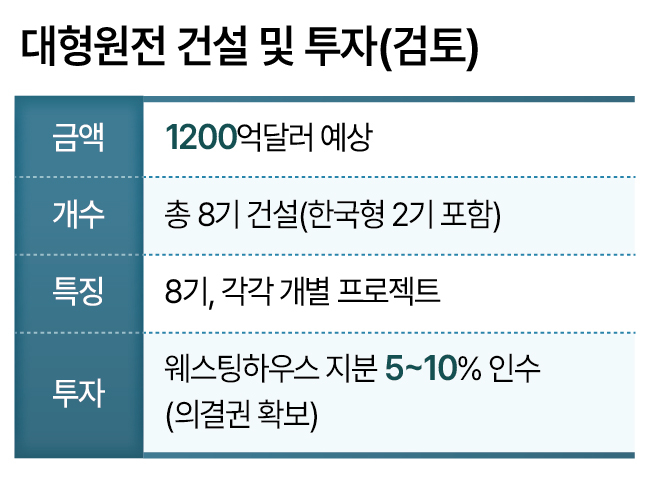
Each nuclear project will be assessed individually for investment viability rather than treated as a single bundled undertaking. The eight reactors will be evaluated as separate projects on their commercial merits, rather than grouped into one program — a reflection of the reality that nuclear projects in the United States proceed on a state-by-state basis, making uniform commercial conditions impossible.
Large nuclear power plant construction is, however, a long-term undertaking that typically takes around 13 years from licensing to completion, and is prone to unexpected setbacks such as sharp cost increases caused by permitting delays.
Westinghouse itself filed for bankruptcy protection in a US court in March 2017 after construction of AP1000 Vogtle Units 3 and 4 in Georgia ran over schedule and over budget. Toshiba, Westinghouse's parent company at the time, suffered losses exceeding 7 trillion won ($5.15 billion) as a result and was plunged into a management crisis. Only those two Vogtle units are currently operating AP1000 reactors in the United States.
The AP1000 was designed with modular construction methods intended to shorten build times, but first-of-a-kind construction challenges, supply chain delays and difficulties meeting licensing and regulatory requirements pushed the actual construction period to roughly 11 years — far beyond the original target of three to five years.
The nuclear industry also expects that securing construction workers in the United States will prove difficult, given competing demands from the Czech Republic nuclear project and the domestic push to build two additional large reactors under South Korea's 11th Basic Plan for Electricity Supply and Demand covering 2024 to 2038.
"The government manages Korea Hydro & Nuclear Power's headcount, so there is already a shortage of nuclear construction workers," an energy industry official said. "If construction in the United States is confirmed, the first priority will have to be expanding Korea Hydro & Nuclear Power's workforce."
oskymoon@heraldcorp.com