'Collective agreement takes precedence over work rules'
Union contract specifies phased deferral of wage-peak system
Hyundai Motor chapter highlights retirement age extension deal
'Blocks expansion of wage-peak scheme'
Union moves to set standard ahead of legislation
Business community warns work-rule relaxation has limits against collective agreements
![Members of the Korean Metal Workers' Union's automotive sector hold a joint strike rally in front of Hyundai Motor's headquarters in Seocho-gu, Seoul, on Aug. 21. The workers called on Hyundai Motor Group to extend the mandatory retirement age, raise parts supplier prices and open direct negotiations with the parent company. [Yonhap]](https://wimg.heraldcorp.com/news/cms/2026/09/23/rcv.YNA.20260821.PYH2026082109280001301_P1.jpg)
The Hyundai Motor union is billing "a retirement age extension without expanding the wage-peak system" as the biggest achievement of this year's wage and collective bargaining talks — and is claiming the deal has effectively neutralized a work-rule exemption that the business community had sought as a safeguard. Management is wary of the agreement hardening into an industry-wide precedent, but the union appears determined to lock it in as the benchmark for any future retirement age legislation.
According to industry sources, the Korean Metal Workers' Union's Hyundai Motor chapter said in a Wednesday newsletter that "one of the biggest achievements of this year's collective bargaining is the retirement age extension without expanding the wage-peak system." The union said the deal establishes a framework for protecting both employment and wages throughout the extended working period, even after a statutory retirement age extension is enacted.
Earlier, Hyundai Motor's labor and management included language in last month's collective bargaining agreement stating that "when the law is revised, the retirement age will be extended and the current wage-peak system will be applied on a phased, deferred basis." The point at which the wage-peak system kicks in will be pushed back in step with any increase in the retirement age. Under the current structure, pegged to a retirement age of 60, base pay is frozen at age 59 and cut by 10 percent at age 60.
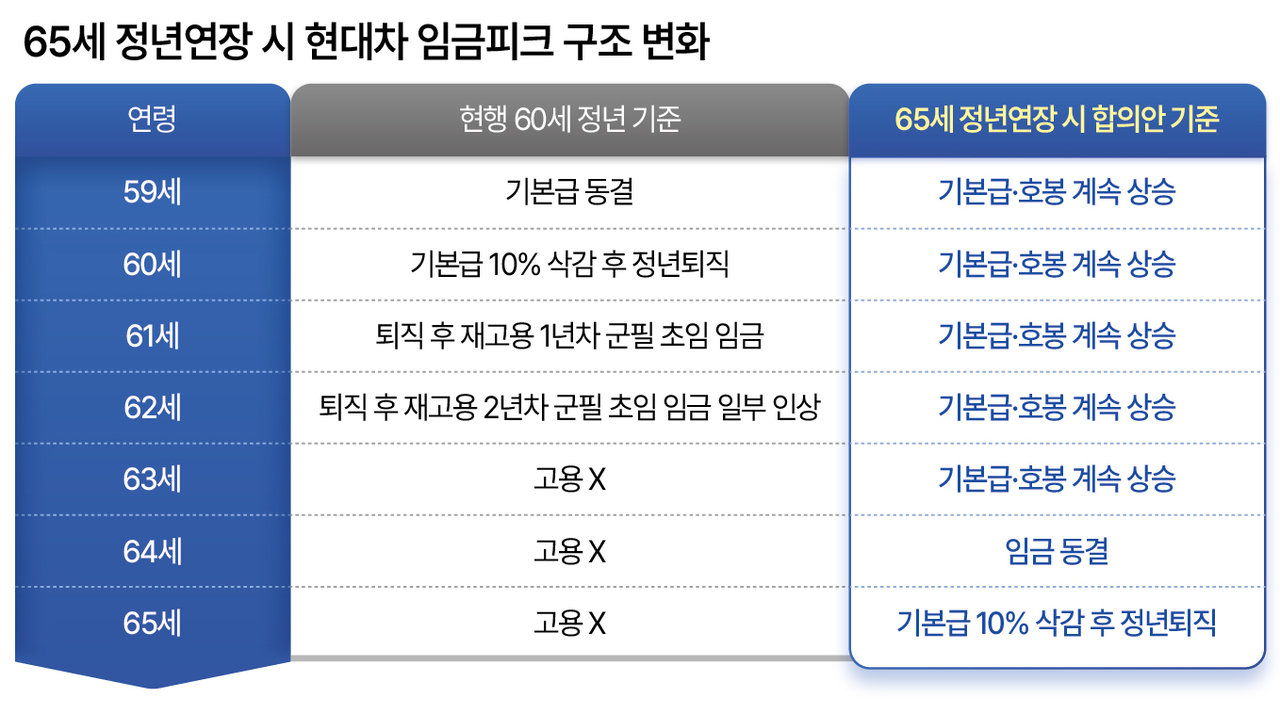
The union says the agreement creates a mechanism to prevent that outcome. The intent is to defer the wage-peak trigger in line with each incremental rise in the retirement age, blocking pay cuts from applying across the entire span of additional working years.
As a result, even if the statutory retirement age eventually rises to 65, workers would retain some room for wage growth during the years beyond the current retirement threshold. The union described this as a "normal retirement age extension" and said it brings closer "a workplace where members can continue building on their skills without an income gap after the current retirement age."
At issue is the practical effect of a work-rule exemption being debated in the National Assembly. The Democratic Party of Korea's special committee on retirement age extension is reviewing a plan to ease the procedural requirements for changing work rules — but only for employees covered by the retirement age extension — alongside a phased increase in the mandatory retirement age.
Under current law, changes to working conditions unfavorable to employees — such as pay or working hours — require the consent of the union or a majority of workers. The proposal would lower that bar to a simple consultation, making it easier for companies to adjust the wage structure and working hours for the extended retirement period.
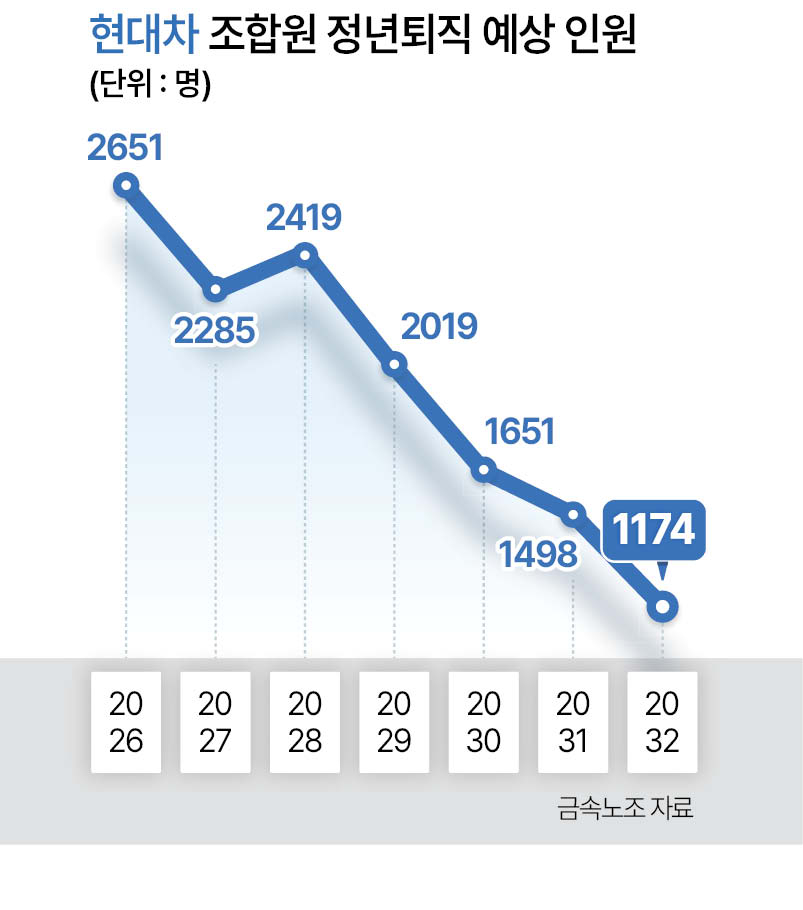
The exemption is also a key safeguard the business community has been pushing for. Corporate groups have argued that extending the retirement age without any wage adjustment mechanism would increase the burden of retaining highly paid older workers, potentially crowding out youth hiring and investment.
The Hyundai Motor union said the labor-management agreement has in effect stripped the work-rule exemption of its force. The union described the provision as "a clause that would let the company do as it pleases by changing work rules even when the retirement age is extended."
The union added that because the collective agreement explicitly requires the phased deferral of the wage-peak system upon any retirement age extension, pushing through an expansion of the wage-peak scheme through work-rule changes alone would be difficult.
Under the Labor Standards Act, work rules cannot override a collective agreement. The hierarchy of norms governing working conditions runs from statutes to collective agreements to work rules and finally to individual employment contracts.
![Ryu Ki-seop, secretary-general of the Federation of Korean Trade Unions, delivers opening remarks at a National Assembly forum on key issues and legislative directions for extending the statutory retirement age to 65, held Wednesday morning at the National Assembly Members' Office Building in Yeouido, Seoul. [Yun Chang-bin]](https://wimg.heraldcorp.com/news/cms/2026/09/23/9/news-p.v1.20260623.496d3ce4fbc74e9d8d6ca250f91ed276_P1.jpg)
The "retirement age extension without wage-peak expansion" language the Hyundai Motor union secured could therefore serve as a powerful bargaining chip when legislation moves forward. Even if the law opens some avenue for restructuring the wage system, a union holding firm behind its collective agreement on the shop floor would make it difficult for management to unilaterally adjust pay.
"There is effectively no way to override a collective agreement," a business community official said. "From a company's perspective, easing the work-rule change procedure is almost the only card available — but even that is hard to play when a collective agreement is standing in the way."
The push for a higher retirement age is spreading to other unions. The Kia union held a press conference in front of the National Assembly on Sept. 7, urging legislation to link the retirement age to the national pension eligibility age. The union said the Democratic Party's phased extension plan was premised on workers born in the 1960s already having retired, and called for immediate legislation.
Within the industry, there is growing unease that the Hyundai Motor deal could solidify into a sector-wide standard — one that other companies would feel compelled to follow simply because Hyundai Motor had done so.
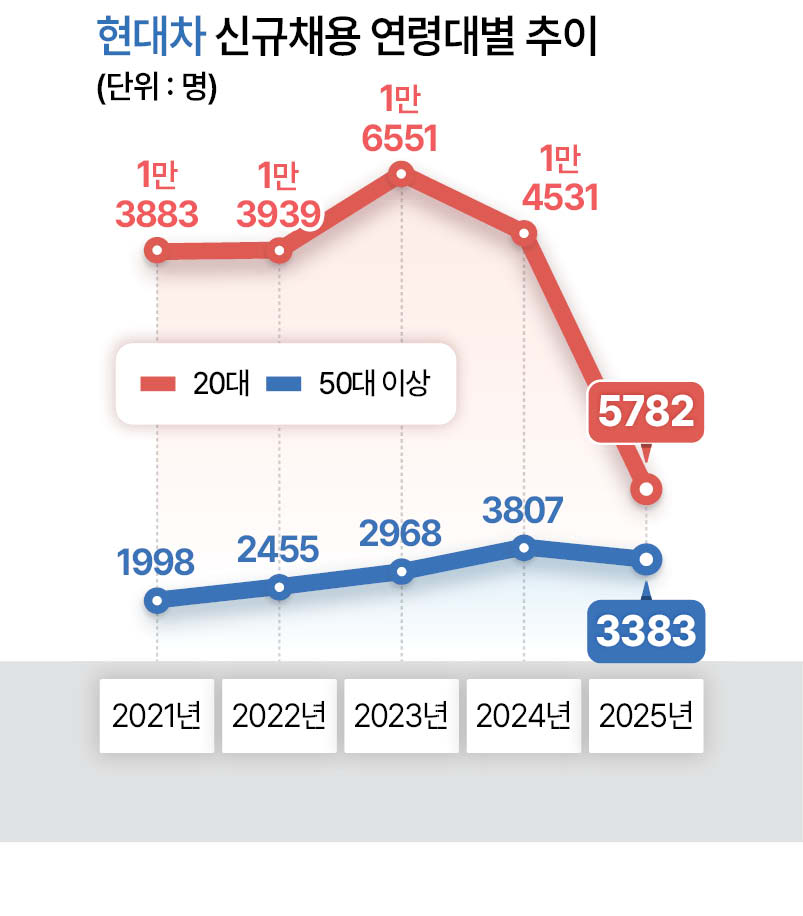
There are also concerns that if a retirement age extension without wage cuts is actually implemented, companies will seek other ways to manage costs — potentially triggering a fresh round of labor-management conflict.
Park Ji-soon, a professor at Korea University School of Law, said the union had "hammered in a nail in advance," and predicted that companies would likely look to offset the cost burden through alternatives to expanding the wage-peak system — such as introducing job-based pay, reassigning older workers to different roles, adjusting working hours or offering voluntary retirement packages.
One scenario would involve reducing the working hours of older employees rather than keeping them on existing production lines, or reassigning them to roles focused on passing their skills on to younger colleagues. "Even if companies accept the labor camp's position of uniformly extending the retirement age, they can seek a soft landing through job changes and adjustments to working conditions — or, if that proves impossible, offer voluntary retirement," Park said. "Another round of restructuring could follow."
While job changes and reassignments may fall within management's personnel authority, analysts note that if unions interpret such moves as a backdoor way of applying the wage-peak system, the dispute could escalate into a second-round conflict in the wake of any retirement age extension.
kwater@heraldcorp.com