System lets officials compare quarantine measures before acting
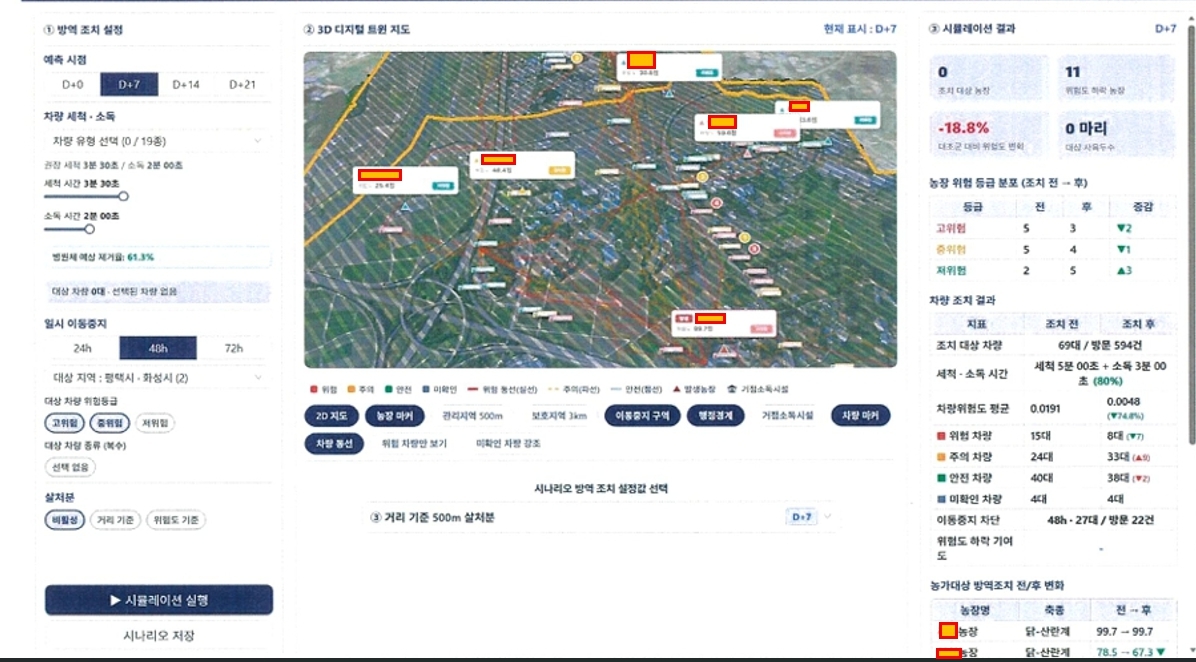
Gyeonggi Province is building a system that uses an AI model to calculate real-time risk changes at nearby poultry farms based on inputs such as vehicle visit records, disinfection times and distance from farms where highly pathogenic avian influenza has been detected. The system is expected to provide significant support for quarantine decision-making, including the designation of containment zones.
According to the province Wednesday, it is developing a "digital twin-based decision support system for highly pathogenic avian influenza control in poultry-dense complexes" — a platform that uses AI and digital twin technology to replicate actual quarantine sites in a virtual environment for use in avian influenza response.
The project is part of the Ministry of Science and ICT and the National Information Society Agency (NIA)'s "2026 AI-based digital twin initiative for safety management." Digital twin technology refers to the creation of identical three-dimensional virtual models of real-world objects and spaces.
Gyeonggi Province is participating as a pilot region, building a system that integrates data on poultry farms, vehicle movements, quarantine operations and migratory bird activity in the pilot area near the Namyang Bay migratory bird habitat in Hwaseong and Pyeongtaek. The system recreates actual poultry farms, vehicles and quarantine facilities in a virtual space.
Beyond simple risk analysis, the system will incorporate drone footage of the pilot sites to simulate highly pathogenic avian influenza outbreaks in the virtual environment. It will then apply various quarantine measures — including vehicle movement restrictions, disinfection and enhanced biosecurity — and run simulations to compare how disease spreads under each scenario.
Quarantine officials are expected to use the platform to review multiple response scenarios before an actual livestock disease outbreak occurs, giving them the scientific basis and decision-making information needed to select appropriate containment measures.
The province plans to complete the system by the end of this month and conduct field verification during the winter special quarantine period. It will also explore the possibility of linking the system with the Animal and Plant Quarantine Agency for use as a national livestock disease decision-support framework.
In connection with the project, the province held a progress meeting at the Gyeonggi Provincial Government building on Friday to review the current status of the system's development in the Hwaseong and Pyeongtaek pilot areas and discuss improvements.
The meeting was attended by representatives from Gyeonggi Province, the Animal and Plant Quarantine Agency, the cities of Hwaseong and Pyeongtaek, Miso IT, Main IT, BigValue, the College of Veterinary Medicine at Chonnam National University, and Banseok LTC, along with other project partners and advisory bodies.
"Using AI and digital twin technology, we can replicate actual quarantine sites in a virtual environment and compare the effectiveness of various measures in advance," said Lee Eun-kyung, head of the animal quarantine and hygiene division. "We will do our utmost to build the system and verify it in the field so that we can support scientific and preemptive livestock disease decision-making to minimize the spread of any outbreak."
pjh@heraldcorp.com