Police agency cites heavier workload from revised espionage law, disbanding of defense counterintelligence unit

"Like it or not, the police are now the only ones left to handle security investigations."
That is how one security police officer described the shifting landscape of national security investigations — a shift driven by a rapid series of institutional changes. When the Defense Counterintelligence Command was disbanded in August, some of the cases it had handled, including violations of the Military Secrets Protection Act involving civilians, were transferred to the police. Earlier, in January 2024, the National Intelligence Service lost its counterintelligence investigation authority, leaving the police solely responsible for such probes while the NIS was reduced to providing intelligence support. Then, on Saturday, an amended espionage statute — Article 98-2 of the Criminal Act — took effect, criminalizing the detection and collection of state secrets on behalf of foreign governments or intelligence agencies. For the first time since the Criminal Act was enacted in 1953, the scope of the espionage law expanded from "enemy states" to "foreign states and organizations equivalent thereto," meaning spy activities conducted on behalf of countries other than North Korea can now be prosecuted. The investigative burden from that expansion is expected to fall squarely on the police.
On top of counterintelligence and counterespionage work, investigations into economic security crimes are also expected to grow. Police say they can apply the existing Industrial Technology Protection Act to technology-theft cases driven by corporate interests, while the amended espionage law can be invoked when a foreign government is involved. The number of technology-theft cases police handled reached 179 last year, more than double the 89 recorded in 2021.
The Korean National Police Agency said Tuesday that the combination of the amended espionage law and the disbanding of the Defense Counterintelligence Command will increase its security investigation workload. In a written response submitted to the office of Democratic Party of Korea lawmaker Yun Geon-young of the National Assembly's Public Administration and Security Committee, the agency said the Defense Counterintelligence Command had been able to investigate civilians implicated in military-related crimes, but the Ministry of National Defense Investigation Headquarters — which inherited those functions — is limited to investigating military personnel and civilian employees of the military. "Taking this into account, we expect the police's security investigation workload to increase following the implementation of the amended espionage law," the agency said.
Revised espionage law long sought — but police now effectively the sole investigative body
A presidential decree on counterintelligence operations designates the NIS, the Korean National Police Agency, the Korea Coast Guard, the Ministry of Justice, the Korea Customs Service, the Intellectual Property Office and the Defense Counterintelligence Headquarters as counterintelligence agencies. Of these, the police are in effect the only agency with a standing organization capable of directly investigating foreign espionage cases.
The NIS serves as the top deliberative body on national counterintelligence but lost its investigation authority in January 2024, retaining only an inquiry function, and now plays a supporting role by feeding intelligence to the police. The Defense Counterintelligence Headquarters, established when the Defense Counterintelligence Command was disbanded in August, handles only military-related counterintelligence activities, while investigations are handled separately by the Defense Ministry Investigation Headquarters. The Korea Coast Guard, the Korea Customs Service and the Ministry of Justice exercise only limited investigative authority within their respective jurisdictions — maritime, customs and immigration matters.
The Serious Crimes Investigation Agency, set to launch in October, will also have jurisdiction over espionage as a state-protection offense. The Defense Ministry Investigation Headquarters can investigate espionage cases involving military personnel and civilian military employees. However, observers say both agencies have limited capacity to absorb the full demand for foreign espionage investigations.
The new agency also faces the challenge of being a brand-new organization, and stabilizing it may take considerable time. A former security police officer said it remains to be seen whether the agency will be capable of investigating sophisticated espionage cases involving foreign intelligence services from the moment it opens its doors.
The Defense Ministry Investigation Headquarters can investigate military personnel recruited by foreign entities to leak military secrets, but it faces difficulty directly investigating civilians implicated in the same cases. As a result, civilian suspects in military-related espionage cases are also expected to fall under police jurisdiction.
Having already become the sole counterintelligence investigation agency after the NIS lost its authority, the police are now also responsible for investigating espionage conducted on behalf of foreign states under the amended law.
Police become last line of defense on security — but budget stagnates and experienced officers are scarce
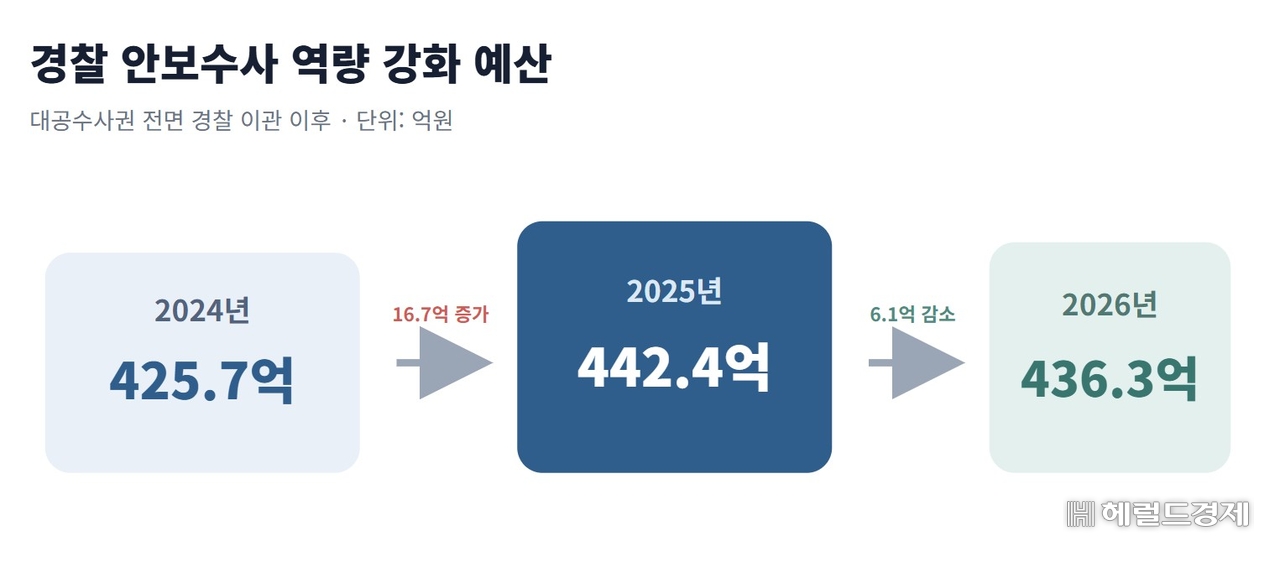
According to documents the Korean National Police Agency submitted to the National Assembly, the agency has requested 44.68 billion won ($32.3 million) in next year's budget to strengthen security investigation capabilities — an increase of 1.04 billion won over this year's allocation. The requested increase covers technology-theft tip rewards, consumable surveillance equipment for security investigations and the cost of building a data-leak prevention system. Even if the full request is approved, however, the total would only marginally exceed last year's budget of 44.2 billion won by about 400 million won — in effect merely restoring the budget to last year's level after this year's cut.
The police have also included a plan to add 25 counterintelligence investigators in their staffing request. The new personnel are to be assigned first to provincial and metropolitan police agencies where demand for counterintelligence work is expected to be high — areas with concentrations of foreign diplomatic missions, military bases, major corporations and research institutes, or large registered foreign populations. Separately, the police have also requested 44 additional security investigators to handle industrial technology theft cases.
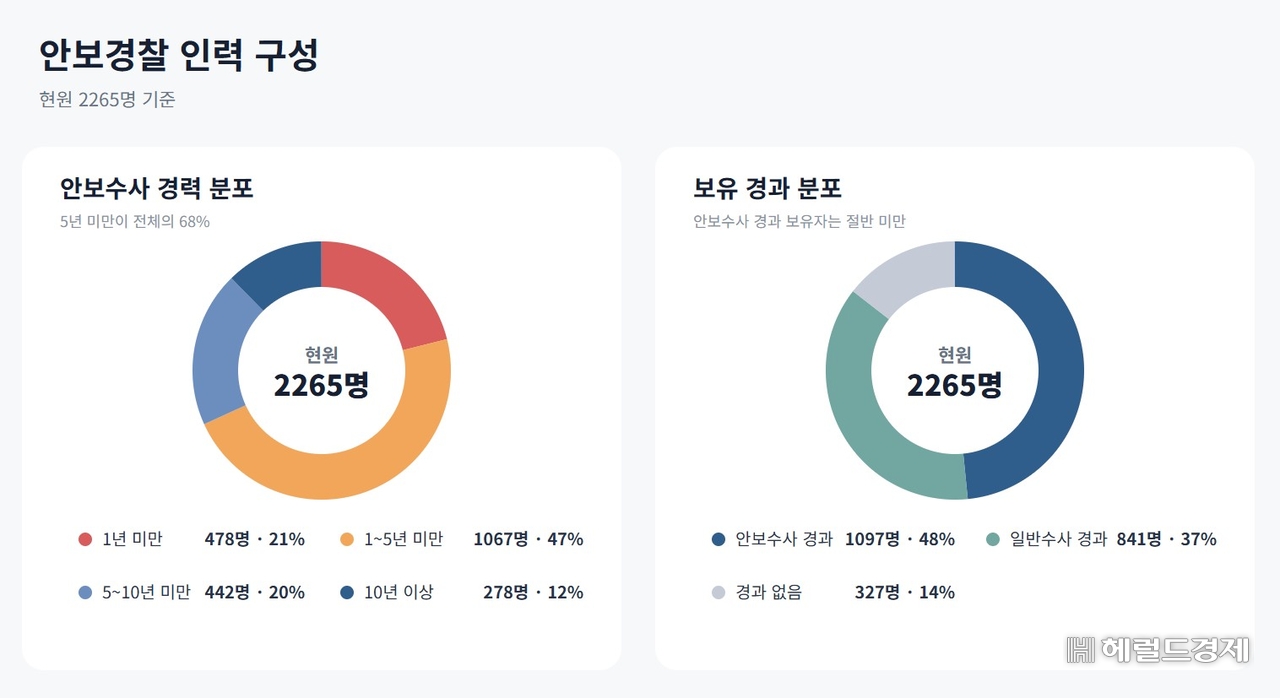
Despite these requests, security police — who handle counterintelligence, industrial technology, terrorism and counterespionage investigations — have fallen short of their authorized strength for three consecutive years since the full transfer of counterintelligence authority to the police in 2024. As of June, the force had 2,265 security officers against an authorized strength of 2,315, a shortfall of 50. That is actually 20 fewer than the 2,285 on the force in 2024. The workload has grown, but staffing has not even recovered to the level of two years ago.
Even the requested increases must clear a review process, leaving their approval uncertain. "With the focus this year on responding to everyday crime, we've been redirecting personnel to general investigation units, and I'm not sure we have the capacity to secure additional security investigators on top of that," a police official said.
'The work keeps coming — the support stays the same'
Under the previous version of Article 98 of the Criminal Act, only those who spied for an "enemy state" or aided an enemy state's spies could be prosecuted. Because North Korea is treated under the Constitution as an anti-state organization rather than a state, espionage cases involving North Korea have been handled primarily under Article 4 of the National Security Act. Spy activities conducted on behalf of other foreign countries — such as China or Russia — had to be prosecuted under separate statutes such as the Military Secrets Protection Act or the offense of leaking diplomatic secrets. If the conduct did not meet the elements of those laws, the leaking of state secrets or core national technologies could go unpunished.
Expanding the scope of the espionage law had therefore long been a goal of security agencies. After the National Assembly passed the amendment in February, the NIS issued a statement welcoming the change. "We welcome the establishment of an institutional foundation that will allow us to protect national security and the national interest against increasingly sophisticated espionage by foreign states," it said, pledging to "do everything in our power, from intelligence collection to judicial action by investigative agencies."
Within the police, however, there is growing frustration that the force has taken on cases previously handled by the NIS and then the Defense Counterintelligence Command without receiving commensurate support. "The work from agencies that no longer investigate keeps flowing to the police, but the budget and infrastructure are not following," one police official said. "The police are left having to secure the resources they need on their own, under inadequate conditions."
The official added: "The door has been opened to prosecuting foreign spies, but under the current structure the police's role and responsibility will inevitably grow. Like it or not, if the police are expected to do this well, the support has to be there to match."
arin@heraldcorp.com