Panel discusses regional investment corporations, transport networks
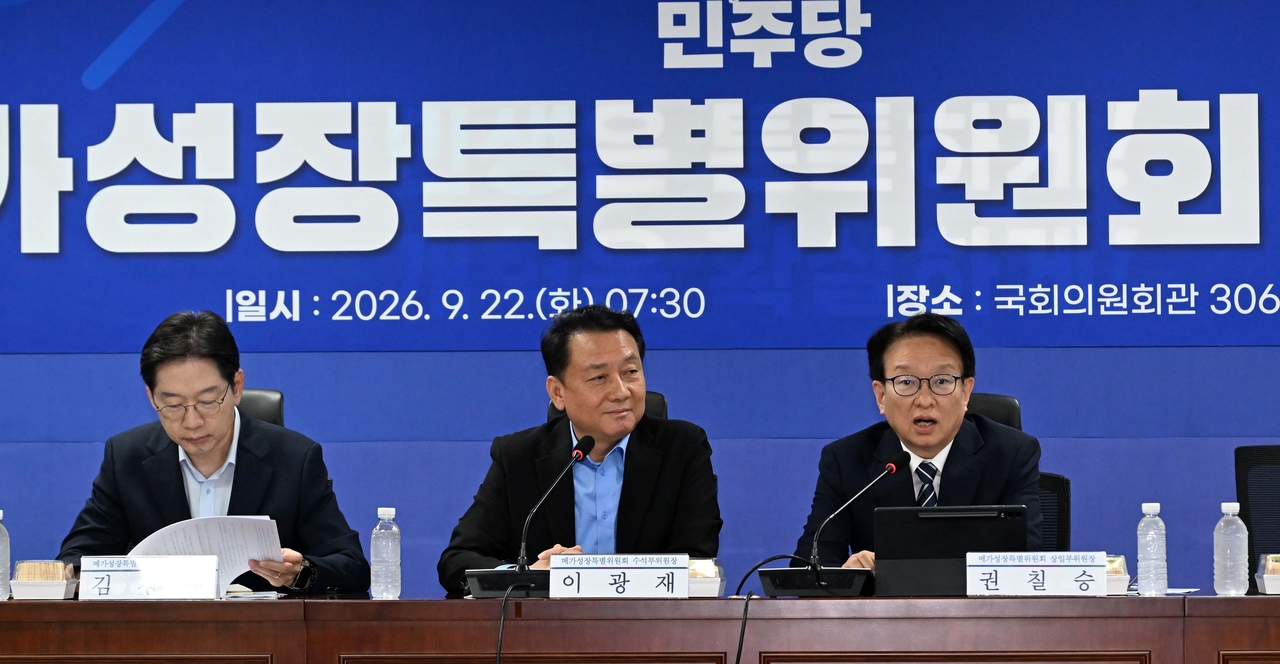
The Democratic Party of Korea said Tuesday it would build consensus during the upcoming national audit period on the government's mega-project initiative and push to deliver concrete results through budgetary and legislative action before the end of the year. Among the specific proposals discussed were the establishment of regional investment corporations in each zone and a "triple helix" industry-academia-government cooperation model linking universities, businesses and local governments.
At a workshop of the party's Special Committee on Mega-Growth held at the National Assembly members' office building, Standing Vice Chairman Kwon Chil-seung said the committee's goal was "to build a sustainable industrial ecosystem in which regions can devise their own growth strategies and grow on their own." He added that "the core and the direction of the mega-growth strategy is not merely sharing the fruits of growth, but creating the very capacity to grow in communities across the country."
Kwon said infrastructure to underpin regional growth was essential. "We need not only industrial infrastructure so that companies can invest and talent can stay, but also living conditions — housing, education and culture," he said. "Legislative, fiscal and regulatory reform to support all of this must move in tandem. Transforming the country into a true era of balanced national development is the defining challenge of our time."
Kim Kyung-soo, also a standing vice chairman of the committee, said the panel must play a role in ensuring that "institutional, budgetary and legislative support for opening a new chapter of national growth from the regions can take root in the National Assembly."
Kim added that with the merger of the mega-project initiative and the balanced-growth committee, the existing "five poles, three special zones" policy also needed to be addressed. "I believe the committee has been given the role of ensuring, at the Assembly level, that the ultra-strong regional development plans and agreements that must be advanced in the second half of the year proceed smoothly on the government side as well," he said.
Senior Vice Chairman Lee Gwang-jae said the mega-project's core mission was "to find new answers to the fundamental question of why the regions are on the verge of withering." He pledged that the committee would "build consensus during the national audit and press hard to produce major results through the budget and legislation before the year is out."
Committee Spokesperson Park Kyung-mi told reporters after a closed-door session that members had discussed at length how central and local governments — both metropolitan and basic — should divide administrative and fiscal responsibilities in order to build growth capacity across multiple regions.
She said the group had also discussed, at the planning level, a university-industry-government cooperation framework as a foundational principle for regional development. "A proposal to establish regional investment corporations in each zone to create a capital ecosystem for the success of the mega-projects is also at the discussion stage," she said.
Park added that members had raised the idea of combining local governments' policy development capacity with the research capabilities of national research institutes. She noted that building transport networks — including rail — was raised as a common priority across all regions.
addressh@heraldcorp.com