111th Busan Future Economy Forum focuses on city's AI transition
7 SEED Projects aim to link regional industries with AI innovation
Soft power sectors — media, tourism, arts — to merge with AI
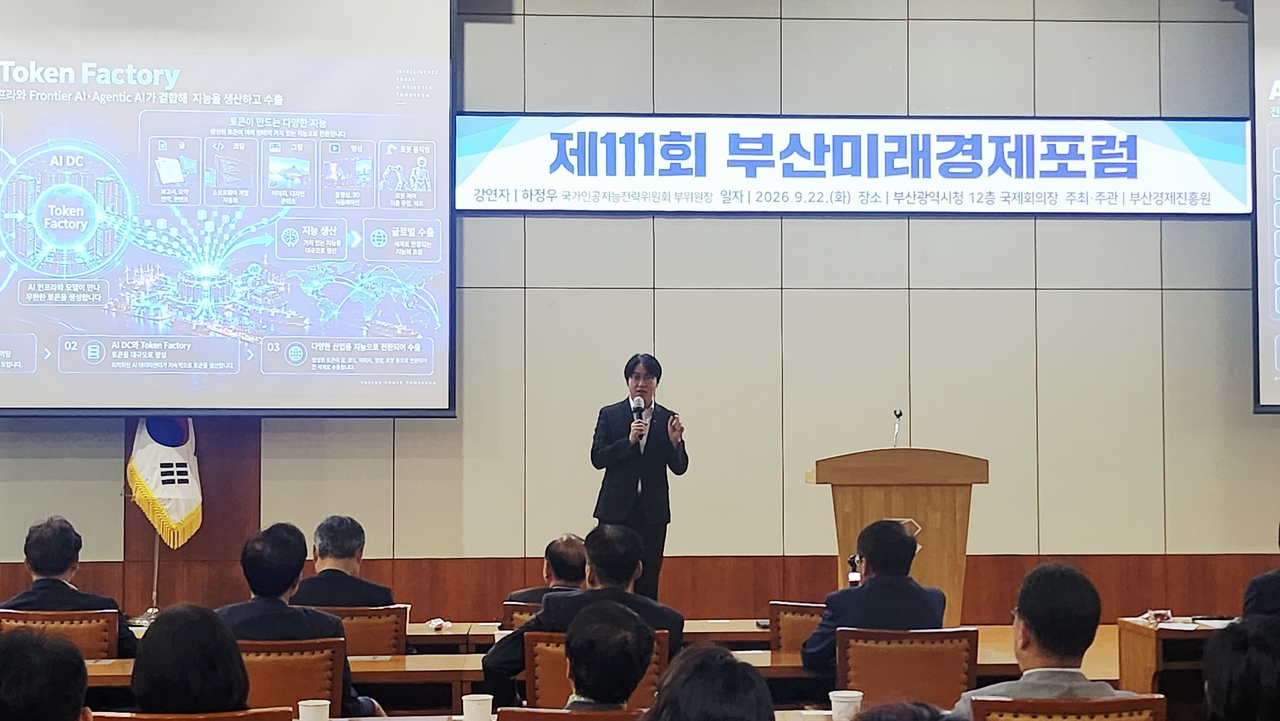
Ha Jung-woo, vice chairman of the National AI Strategy Committee, delivered a lecture Tuesday morning at the 111th Busan Future Economy Forum, held at the city hall international conference hall.
Speaking at the forum, jointly organized by the Busan city government and the Busan Economic Promotion Agency, Ha presented on the theme of "Busan's AI Transition." About 300 people attended, including Busan Mayor Jeon Jae-soo, city officials, heads of public institutions, university presidents and business leaders from the region.
The Busan Future Economy Forum is a monthly study group launched in 2015 that invites prominent figures to discuss domestic and international economic and social trends, diagnose key issues facing the Busan economy, and develop policy alternatives.
This session was organized to discuss a future vision and action plan for Busan to develop into a new AI growth hub for South Korea and a global AI city — one that connects the maritime, manufacturing and content sectors with artificial intelligence.
Ha outlined the national AI strategy, three major mega-projects, and the direction of the seven SEED Projects, which are designed to link regional industries and innovation capabilities through AI. The seven SEED Projects are a national initiative to nurture advanced technologies — identified as core assets for the economy and national security — into future growth engines for South Korea.
Ha laid out a path for Busan to leverage its strengths in the maritime, port and logistics sectors alongside AI to emerge as a global maritime AI capital, and presented a strategy for the city to become the AI transformation brain for the broader Busan-Ulsan-South Gyeongnam industrial corridor. He also assessed the potential for Busan to rise as the leading city of southern South Korea by fusing AI with the city's soft power assets in media, content, tourism and the arts.
"Busan is seeing a sharp decline in its youth population while aging is accelerating," Ha said. "The reason young people are leaving at an increasing rate is the lack of high-value-added jobs and anchor companies." He added that while major shipping conglomerates such as HMM are relocating to the city, Busan must go further by adopting the AI transformation of shipping, port and logistics as its core growth strategy.
Mayor Jeon said the city must graft AI onto Busan's identity as a maritime capital to create new growth engines capable of competing not just within South Korea but on the global stage. "Through this forum, we will think together about the direction of Busan's AI transition and focus all of the city's administrative capacity on completing Busan as the maritime capital," he said.
kaf2002@heraldcorp.com