Employees pitch AI solutions to real workplace problems
Photo booths, K-pop robot and signing session add festival feel
Record 923 participants; 2,732 have taken part over five years
About 30 hackathon ideas already in use at worksites
Seven fully deployed, including AI safety platform AIR
'Goal is to redesign inefficient offline work through AI'
![Participants pose for a group photo at the fifth GS Group Hackathon, held Monday at the Westin Seoul Parnas in Gangnam-gu, Seoul. [GS]](https://wimg.heraldcorp.com/news/cms/2026/09/22/news-p.v1.20260922.88707c40fb764778890d4e57f66d0369_P1.jpg)
Some 468 GS Group employees dressed in baseball-style uniforms gathered Monday at the Westin Seoul Parnas in Gangnam-gu for the fifth GS Group Hackathon, spending the day deep in AI solution development.
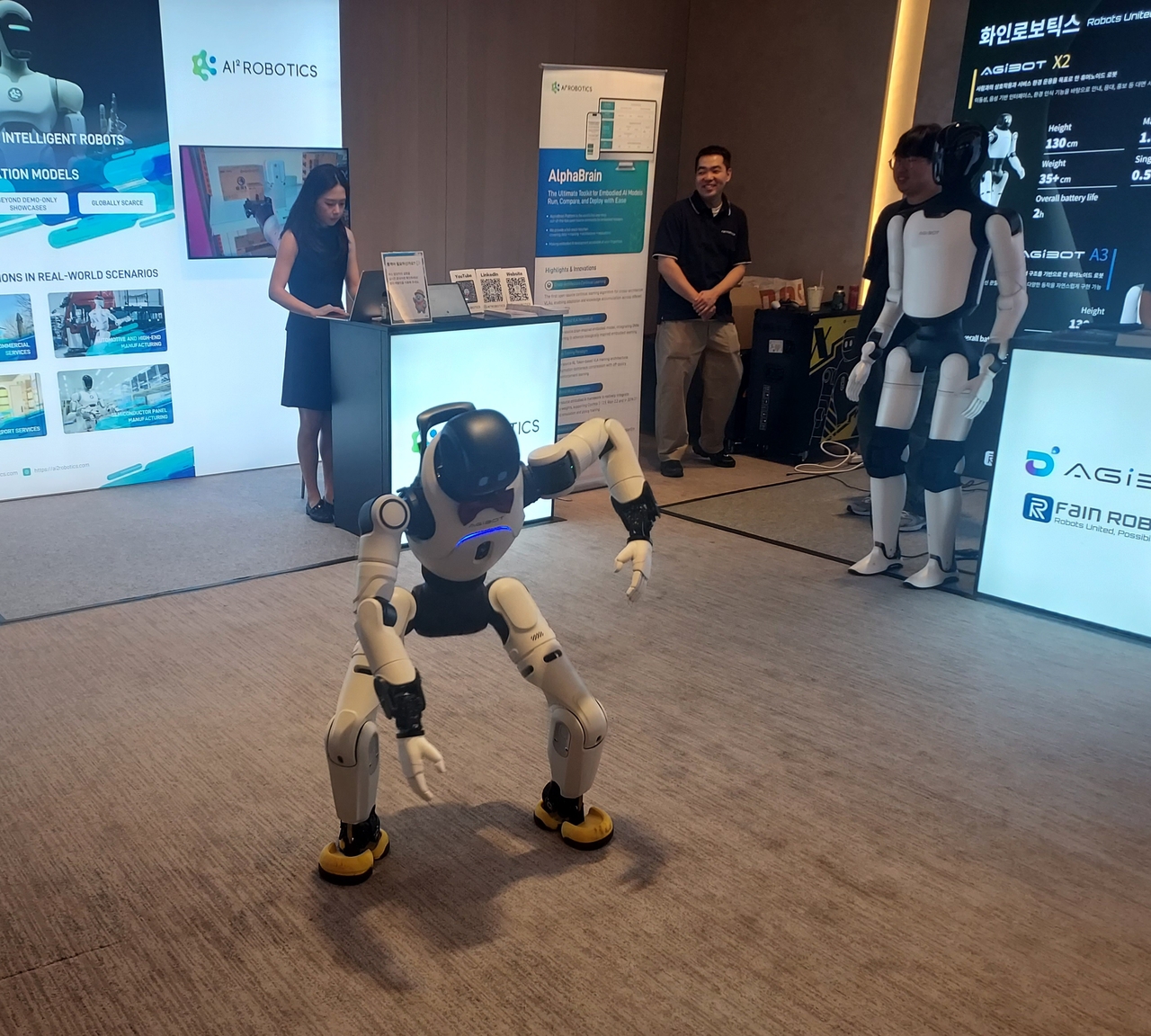
The event looked nothing like a typical stiff corporate AI competition. A photo-booth machine drew a steady stream of participants, while a robot performed K-pop idol dance routines nearby. GS Caltex's KIXX women's volleyball team held an autograph session that had employees lining up to meet the players. Those who needed a break from coding stepped outside to camping chairs, where they ate ramyun by the Han River. The setup was designed to let staff focus on AI development without feeling pressured.
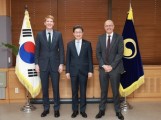
GS Group Chairman Heo Tae-soo and GS Caltex Vice Chairman Heo Se-hong attended the event, encouraging employees and asking questions such as how they planned to apply their coding skills. They also visited booths run by participating companies — Amazon Web Services, OpenAI and Hwain Robotics — to ask about the latest technology trends.
The hackathon is an annual event where GS Group employees pitch AI-powered ideas to solve real problems inside the company. The two-day event, which runs through Tuesday, is expected to draw a total of 923 participants — 797 from GS affiliates and 126 from outside the group — the largest turnout in the event's history. Cumulative participation over the past five years stands at 2,732.
Kim Jin-a, the GS senior managing director who organized the event, said the company pays close attention not just to the ideas employees propose but to the problems they identify. "The agenda that comes up most often at the hackathon is safety," she said, adding that safety workers were spending so much time on paperwork that they had little time to visit actual worksites. Executives are now discussing how to address that problem, she said.
This year's theme is "Play with GenAI Season 3: Build & Act" — a signal that the hackathon aims to go beyond idea generation. "Build" means producing AI tools that actually work; "Act" means connecting those tools to real operations and business sites. To help participants, GS provided AI-ready data that AI systems could use on the spot.
![GS Group Chairman Heo Tae-soo (center) and GS Caltex Vice Chairman Heo Se-hong (third from left) encourage employees at the fifth GS Group Hackathon, held Monday at the Westin Seoul Parnas. [GS]](https://wimg.heraldcorp.com/news/cms/2026/09/22/news-p.v1.20260921.ff9dc81838dd433d9bcff88b367329bb_P1.jpg)
Kim said there is broad internal consensus that hackathon experiments play an important role in driving change on the ground. "We felt the pace of moving from experiment to real-world application needed to pick up, which is why we chose 'Build & Act' as the theme," she said.
About 30 ideas generated through GS hackathons are already being applied at worksites, seven of them fully deployed. The standout example is AIR (AI Risk Assessment), proposed by GS Power employees at the third hackathon. AIR takes a task name and a brief description as inputs and automatically identifies potential hazards, assigns risk ratings and suggests preventive safety measures. The platform is now in use at more than 330 worksites across GS and beyond. A real-time temperature and humidity monitoring alert system being introduced by GS Power, and an AI-based design risk inspection tool at GS Retail, also trace their origins to hackathon proposals.
"As the AIR case shows, we are entering an era where employees on the ground can solve problems directly through AI," Kim said. "Starting this year, helping more programs reach actual worksites is our main goal."
![GS Senior Managing Director Kim Jin-a answers reporters' questions at the fifth GS Group Hackathon, held Monday at the Westin Seoul Parnas. [GS]](https://wimg.heraldcorp.com/news/cms/2026/09/22/news-p.v1.20260922.f7acd08ab8554f2aa0b5640dc6ddbabb_P2.jpg)
Underpinning employees' ability to build AI programs with relative ease is Miso, GS Group's in-house AI transformation platform. Used at the hackathon itself, Miso is designed to help staff create AI-related tools without specialized expertise. Kim said employees have used the platform to attempt development of more than 20,000 AI programs.
"GS aims to redesign offline work processes through AI," she said. "Certain tasks may be delegated to AI, but that does not mean employees are being replaced." She added that because frontline workers carry heavy workloads, AI handles inefficient tasks on their behalf.
yeongdai@heraldcorp.com