Ministry of Trade, Industry and Energy unveils battery industry technology roadmap
Plan centers on domestic production and process innovation
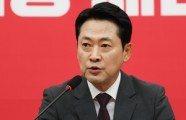
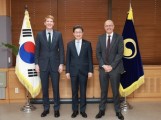
![Lee Min-woo (second from left), director general of the industrial growth division at the Ministry of Trade, Industry and Energy [The Herald Business DB]](https://wimg.heraldcorp.com/news/cms/2026/09/22/news-p.v1.20260901.deda8554224744039874b4b2ec6ac64f_P1.jpg)
The government will create a new 400 billion won ($289 million) research and development program to accelerate the commercialization of sodium-ion batteries and all-solid-state batteries, two next-generation technologies seen as critical to the industry's future. Domestic battery companies have also pledged to invest about 8 trillion won in R&D and equipment by 2030. The plan reflects a two-track strategy to defend South Korean battery makers against slowing electric vehicle demand and a low-cost offensive from Chinese rivals — competing in the affordable mass market with sodium batteries while targeting high-performance applications with all-solid-state technology.
South Korea's Ministry of Trade, Industry and Energy unveiled the battery industry technology roadmap Tuesday at a meeting held at the Korea Chamber of Commerce and Industry in Seoul, attended by representatives from LG Energy Solution, Samsung SDI, SK On, Posco Future M, L&F, Ecopro BM and other industry and related organizations.
The roadmap prioritizes two battery types: sodium-ion for the mass market and all-solid-state for high-performance applications. Sodium batteries offer cost advantages over lithium-based cells and carry lower supply chain risk, prompting the government to concentrate commercialization funding there. In parallel, the plan calls for developing all-solid-state batteries with maximized energy density and safety to open new markets for robots, drones and urban air mobility vehicles.
The roadmap also establishes a framework to reduce duplicated investment among companies and speed development from materials to finished products. The three domestic cell makers will be encouraged to conduct joint research in non-competitive areas, while materials companies and cell manufacturers will pursue collaborative R&D to ensure that newly developed materials reach actual products.
In process innovation, investment will go toward low-carbon and energy-efficient manufacturing technologies — including dry-electrode processes and waste-heat recovery — as well as the development of advanced equipment.
Companies plan to invest a combined 7.93 trillion won by 2030, broken down as follows: 156.5 billion won for circular materials development, 4 trillion won for domestic production, 2.76 trillion won for process innovation, 589.6 billion won for materials diversification and 430 billion won for materials localization.
Of that total, 6.76 trillion won — roughly 85 percent — is earmarked for domestic production and process innovation, underscoring that a large share of private investment is aimed at cutting manufacturing costs and strengthening the competitiveness of South Korean production facilities, not just securing next-generation technology.
Companies also plan to diversify their materials mix by developing mid-nickel and lithium manganese-rich cathodes, and to invest in next-generation core materials where South Korea remains heavily import-dependent, including precursors, anode materials and lithium sulfide.
To stimulate domestic production, the government will introduce a production tax credit and plans to incorporate assessments of domestic industry contributions — such as supply chain stability, job creation and rapid-response capability — into the competitive bidding process for battery energy storage systems on the central contract market.
The roadmap also calls for building a circular battery ecosystem to meet tightening environmental regulations in the EU and other major markets. The government plans to align South Korea's used-battery recycling standards with EU requirements to encourage corporate investment in recycling. The EU has set targets requiring recycled content ratios of 16 percent for cobalt, 6 percent for lithium and 6 percent for nickel by 2031.
"To respond to a global market being reshaped around price competition and growing supply chain uncertainty, the public and private sectors must act as one team with a strategy of focus and prioritization," said Lee Min-woo, director general of the industrial growth division at the Ministry of Trade, Industry and Energy. "We will provide full support — through large-scale R&D funding and institutional incentives — to ensure that K-battery firmly reclaims leadership in the global market."
oskymoon@heraldcorp.com