FVI reaches long-term average of 46.5 in Q2
Household credit surpasses 2,000 trillion won
Housing loans, other lending accelerate sharply
BOK chief: higher rates would bring index down
South Korea's Financial Vulnerability Index, a gauge of medium- to long-term financial imbalances, rose for the ninth consecutive quarter as household debt climbed sharply on home purchases and leveraged stock investments. The index has now reached its long-term average, prompting warnings that household credit growth is outpacing the country's economic fundamentals.
The Bank of Korea said Tuesday the FVI stood at 46.5 in the second quarter of this year, up 0.8 points from the previous quarter's 45.7, according to its September Financial Stability Report. The index has risen for nine straight quarters since the first quarter of 2024, when it stood at 37.6, and has now matched the long-term average of 46.5 — calculated from the first quarter of 2008 through the second quarter of this year. The FVI is a composite of 64 indicators across three categories: credit, asset prices and financial institution resilience.
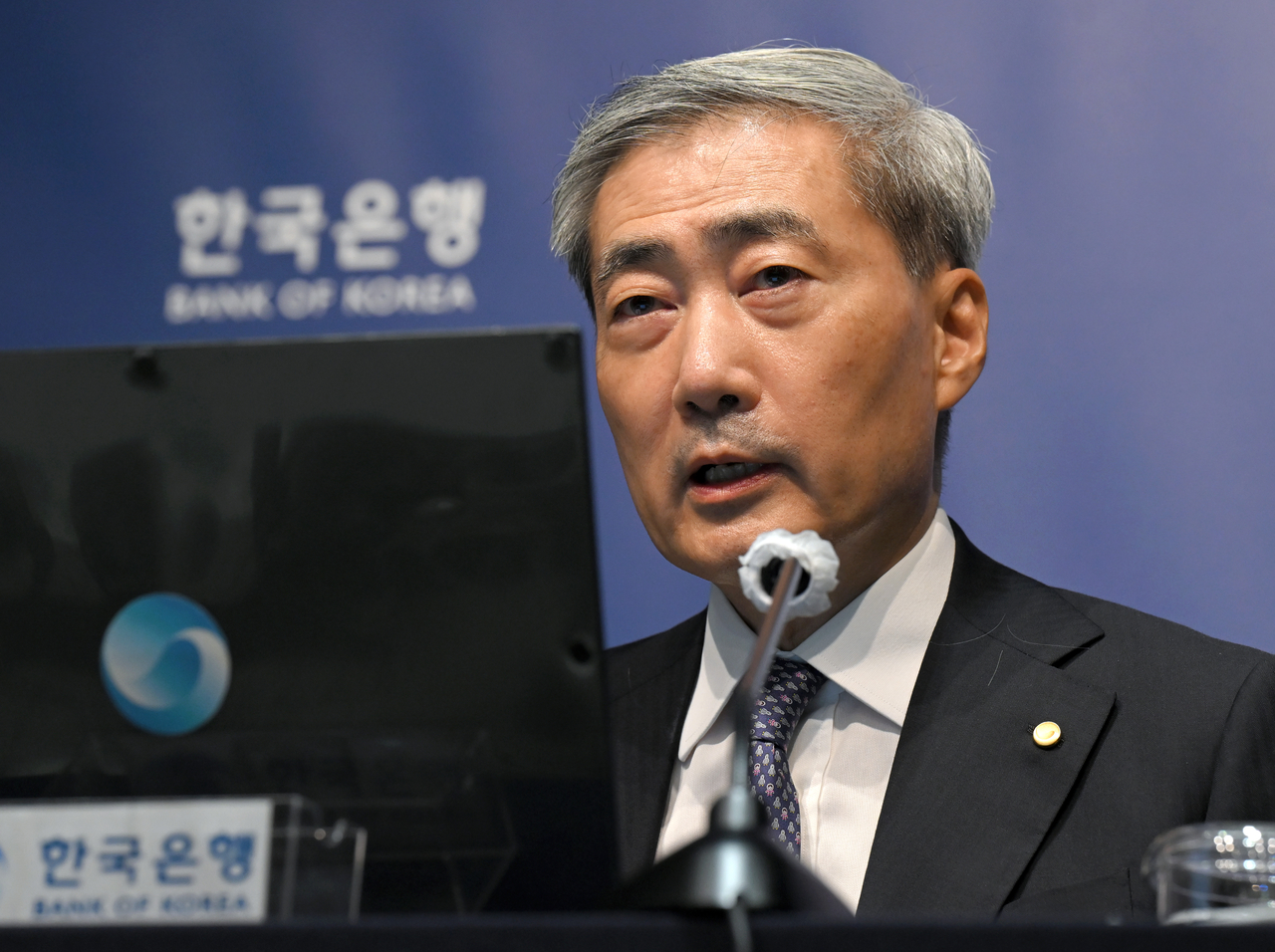
Bank of Korea Governor Shin Hyun-song had cited the FVI as a rationale for raising interest rates at a press briefing following last month's Monetary Policy Board meeting. "The FVI, which reflects medium- to long-term vulnerabilities in the financial system, has risen to a level exceeding the long-term average," Shin said at the time. "Higher interest rates are not a cure-all, but generally speaking, when rates go up, the index comes down."
The recent rise in the FVI has been driven particularly by household credit and real estate. Household credit outstanding grew 1.3 percent from the previous quarter in the second quarter of this year, surpassing 2,000 trillion won ($1.44 trillion) — nearly double the growth rate of 0.7 percent recorded in the first quarter. Rising domestic housing prices and share prices drove sharp increases in both housing-related loans, which grew by 12.2 trillion won, and other loans, which expanded by 12.8 trillion won.
The share of financially vulnerable borrowers edged up 0.1 percentage point to 6.8 percent, while the proportion of potentially vulnerable borrowers held steady at 18 percent. The household loan delinquency rate edged down from 1 percent to 0.98 percent. Bank-sector delinquencies were unchanged, while the non-bank sector's rate fell from 2.26 percent to 2.22 percent.
The real estate market continued to see price gains, led by mid- to low-priced housing in the Greater Seoul area. Nationwide home sale prices rose for 15 consecutive months since June last year. The divergence between regions was stark: the Greater Seoul area posted 18 straight months of gains, while non-metropolitan areas recorded three consecutive months of increases.
In the rental market, jeonse and monthly rent prices have been rising sharply, particularly in the Greater Seoul area. Rental transaction volumes fell steeply from March onward, and monthly rent continued to account for a high share of lease transactions at 67.6 percent. Monthly rent transactions in both the Greater Seoul area and non-metropolitan regions remained above their long-term averages.
The stock market saw high volatility in the second quarter, with share prices surging before a steep correction from late June. The Kospi hit an all-time high and broke through the 9,000 level at the end of June, driven from April onward by upward revisions to earnings forecasts for major chipmakers and an expansion of leveraged investing by retail investors. It then fell back to the mid-5,000 range as investor sentiment soured on concerns about the sustainability of capital expenditure by major big-tech companies. Since August, the index has recovered some of those losses on the back of strength in US technology stocks and has been trading in the mid-to-upper 6,000 range.
Monetary Policy Board member Jang Yong-sung, who oversaw the financial stability report, said South Korea's financial system remains broadly stable, supported by resilient financial institutions and solid external payment capacity despite domestic and external uncertainties, but cautioned that latent risk factors warrant close attention. "Housing prices in the Greater Seoul area continue to rise and pressure on household loan growth could intensify, so vigilance against the buildup of financial imbalances remains high," he said.
kimstar@heraldcorp.com
forest@heraldcorp.com