Analysis of Ministry of Land, Infrastructure and Transport and Korean Air data by lawmaker Jang Jong-tae
International routes to gain 15 weekly flights after merger
Domestic network frozen at 12 routes, 541 weekly flights
No replacement carrier found for 6 domestic routes
Calls grow for measures to strengthen low-cost carrier competitiveness
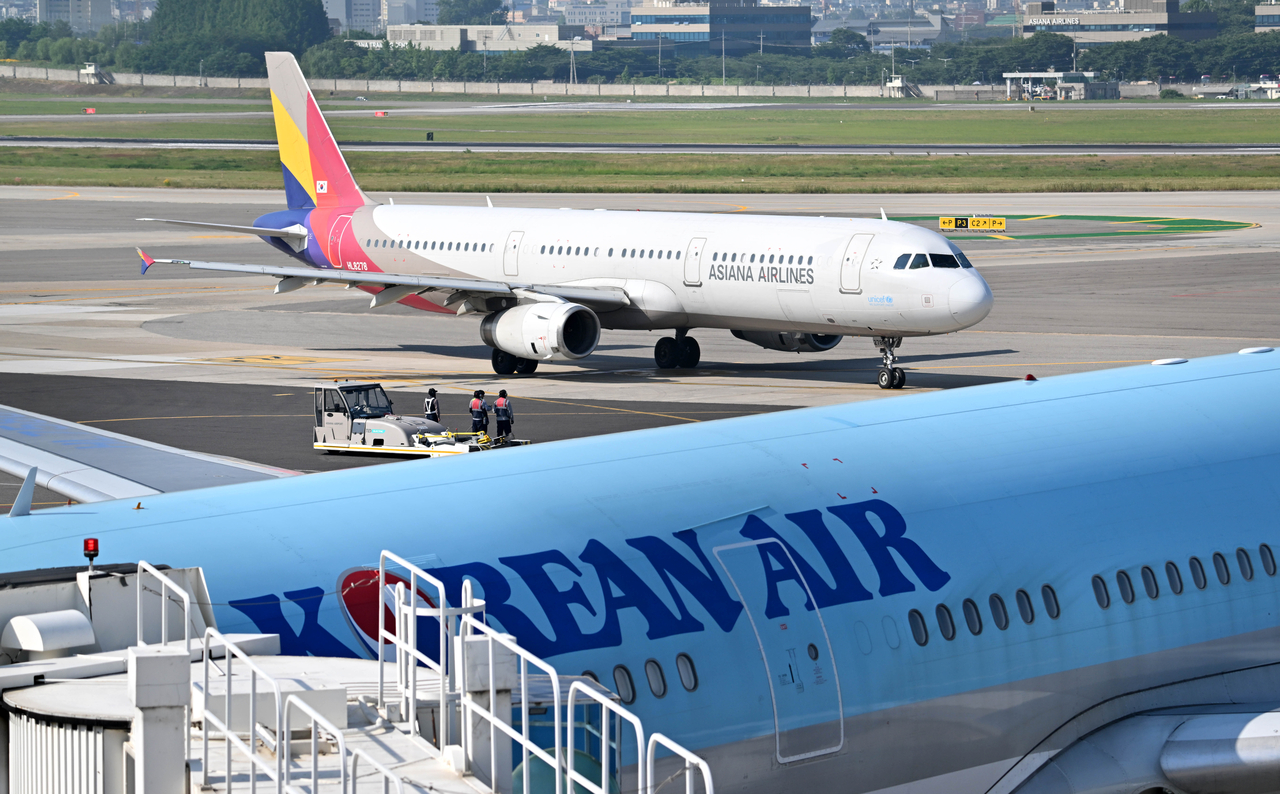
With Korean Air and Asiana Airlines set to launch a unified carrier in December, the merged airline has no plans to add a single domestic flight, a review of official data has found. As the entry of low-cost carriers and other replacement airlines into domestic routes continues to stall, calls are growing — particularly in political circles — for measures to expand domestic supply and promote competition.
According to data submitted to Democratic Party of Korea lawmaker Jang Jong-tae of the National Assembly's Land and Transport Committee by the Ministry of Land, Infrastructure and Transport and Korean Air, the merged carrier's international network will grow from 111 routes and 1,459 weekly flights to 113 routes and 1,474 weekly flights — an increase of two routes and 15 weekly departures.
The domestic network, by contrast, will remain unchanged before and after the merger at 12 routes and 541 weekly flights. No additional domestic services are being added beyond those already operated separately by the two carriers.
Korean Air had previously told the ministry in its integration plan that it would "maintain Asiana Airlines' routes without consolidation or cuts, and increase frequencies on routes that require additional services." The current operational plan, however, contains no specific provisions for expanding domestic flights.
With the merged carrier's domestic capacity set to stay flat, concerns are also mounting that the entry of low-cost carriers and other replacement airlines — intended to ease monopoly fears — is failing to gain momentum.
During its review of the Korean Air-Asiana merger, the Korea Fair Trade Commission ordered the two airlines to transfer slots — takeoff and landing rights — to any carrier that newly enters or expands service on eight domestic routes where competition was deemed at risk.
So far, however, slot transfers have been completed on only two routes: Gimpo-Jeju and Jeju-Gimpo. The remaining six domestic routes — Gwangju-Jeju and Jeju-Gwangju, Busan-Jeju and Jeju-Busan, and Cheongju-Jeju and Jeju-Cheongju — have yet to see any slot transfers.
On the Gwangju-Jeju route, a separate open call was held to select a replacement carrier, but not a single airline applied. On the Busan-Jeju and Cheongju-Jeju routes, the bidding process has not yet begun. Regional lawmakers warn that with the merged carrier adding no domestic capacity and competing airlines slow to enter, passengers in provincial areas could face fewer choices and less convenient air travel.
The deeper problem is that even when slots become available, conditions for low-cost carriers and other airlines to actually operate the routes are far from favorable. Trinity Airways — formerly T'way Air — and Air Premia, both of which entered international routes under the merger remedies, have cut a combined 183 weekly flights from their summer season schedules (March 28 to Oct. 24), citing factors including persistently high fuel prices driven by the war in the Middle East.
Even as replacement carriers' operational capacity shrinks, passenger demand on key domestic routes remains substantial. From January through August this year, the Gimpo-Jeju route carried about 9.68 million passengers. Data from the Ministry of Land, Infrastructure and Transport's aviation information portal show that roughly 10 million passengers use the route during the same period each year.
"When Korean Air and Asiana become one, the competitive role that low-cost carriers must play in the domestic aviation market becomes even more important," Jang said. "If the merged carrier does not increase domestic supply and competing airlines fail to enter the market, the burden will inevitably fall on passengers."
He added that simply releasing slots and repeating open calls would not be enough to create real competition, particularly when low-cost carriers are already stretched thin by high fuel costs and fleet shortages. "We need to understand why airlines are not coming in, and put in place practical measures to strengthen low-cost carrier competitiveness — such as allocating additional traffic rights and reducing airport facility fees," he said.
Jang also called on the ministry to move quickly on open calls for routes where bidding has not yet started, including Busan-Jeju and Cheongju-Jeju, and to monitor changes in supply, fares and passenger inconvenience on routes where slot transfers remain incomplete.
thanks@heraldcorp.com