First-floor mayor's office era begins — communications staff and consultation space all under one roof
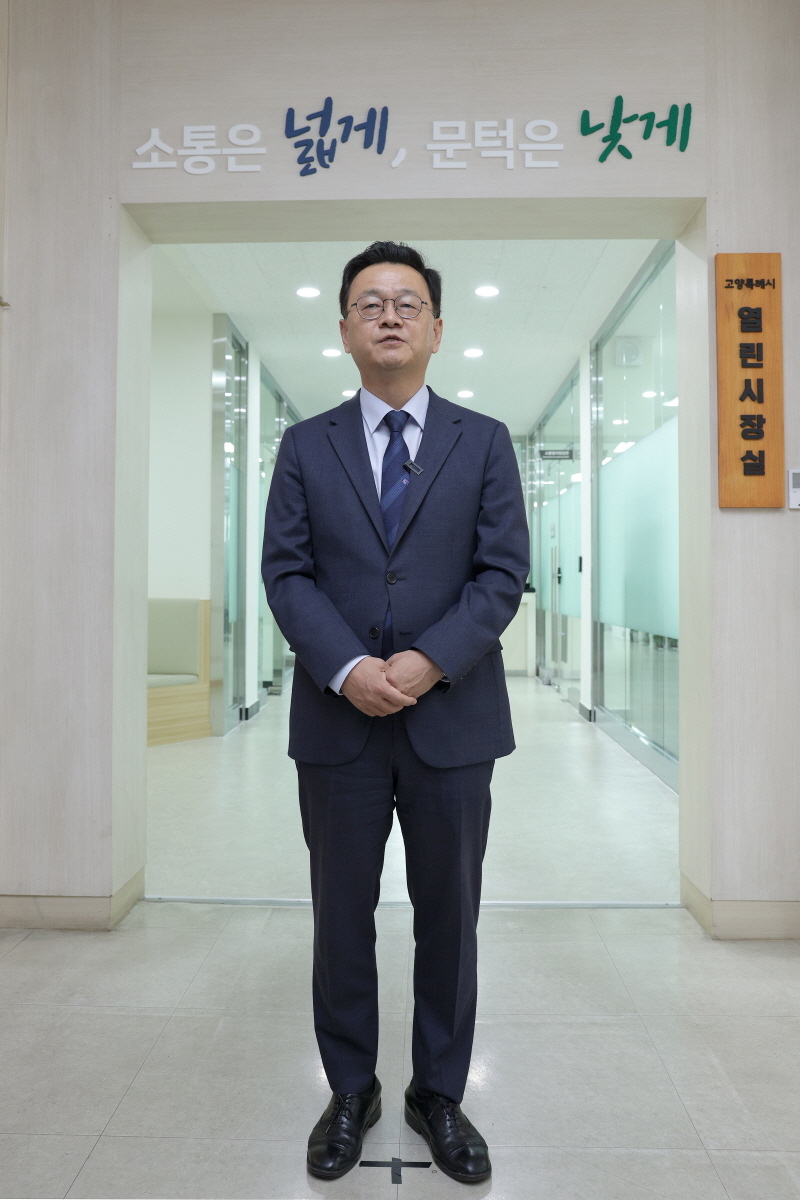
Goyang Special City Mayor Min Gyeong-seon has launched a new era of barrier-free, field-centered governance by relocating his office to the first floor of city hall.
Min reported for work Monday at the newly established first-floor mayor's office, having moved from the second floor of the main city hall building. The space brings together the mayor's working office, a secretariat, a communications and cooperative governance unit, and a public lounge — creating a one-stop system designed to capture residents' voices directly and respond quickly.
The arrangement eliminates what officials described as "siloed administration" by placing communications staff and consultation spaces within the mayor's office itself, enabling smoother handling of city affairs.
The first-floor office was set up to remove mobility barriers for elderly residents, people with disabilities and other visitors, and to deliver accessible administrative services. Corridors and information areas were connected to allow easy access for outside visitors, and the space was designed as an open area where people can wait and engage comfortably.
The mayor's working area was designed with both openness to the public and operational security in mind, with the secretariat, communications unit and other political and constituent-service functions arranged along a coordinated flow.
The previous mayor's office on the second floor had drawn criticism for poor accessibility. The main city hall building has no elevator, meaning visitors had to use stairs or take a detour through the city council wing to reach it — a particular hardship for the elderly, children and wheelchair users.
Since taking office in July, Min has pursued an active communications-driven approach to governance, opening a direct text-message line to the mayor, holding town hall meetings, operating the first-floor office, conducting field visits to key sites, and running community dialogue sessions in individual neighborhoods.
On Monday, Min held a tea gathering with the office's first guests, listening to their concerns. Attendees included Kim Hee-eun, an official from the Luxembourg Institute of Health, a biomedical research institution; Son Seung-hyeon, chief executive of Westworld Co., a cultural content company; Jeon Dong-ik, chief executive of Momentum Space Co., an aerospace firm; Lee Seung-ok, a disability awareness educator at the Goyang Comprehensive Welfare Center for People with Disabilities; and Kim Yeong-i, a member of the Wonsin-dong community social security council.
Son, the Westworld chief executive, said Goyang has extensive cultural content infrastructure — major broadcasters, aqua studios and drama series and film shooting locations — and expressed hope that the city could leverage those strengths to educate local youth and create jobs. He also urged the mayor to meet more frequently with local businesses.
Lee, the disability awareness educator, said she was surprised and grateful when she heard the mayor's office was moving to the first floor. She called on the city to factor in the needs of people with mobility difficulties when redesigning the transportation system, and to conduct awareness training for relevant officials in advance.
Kim, the Wonsin-dong council member, said overgrown weeds in a small stream running through her neighborhood had been blocking drainage during heavy rain and causing flooding in nearby farmland. "I tried sending a complaint through the mayor's direct text line on the off chance it might help," she said, "and I'm grateful that someone came out to inspect the site and carry out weeding." She asked for the city's continued attention going forward.
Min said the barrier-free first-floor office is more than a change of location. "It is a kind of declaration — a symbolic statement that the mayor is ready to meet any Goyang resident, at any time, in any place," he said. "It is also a strong message to district mayors, directors, department heads, section chiefs and frontline staff alike: go out and meet residents actively, and work to solve problems in the field."
Min added that city affairs and resident complaints cannot be resolved by sitting and waiting. "You have to visit the scene directly, hear residents' real voices, and think through solutions together in conversation — that is how creative answers emerge," he said. "When the mayor leads from the front by communicating in the field and meeting residents, I expect the civil service to change proactively, energy to rise, and the pace of key projects to accelerate. I will use field-centered, communicative governance as the driving force to reform the civil servant organization and lead Goyang into a new era of change."
pjh@heraldcorp.com