350,000 construction-type rental units, 243,000 public pre-sale units among targets
Universal public rental housing to cover 190,000 units; 20-year private rental model introduced
Tailored support for youth, newlyweds and elderly across life stages
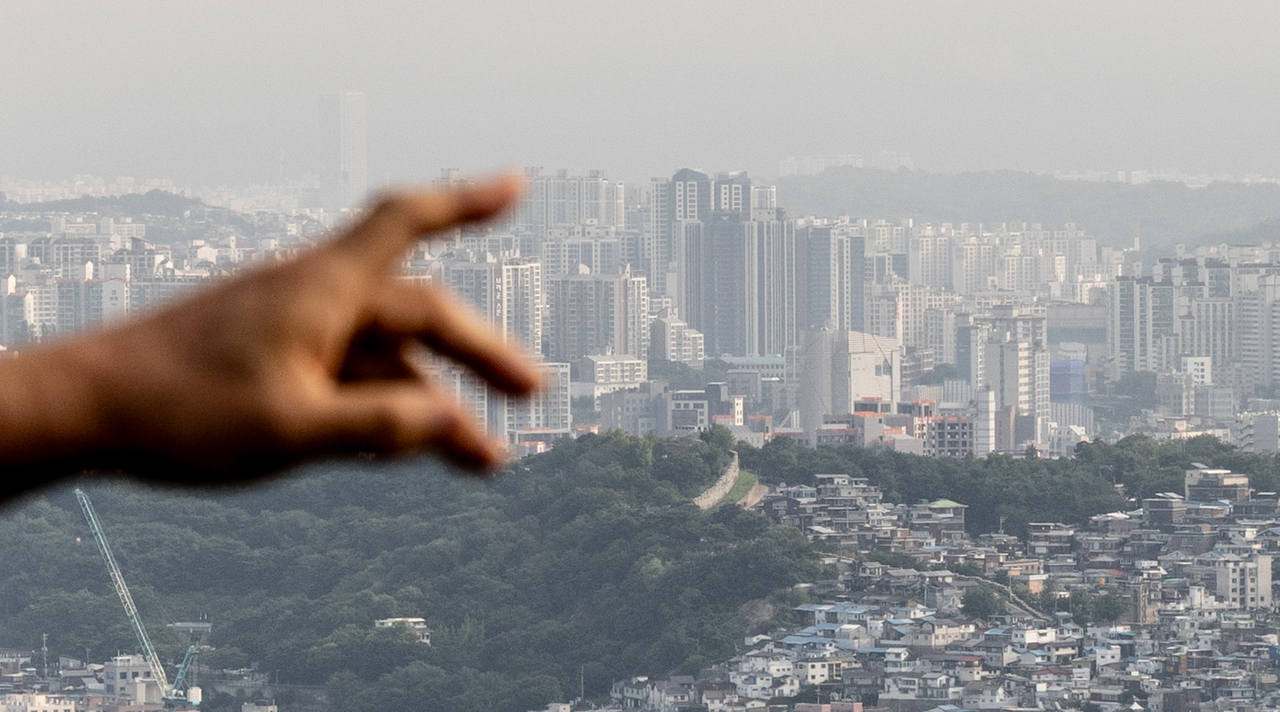
The government plans to supply about 1.19 million public housing units nationwide by 2030. Of these, 190,000 units under a newly introduced universal public rental housing model will be rolled out first in third-generation new town project zones, while about 240,000 public pre-sale units will be supplied in the Greater Seoul area. The plan also introduces a long-term private rental model with operating periods of 20 years or more, as part of a broader effort to provide tailored public housing support across life stages — for youth, newlyweds and the elderly.
The Ministry of Land, Infrastructure and Transport announced the plan Monday under the title "Housing Stability Plan for Realizing Thick and Fine-Grained Residential Welfare." The core targets through 2030 are: 350,000 construction-type public rental units (299,000 on public land sites and 51,000 in urban areas), 313,000 purchase-type public rental units (193,000 newly built and 120,000 existing), 230,000 jeonse-type public rental units, 52,000 publicly supported private rental units and 243,000 public pre-sale units. The targets are set on the basis of ground-breakings, agreements, purchases and contracts, and are separate from the public-private supply plans — the Sept. 7, Jan. 29 and Aug. 13 measures — which target at least 1.491 million units in the Greater Seoul area by 2030.
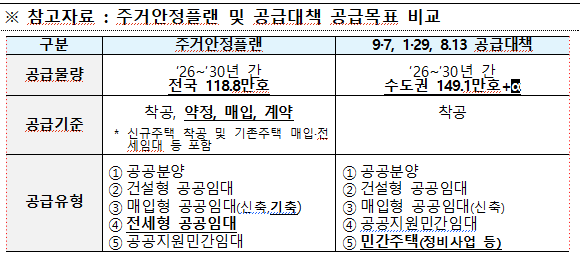
The plan translates to an average annual supply of about 240,000 units. Of the 1.188 million units, about 920,000 — or 77 percent — are concentrated in the Greater Seoul area, where residential demand is highest. Units available for move-in from the end of the fourth quarter this year through next year are estimated at about 150,000 nationwide and 100,000 in the Greater Seoul area.
Under the plan, 190,000 units will be supplied as universal public rental housing — a new category the government announced through its Aug. 13 rapid housing supply measures. Unlike conventional public rental housing targeted at vulnerable groups, the universal type is designed to allow a broader range of income groups to live stably at affordable rents. The government aims to supply public rental housing that middle-income households can also choose, with larger floor areas and higher-grade finishes. A total of 175,000 construction-type units will break ground by 2030 in preferred locations such as transit-oriented areas and urban centers, alongside 18,000 purchase-type units.
The ministry also disclosed specific sites for the universal public rental housing program. Three locations will be developed under the model: the Goyang Changneung B-1 block (1,594 units), which breaks ground this year; the Namyangju Wangseok 2 A-5 block (351 units), set to break ground next year; and the Namyangju Jinjeop 2 A-2 block (342 units).
A long-term private rental model with operating periods of 20 years or more will also be introduced through enhanced financial support and deregulation. To support stable long-term operations, a Korea Housing and Urban Guarantee Corporation-backed long-term mortgage product is set to launch in the second half of this year.
Alongside the new housing types, the quality of existing public rental housing will also be upgraded. New public rental units will increasingly be located in prime areas such as transit-oriented zones and urban centers, with a greater share of mid-sized units. Expandable floor plans will be applied even to single-person household units to better match what residents want — for instance, a 31-square-meter unit (exclusive use area) can be used as a 36-square-meter space through balcony expansion.
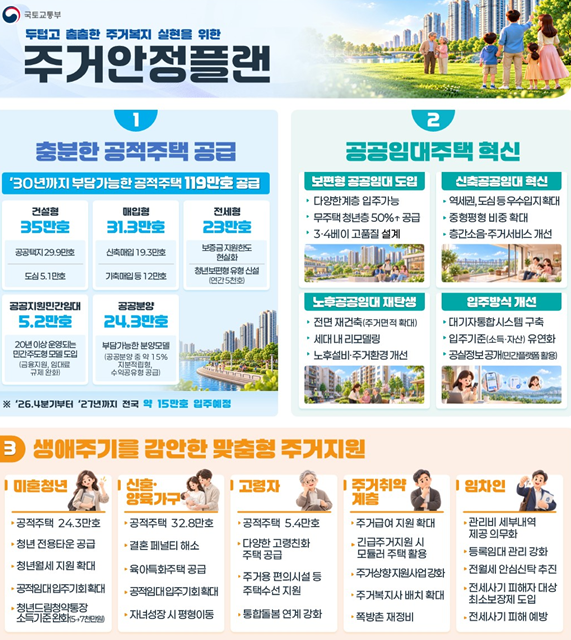
The housing stability plan also includes life-stage tailored support measures beyond expanded public rental supply. Targeted supply figures by demographic group are: 243,000 units for unmarried youth including university students and early-career workers, 328,000 for newlywed and child-rearing households, and 54,000 for the elderly.
For young people, monthly rent support will be strengthened to ease housing costs. The income eligibility threshold will be raised from 1.54 million won ($1,110) — 60 percent of the median, or up to 2.2 million won with income deductions — to 2.74 million won, equivalent to 100 percent of the median, with income deductions abolished. For youth at or below the near-poverty threshold, the support period will be extended from 24 months to 48 months. The income ceiling for the Youth Dream housing subscription account will also be relaxed from 50 million won to 70 million won, broadening opportunities for asset accumulation.
For newlywed and child-rearing households, the threshold for policy-backed loans will be lowered. Loans will be permitted when at least one spouse meets the standard income criteria — 60 million won for the Diditmdol loan and 50 million won for the Buitimdok loan. Child-rearing-specialized housing will also be supplied, and households needing more space due to childbirth or child-rearing will be supported in moving to larger units.
Elderly residents will see expanded tailored support through general private rental housing and large-scale complexes such as retirement villages, broadening their housing choices beyond the welfare housing that previously offered linked services. Given the high rate of homeownership among the elderly, support will also be provided for installing safety grab bars and other accessibility fixtures, as well as home renovation.
A unified waitlist system for public rental housing will also be built to make the move-in process more convenient. Application announcements and eligibility verification procedures — previously handled separately by Korea Land and Housing Corporation and individual regional housing corporations — will be integrated into a single system. This is expected to cut the time from application to tenant selection from 150 days to 40 days, and a personalized housing recommendation service tailored to each household's characteristics and circumstances will also be provided.
The autonomy and role of local governments in housing policy will also be strengthened. Institutional support will be expanded — including allowing investment in regional housing corporations — so that local governments, which best understand their communities' needs, can more actively respond to tailored housing demand.
The ministry said the housing stability plan targeting 1.188 million units will contribute to housing security for non-homeowning tenant households. The 1.188 million units represent about 13.6 percent of all tenant households in South Korea, which total about 8.717 million.
Kim I-tak, first vice minister of land, infrastructure and transport, said the plan would not only expand public housing to levels surpassing those of advanced economies but also raise housing quality and residential services to meet residents' expectations, and shift toward a locally driven, tailored support system that accounts for life stages and regional conditions. "The government will push forward with this housing stability plan one step at a time to ensure it translates into real change in people's lives, not just a plan on paper," he said.
hwshin@heraldcorp.com