Korea Chamber of Commerce and Industry hosts 3rd Social Value Festa in Seoul
More than 400 organizations and 15,000 visitors take part this year
Event runs through Tuesday
Chey also calls for 'social value measurement' to draw businesses into problem-solving
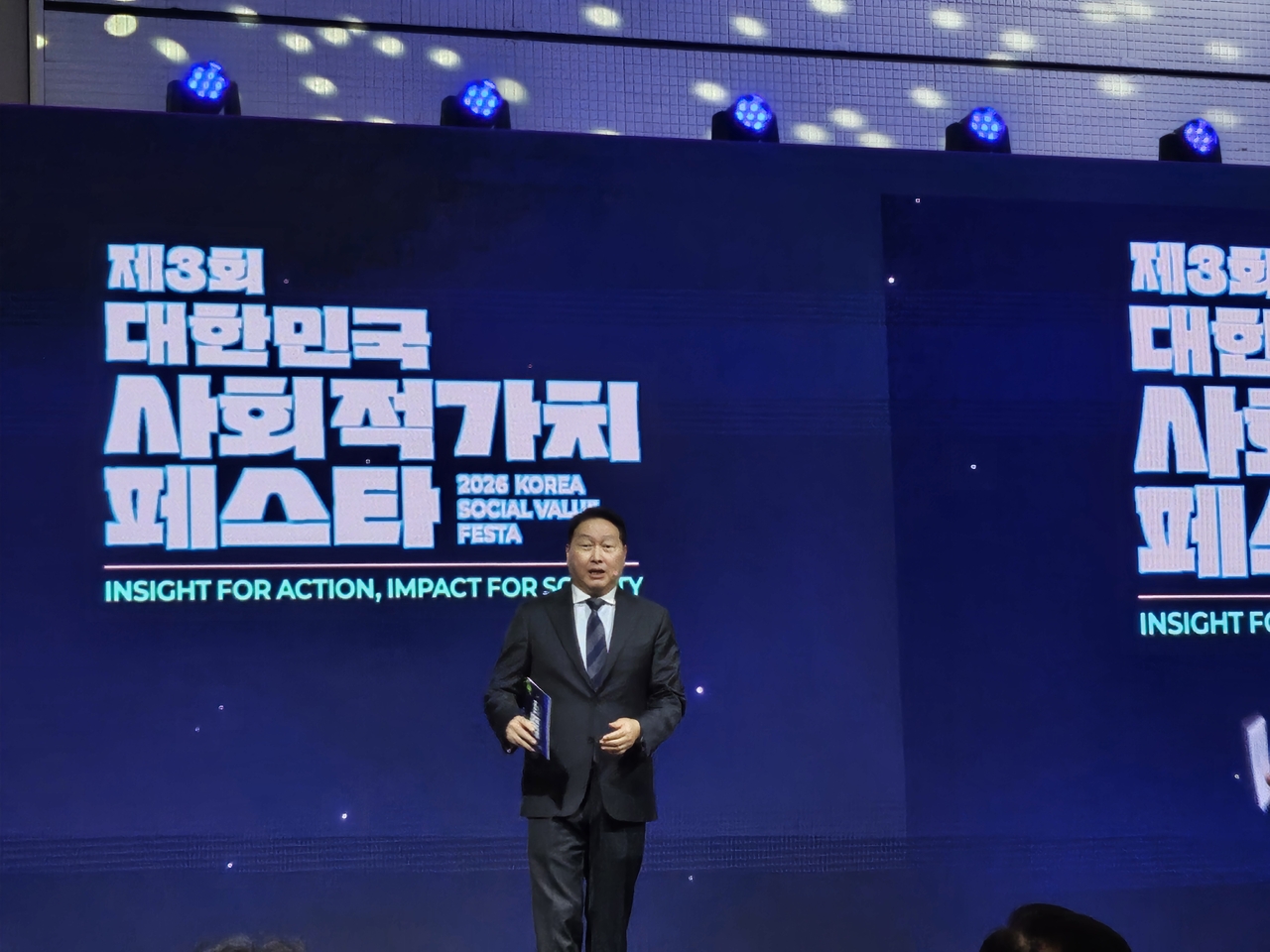
Chey Tae-won, chairman of the Korea Chamber of Commerce and Industry, said Monday that applying AI to social problems could reduce the costs society bears — and that quantifying social value and rewarding companies for delivering it could give rise to an entirely new economic model.
"People say AI will replace jobs and create many social problems, but we need to take a more proactive approach to solving those problems," Chey said in his opening remarks at the 3rd Social Value Festa, held at COEX in Seoul.
This year's festa focused less on sharing ideas and more on building action-oriented collaboration models. Participating organizations numbered more than 400, up from 344 last year, while attendance reached roughly 15,000. The number of programs in which organizations take part also grew, from 39 last year to 49 this year.
Chey put forward AI as a tool for cutting social costs in an era of slow growth. "The biggest social problem right now is that social costs are rising as economic growth slows," he said. "Businesses have traditionally solved social problems by earning profits and paying taxes, but now they need to tackle those problems directly and bring the costs down themselves."
Chey also called for a "social value measurement" framework to encourage companies to engage more actively in addressing social problems. "We need a structure that measures how social problems are being solved and creates rewards and investment commensurate with those results," he said. "We need a new concept — a way to make money that comes with rewards even when you solve social problems."
This year's Leaders Summit, held with more than 140 leaders from various sectors, was organized around the theme "How does capital grow social value?" In his address, Chey said different pools of capital already exist across business, government, finance and the social economy, and that connecting them more efficiently was essential. "When various forms of capital come together and grow in scale, the social impact will be far greater," he said.
Social enterprise representatives at the summit agreed that sufficient time and funding must back social enterprises before they can produce real results.
Kim Jeong-tae, chief executive of impact investment firm MYSC, said in a keynote address that solving social problems is a high-risk, long-term undertaking that cannot be sustained by a single source of capital. He argued that a "blended finance" system must take hold — one in which government subsidies play the lead role at the outset, loss-tolerant philanthropic capital steps in during the model-validation phase, and impact investment and loans take over during the growth phase.
Kazunari Taguchi, chief executive of Borderless Japan, a leading Japanese social enterprise group, then introduced his company's internal reinvestment model — known as "Onokuri" — under which private companies voluntarily channel 10 percent of their profits back into new ventures. He said the key to a sustainable social-problem-solving ecosystem lies in a virtuous cycle between "patient capital," which waits without rushing to recoup returns until results emerge, and "catalytic capital," which absorbs the risks that come with scaling up after results are verified.
A panel discussion followed, with Mok Seung-hwan of the Ministry of SMEs and Startups, Jo Yeong-mu of NH Financial Research Institute, Kim Eung-su of the National Pension Service, Song Ho-jun of Amorepacific's CSR team and Kim Jin-a of the Beautiful Foundation taking part to discuss ways to link and coordinate capital.
The exhibition floor, open through Tuesday, features booths from more than 300 companies organized under four themes: cooperation, innovation and environment, local community, and society. The innovation and environment zone in particular showcases how SK hynix and SK Telecom are applying AI to everyday life, caregiving, talent development and local problem-solving.
Also running through Tuesday are a life-preservation conference on suicide prevention policy cooperation, organized with support from the pan-government Life-Saving Promotion Headquarters under the Office for Government Policy Coordination, and a forum co-hosted by the Ministry of Employment and Labor and the Korea Chamber of Commerce and Industry on tackling youth unemployment in the age of AI.
Kim Jong-il, standing vice chairman of the Korea Chamber of Commerce and Industry, said increasingly complex social problems cannot be solved by any single actor alone. "I hope this festa establishes itself as a powerful social solutions platform that connects the capabilities of businesses, government, social enterprises and civil society — turning each party's individual concerns into solutions for everyone," he said.
klee@heraldcorp.com