Unauthorized fallow land, illegal leases to be spared from disposal if entrusted to farmland bank
Illegally converted land eligible for retroactive legalization after paying farmland preservation levy
Clear speculation and serious illegal conversions to face full legal consequences
Special measures law targeted for year-end; Farmland Act revision planned for first half of next year
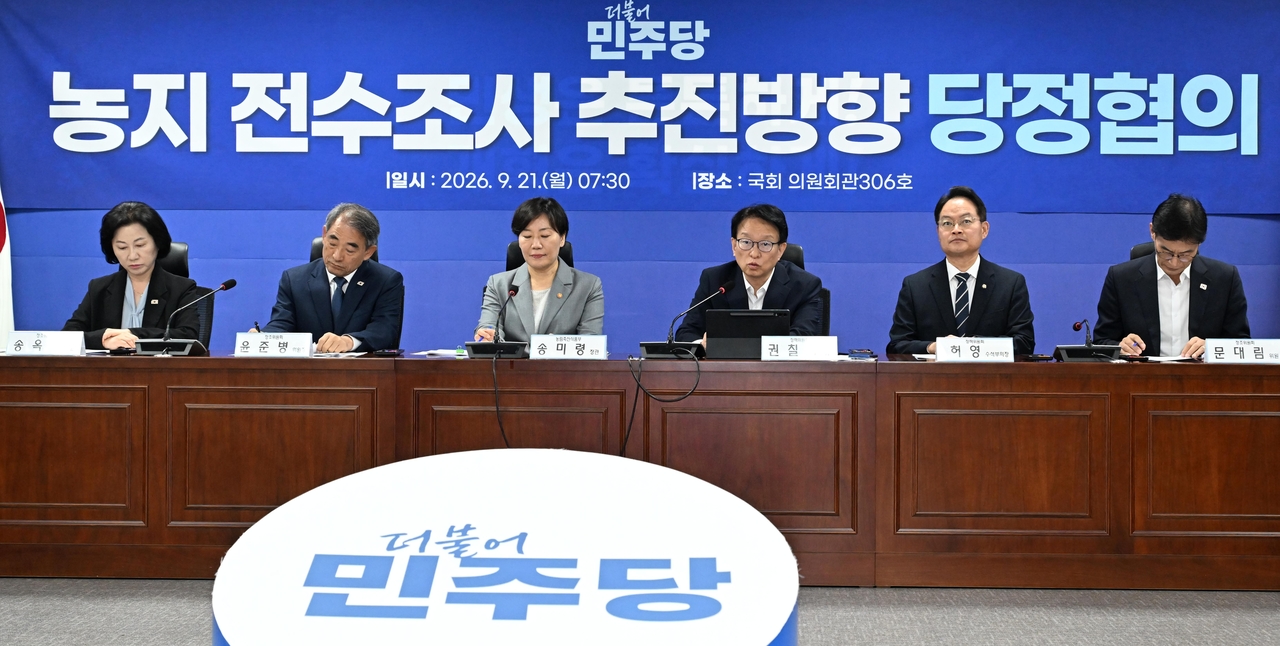
The Democratic Party of Korea and the government unveiled relief measures Monday for minor violations of the Farmland Act, seeking to calm farmer anxiety and backlash over an ongoing nationwide farmland survey. Under the plan, farmland left fallow without authorization or leased out illegally — when not for speculative purposes — can avoid immediate disposal orders if the owner entrusts the land to the farmland bank. Land used for unauthorized purposes without a conversion permit would also be eligible for retroactive legalization after payment of a farmland preservation levy.
The ruling party and government announced the measures at a consultation meeting held Monday at the National Assembly Members' Office Building. Democratic Party Policy Committee Chairman Kwon Chil-seung, Yun Jun-byeong, who leads the ruling party's side on the Agriculture, Food, Rural Affairs, Oceans and Fisheries Committee, and Agriculture Minister Song Mi-ryeong attended the meeting.
Speaking to reporters immediately after the meeting, Yun said the two sides had agreed to "take action according to law and principle for clear cases of speculation and serious illegal conversion, while normalizing farmland use relationships for habitual or minor violations that arise from the realities of rural life."
To that end, the ruling party and government plan to push for the enactment of a special measures law by the end of this year and to draft an amendment to the Farmland Act reflecting rural realities by the first half of next year.
Specifically, farmland left fallow without authorization or leased out illegally for non-speculative reasons will be given a path to continued lawful use rather than facing immediate disposal. Owners who find it difficult to manage their land in compliance with the law will be able to entrust it to the farmland bank to have disposal orders deferred, and the government will also review support measures to promote farmland bank leasing arrangements.
Farmland used for other purposes without a conversion permit will also be eligible for retroactive legalization. "For illegal facilities where the conversion procedure was omitted, we plan to pursue a legalization measure that allows retroactive approval after payment of the farmland preservation levy," Yun said.
The push for reform reflects a judgment that a gap exists between the current Farmland Act and the realities of an aging rural population. The government aims to bring the law in line with the reality that many farmers, unable to work the land themselves due to old age, have left fields fallow or entrusted cultivation to others.
The timing is also driven by a surge in farmer opposition to the comprehensive farmland survey ahead of the chuseok holiday, prompting the ruling party and government to move quickly to soothe public sentiment in rural communities.
At the same time, speculative farmland acquisitions and serious illegal acts will be dealt with strictly. Representative cases include acquiring farmland in a land transaction permit zone under the pretense of farming and then leaving it idle or secretly having others cultivate it, and agricultural corporations engaging in real estate-like activities without actually farming. The specific criteria for distinguishing speculation from minor violations, however, will be drawn up at a later stage, as the comprehensive survey is still under way.
Yun also pledged to secure funding so that farmers would not have to wait for the farmland bank to purchase their land, and to increase the farmland pension budget sufficiently so that enrollment would not be a burden. "We will make sure no one has to say, 'I want to sell my farmland but no one will buy it,'" he said.
The ruling party and government also agreed to review the methods used in field investigations to prevent farmers from growing more anxious during the survey process. "There were calls to ensure that anxiety among farmers does not intensify during the investigation," Yun said. "We agreed that it is necessary to carefully review what survey workers are saying so that farmers are not unnecessarily misled."
Meanwhile, the opposition continued to criticize the government's farmland survey. People Power Party leader Jang Dong-hyeok said at a supreme council meeting Monday that the ruling camp was "busy stoking division by labeling people as opponents of farmland survey reform." Floor Leader Jeong Jeom-sik also criticized the government Friday, saying it had "branded despairing and angry farmers as opponents of reform and forces of resistance."
thanks@heraldcorp.com