Online sales blocks of counterfeit cosmetics up 2.3-fold year-on-year
Takedowns rise on Alibaba.com and AliExpress
Fakes made in China distributed to Southeast Asia and beyond
Lawmaker calls for stronger institutional safeguards
![A comparison of genuine and counterfeit versions of APR's Medicube Collagen Night Wrapping Mask. The fake product misspells "collagen" on its label. [Courtesy of APR]](https://wimg.heraldcorp.com/news/cms/2026/09/21/news-p.v1.20250528.5c9cf7dc5e2d473ab9c5c9bf6f7dca26_P1.png)
As K-beauty's global popularity surges, counterfeit versions of South Korean cosmetics brands are spreading rapidly. More than 37,000 listings for fake cosmetics have been identified and blocked from online sale this year alone — 2.3 times the number removed during the same period last year. The increase has been particularly sharp on Chinese e-commerce platforms, where takedowns more than doubled year-on-year.
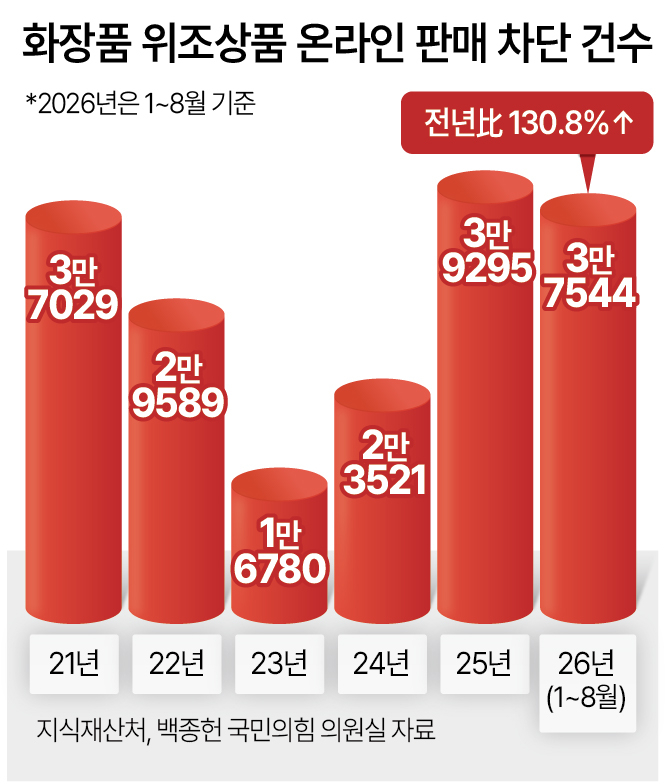
Data submitted to the office of People Power Party lawmaker Baek Jong-heon, a member of the National Assembly's Health and Welfare Committee, by the Korean Intellectual Property Office show that 37,544 listings for counterfeit cosmetics were blocked across major domestic and international online platforms between January and August this year. That is a 130.8 percent increase from the 16,270 cases removed in the same period last year. In just eight months, this year's total has already reached 95.5 percent of last year's full-year figure of 39,295 cases.
The number of blocked listings has been climbing steeply in recent years. It rose 40.2 percent from 16,780 in 2023 to 23,521 in 2024, then jumped another 67.1 percent to 39,295 last year — a 134.2 percent increase compared with two years ago.
The growth has been most pronounced on Chinese e-commerce platforms. Between January and August this year, 1,291 counterfeit cosmetics listings were blocked on Alibaba.com, the business-to-business platform of China's Alibaba Group, up 124.5 percent from 575 cases in the same period last year. AliExpress, Alibaba Group's consumer-facing platform, saw takedowns rise 162.9 percent over the same period, from 140 cases to 368.
Cumulative figures since 2021 also underscore the scale of the problem on Chinese platforms. From 2021 through August this year, Alibaba.com recorded the highest total with 10,522 blocked listings, followed by AliExpress with 1,278. Amazon came next with 270 cases, and Coupang Inc with 15. Counterfeit products were also detected on Southeast Asia-based platforms including Shopee, Lazada and Tokopedia.
Consumer complaints about fake cosmetics purchased online are also on the rise. Data submitted to Baek's office by the Korea Consumer Agency show that inquiries about counterfeit cosmetics received by the 1372 Consumer Counseling Center totaled 101 in 2022, 105 in 2023, 151 in 2024 and 225 last year. A further 139 cases were logged through August this year. By product category, basic skincare items accounted for the largest share at 64 cases, or 46.0 percent, followed by perfume at 28.1 percent and cleansing products at 9.4 percent. Quality problems were the most common reason for complaints, cited in 46.8 percent of cases.
China has been identified as the primary production and shipping hub for counterfeit goods. Of the K-beauty counterfeit items intercepted by the Korea Customs Service at the border last year, 97.7 percent were dispatched from China. Cosmetics accounted for the largest share by product category at 35.9 percent.
Illegal manufacturing facilities producing counterfeit K-beauty products have been uncovered in China in quick succession. According to APR, authorities raided a large-scale illegal production facility spanning about 2,000 square meters in Zhaoqing, Guangdong Province, in May last year, seizing more than 1,400 counterfeit Medicube products on site. In the first half of the same year, another facility was discovered in the Shantou area of Guangdong Province, where more than 40,200 counterfeit Medicube items were confiscated.
Counterfeit K-beauty products made in China are being distributed to overseas markets, particularly in Southeast Asia, through local logistics networks. Southeast Asia accounts for the largest share of blocked listings by distribution region. Between January and August this year, 21,266 counterfeit cosmetics listings were blocked in Southeast Asia, up 106.4 percent from the same period last year and representing 56.6 percent of all takedowns globally.
Takedowns in China itself rose 162.2 percent, from 2,038 to 5,344 cases. The distribution footprint is also widening as K-beauty gains traction in Japan, Europe and the United States. Blocked listings in the US climbed 108.1 percent from 504 to 1,049, while Japan saw a 66.0 percent increase from 1,344 to 2,231. Europe recorded the sharpest surge, jumping roughly 17.2-fold from 129 to 2,224 cases.
Counterfeit cosmetics pose risks that go beyond lost sales, threatening consumer safety and the broader reputation of K-beauty brands. Because these fakes are manufactured and distributed overseas, individual companies face significant obstacles in tracing local production facilities and distribution networks and coordinating with investigative and enforcement authorities.
"The growing number of counterfeit and imitation cases involving Korean cosmetics overseas not only undermines the competitiveness of the domestic cosmetics industry, but could also threaten the health and safety of consumers if such products enter the country," Baek said. "We need to put more precise institutional safeguards in place to protect both the intellectual property rights of our companies and the safety of consumers."
![Counterfeit Medicube products seized during a crackdown carried out by China's State Administration for Market Regulation. [Courtesy of APR]](https://wimg.heraldcorp.com/news/cms/2026/09/21/news-p.v1.20260921.3ecad5fdc4ef4bdcb9524a3df517d987_P1.png)
korean@heraldcorp.com