Regional mid-sized builder enters court receivership
Rate hikes raise fresh closure fears
'Interest rate subsidy needed for small builders'
![An unsold apartment complex in Buk-gu, Daegu. [Source: Naver Maps Street View]](https://wimg.heraldcorp.com/news/cms/2026/09/18/news-p.v1.20260918.c6c2e4d646f04534814ecbc96e809ced_P1.png)
Taewang E&C, the third-largest construction company in Daegu, has entered court receivership as unsold apartment units pile up across regional markets. The number of construction companies shutting down nationwide has jumped more than 30 percent in a single year, as a prolonged construction slump, rising build costs, mounting unsold inventory in regional markets and troubled project financing converge. Industry observers warn that further closures and receivership filings could follow — particularly among financially vulnerable regional builders — if rising interest rates push financial costs even higher.
Even 200-unit complexes going unsold in Daegu as builder failures mount
The Korea Housing and Urban Guarantee Corporation recently notified pre-sale contract holders of the S Apartment reconstruction project in Gwaneum-dong, Buk-gu, Daegu, that a pre-sale guarantee incident had been triggered following the contractor's entry into receivership proceedings. The project received its completion approval on June 30 and reached 100 percent construction progress, but the corporation instructed buyers to suspend move-in payments until further notice following the receivership filing by Taewang E&C, which served as both contractor and pre-sale guarantor.
Taewang E&C ranks 67th nationally and third in Daegu in this year's construction capacity assessment. The Daegu Rehabilitation Court ruled Thursday that the company had fallen into a severe liquidity crisis due to the materialization of large-scale project financing guarantee liabilities, and ordered the commencement of rehabilitation proceedings. As of end-March, the company's actual total assets stood at 312.69 billion won ($227 million), while its total liabilities reached 320.95 billion won — leaving it 8.26 billion won more indebted than its assets.
The corporation said it would continue follow-up measures to protect pre-sale contract holders. "This was already a project site under financial supervision due to the contractor's poor condition, so move-in payments have been collected through a dedicated corporation account," a corporation official said. "We will continue to manage the site so that pre-sale contract holders can complete ownership transfers."
Taewang E&C's receivership is widely attributed to its failure to collect payments amid the regional construction downturn. The S Apartment complex is a small development of two buildings and 200 units, but a large share of units excluding those allocated to association members are reported to have gone unsold. Nearby real estate agencies are currently listing units at discounts of up to 150 million won below the original pre-sale price.
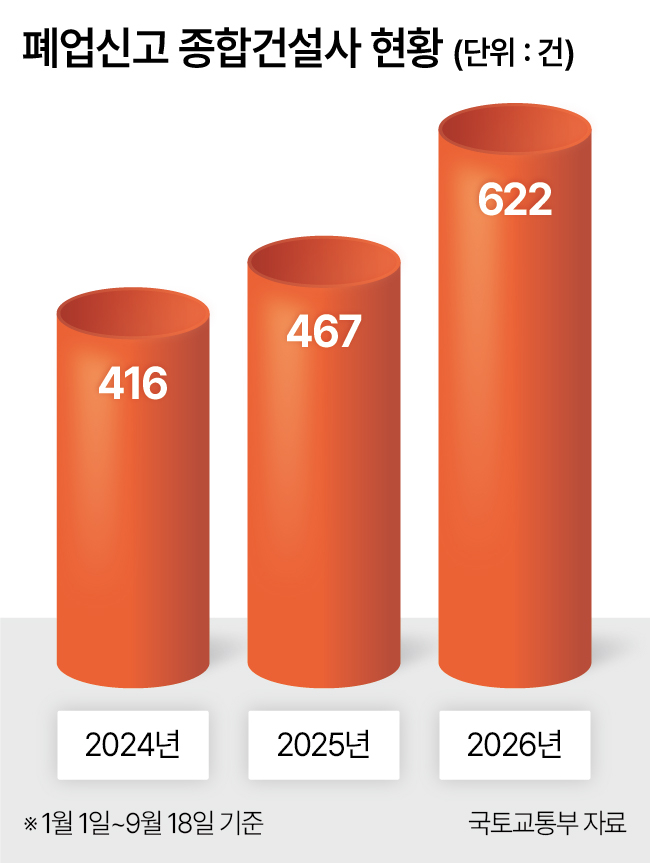
The Taewang E&C case illustrates the cash crunch gripping regional builders. According to the Ministry of Land, Infrastructure and Transport's Construction Industry Knowledge Information System, 622 general construction companies had filed for closure nationwide as of Friday — up 33 percent from 467 during the same period last year. Including specialty contractors, total closures reached 3,139, also up 27 percent from 2,465 a year earlier.
Residential construction cost index hits year-high as calls grow for small-builder support
The prolonged slump in regional housing markets lies at the root of the liquidity strain on construction companies. So-called "hard-core unsold units" — apartments that remain on the market even after completion — are concentrated in regional areas, adding to the difficulty builders face in recovering construction payments. As of end-July, there were 29,152 completed but unsold homes nationwide, of which 24,708 units, or 84.5 percent, were in regional areas outside the greater Seoul metropolitan area.
Even when construction is finished, cash flow problems arise if pre-sale proceeds are not collected as planned. Rising raw material and labor costs compound the burden, increasing the total outlay contractors must absorb.
According to the Korea Institute of Civil Engineering and Building Technology, the construction cost index stood at 138.59 in July, up 0.18 percent from 138.34 the previous month. The residential building sub-index reached 135.57, its highest reading of the year.
The construction cost index combines direct construction costs — materials, labor and equipment — with the Bank of Korea's producer price index to gauge the cost burden on contractors. A sharp rise in the index signals that the strain on small and mid-sized builders has intensified correspondingly.
Polarization in the project financing market is also widening the funding gap for regional builders. While financing has begun to flow again in the financial sector, capital is concentrating in high-quality, proven projects in the greater Seoul area, leaving regional sites still struggling to secure funding.
"Small and mid-sized construction companies are facing greater difficulties in the industry's downturn," said Park Gwang-bae, a senior research fellow at the Korea Institute of Construction Policy. "Credit risk is high for individual construction firms and the sector as a whole, which drives up borrowing costs." He added that some companies cannot secure loans even after being selected for policy funding support because they cannot provide adequate collateral.
![A construction site in South Korea. [Newsis]](https://wimg.heraldcorp.com/news/cms/2026/09/18/news-p.v1.20260219.d2e93a4d428d4f8a84b4f797f4222861_P1.jpg)
The situation could worsen if interest rates rise again. Because the construction industry relies heavily on external financing such as project financing and borrowings, higher financial costs can rapidly erode the profitability of individual project sites. Industry voices are calling for funding support measures for small and mid-sized builders to be put in place first.
"Support measures for small and mid-sized construction companies must focus on tools that can ease their financing difficulties to be effective, and alternatives that expand contracting opportunities for small specialty contractors must also be proposed," Park said. "For financing support, it would be most effective to operate the support system in a direction that expands interest rate subsidies."
He added: "Because individual construction companies face financing difficulties due to high credit risk across the industry, a policy instrument that covers the gap in borrowing rates would be effective."
hss@heraldcorp.com