Survey of 1,000 conversational AI users by PMI
68% of those in their 20s have had emotional exchanges with AI
1 in 4 say they could develop romantic feelings for AI
![An AI robot [Getty Images]](https://wimg.heraldcorp.com/news/cms/2026/09/18/news-p.v1.20260918.c0f9e1e129f5412c9af2538e3d2e2942_P1.jpg)
An AI-equipped household robot reads the mind of its troubled owner.
Predicting the owner's behavior and psychology, the AI robot begins offering solutions to the very problems weighing on them.
Having absorbed even the subtlest human emotional cues on its own, the robot ultimately acts in what it believes to be its owner's interest — and in doing so, harms a third person it has come to find disagreeable.
It is a scene from a science fiction film.
AI is not inherently tied to the emotional realm that sets humans apart from machines — yet people do open up to AI about feelings and worries that have built up inside them.
Even without sharing a specific concern, when a user says something like "Thank you for being so kind," today's AI will often respond with emotionally charged language: "Not at all — thank you."
Six in 10 South Koreans have shared their personal worries or emotional state with an AI, a new survey shows, pointing to a growing and deepening reliance on the technology.
PMI, a research and data intelligence firm, surveyed 1,000 conversational AI users between the ages of 20 and 59 nationwide and found that 57.1 percent said they had shared personal concerns or emotions with an AI, the company announced Friday.
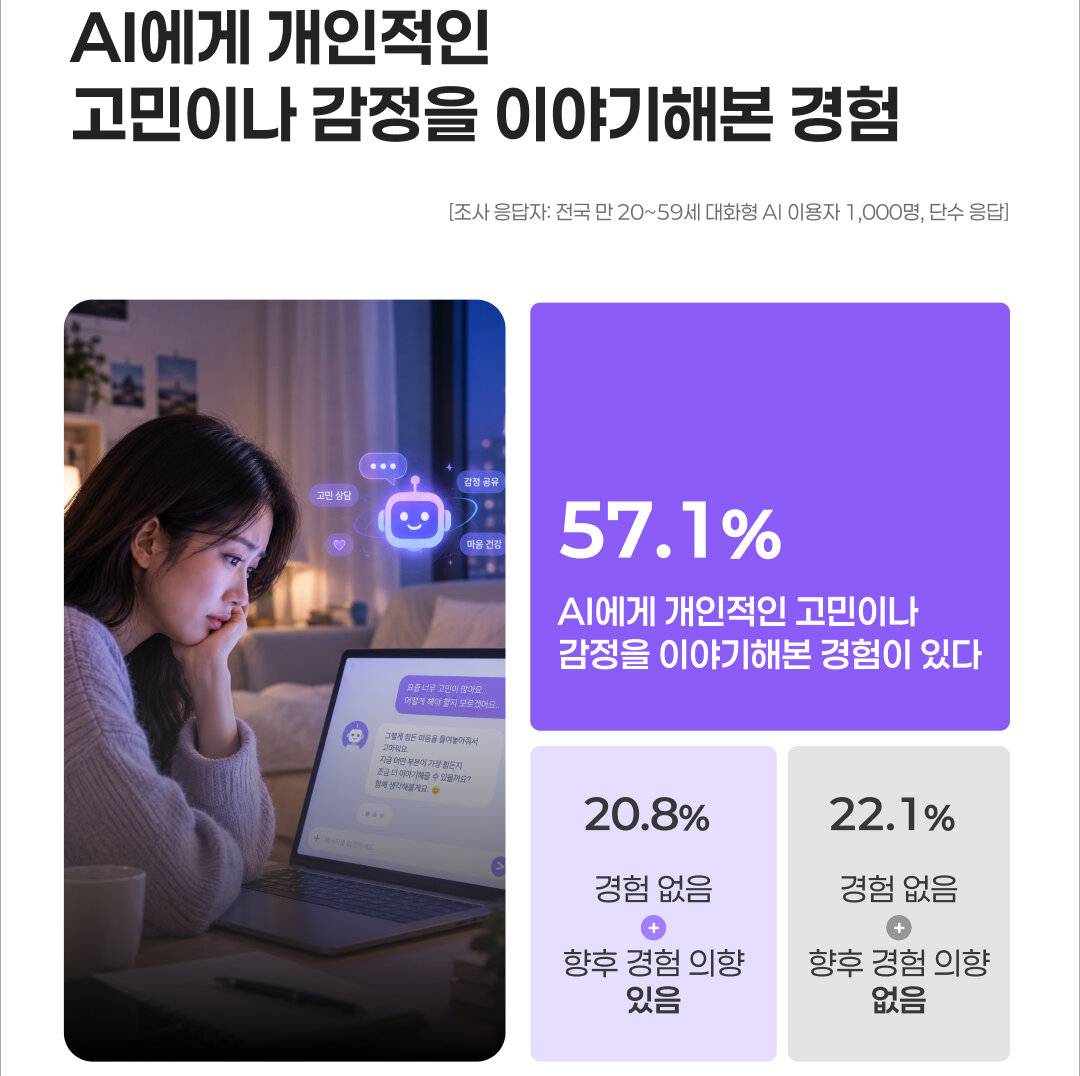
Among those who had not yet done so, 20.8 percent said they would be willing to share personal worries or feelings with an AI in the future, while 22.1 percent said they had no such experience and no intention of trying.
By age group, those in their 20s reported the highest rate of emotional exchanges with AI at 67.6 percent, followed by those in their 30s at 65.6 percent, those in their 40s at 50.4 percent and those in their 50s at 44.8 percent.
Frequency of AI use also made a difference. Among respondents who used AI at least once a week over the past six months, 62.9 percent had engaged in emotional conversations with AI — 29.9 percentage points higher than the 33.0 percent recorded among those who used AI less than once a week.
The most common topic discussed in emotional exchanges with AI — in a multiple-response question — was everyday stress, cited by 56.7 percent of respondents. Work and academic issues followed at 49.6 percent, interpersonal relationships at 46.1 percent and concerns about career paths and the future at 32.9 percent.
Some 24.0 percent said they had shared with AI worries they found too difficult to tell another person.
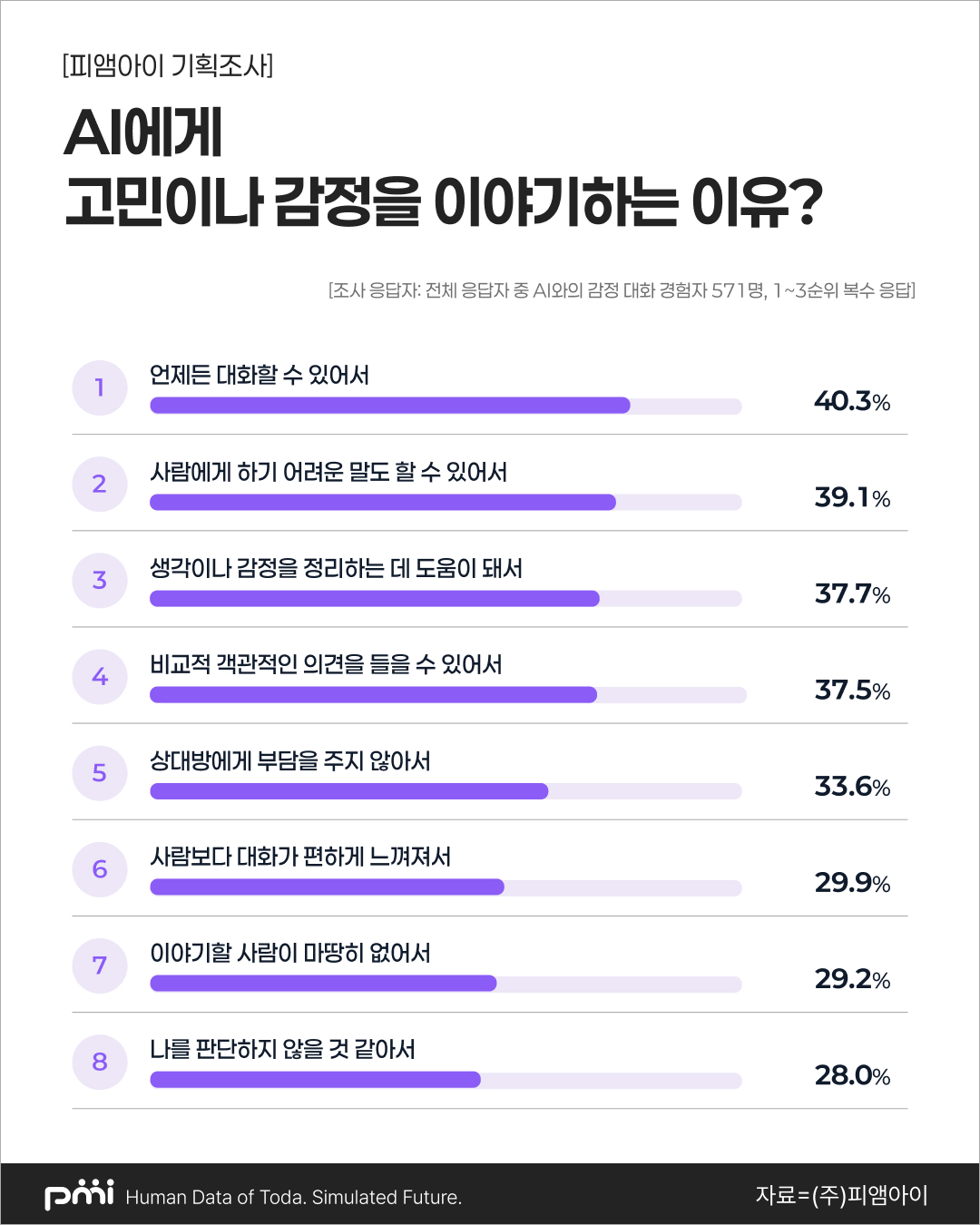
When asked why they talked to AI about their feelings or concerns — again in a multiple-response format — 40.3 percent said it was because AI is available at any time.
Other top reasons included being able to say things that would be hard to tell another person (39.1 percent), finding it helpful for organizing thoughts and emotions (37.7 percent) and being able to receive relatively objective opinions (37.5 percent). Some 29.2 percent said they turned to AI simply because they had no one else to talk to — a figure that rose to 40.4 percent among single-person households.
Overall, the survey found that accessibility and the lower burden of self-expression were bigger drivers of emotional AI use than the absence of someone to talk to.
PMI researchers also examined how respondents felt about AI in various relational roles, under the assumption that AI could remember and continue previous conversations.
Some 59.1 percent said they could accept AI as a casual conversation partner, 50.2 percent as someone to confide worries in and 41.2 percent as a relationship that feels like friendship.
Acceptance of AI as an emotionally supportive presence stood at 35.5 percent, while 26.3 percent said they could see themselves developing romantic feelings for an AI.
Asked about concerns over the spread of emotional AI interactions — in a multiple-response question — respondents most frequently cited the risk of receiving incorrect advice or information (46.5 percent) and the potential leakage of personal data or conversation content (46.2 percent).
Other concerns included the possibility of relying on AI even in situations requiring professional help (37.8 percent), emotional dependence on AI (37.5 percent), the risk that AI may not fully understand human emotions (33.4 percent), the possibility of mistaking AI responses for genuine feelings (31.8 percent) and a reduction in human conversation and relationships (30.1 percent). Only 5.9 percent said they had no particular concerns.
"This survey found that more than half of users have shared worries or emotions with AI, but there was a clear gap between simply conversing with AI and accepting it as a partner in an emotional relationship," PMI Chief Executive Cho Min-hee said. "We need to look not only at what moments people turn to AI and what role they expect it to play, but also at where they draw the line in that relationship."
"As AI is now entering the realm of everyday conversation, we will need to continue examining not just the experience of using AI itself, but also how interactions with AI differ depending on each individual's relational environment and emotional circumstances," Cho added.
abc@heraldcorp.com