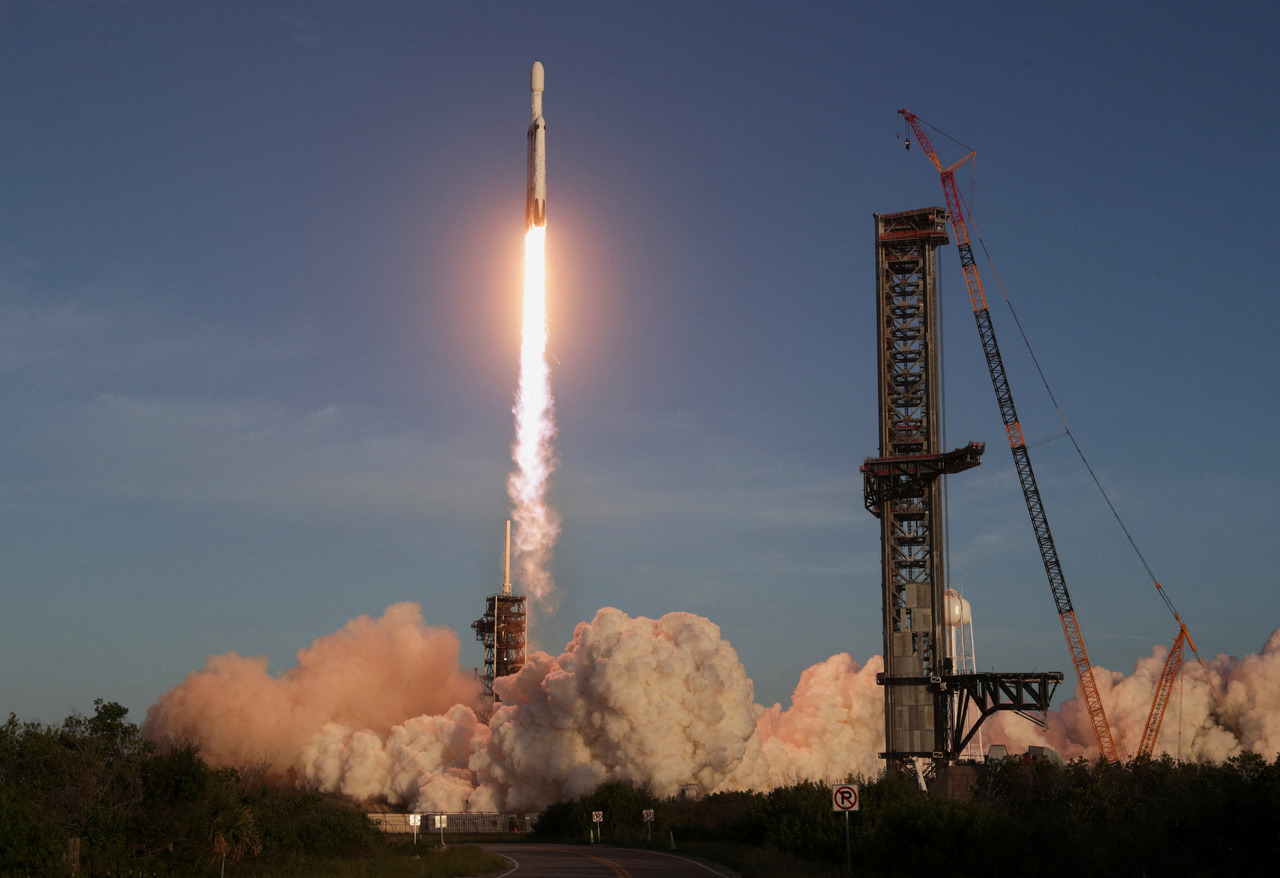
SpaceX is preparing to send its Starship rocket into Earth orbit for the first time.
The test flight is seen as a critical proving ground not only for the rocket's development but also for the commercial value of SpaceX, which listed on NASDAQ in June.
SpaceX announced Thursday that it plans to conduct the 14th Starship test flight on Tuesday — between 9:15 p.m. and 10:30 p.m. Korean Standard Time — pending regulatory approval, and will carry 26 Starlink V3 satellites on board.
Unlike the 13th test in July, which reached only a suborbital trajectory, this mission aims to place Starship in an orbit roughly 275 kilometers above Earth, complete six loops around the planet, and then splash down in the Pacific Ocean west of Chile after about 10 hours.
The flight will mark the first time the new Starlink V3 satellites — each weighing 2,000 kilograms — enter actual orbit.
In addition, two heat-shield tiles recovered from the 13th test vehicle have been reinstalled on the spacecraft for this mission, making it SpaceX's first instance of tile reuse.
SpaceX Chief Financial Officer Bret Johnsen called the upcoming launch a "massive milestone," saying it would be the first revenue-generating flight for Starship since the company's listing.
Each satellite adds one terabit per second of capacity, meaning a single launch will increase total communications capacity by roughly 10 times what a single Falcon 9 smallsat mission delivers, the company said.
SpaceX CEO Elon Musk posted on X that Starlink V3 would provide "more than 100 times the bandwidth" of the current constellation of about 11,000 satellites.
SpaceX also plans to test the booster's launch, separation, boostback burn and splashdown procedures during the flight.
During the 13th test, only 8 of the 13 engines required for the pre-splashdown relight successfully ignited, resulting in a hard landing. The company said it has since improved engine filtering hardware and reignition software.
Musk said at an event Thursday that this flight would be the last mission before SpaceX attempts to "catch the ship" for the first time, adding that it was "very likely" the company would achieve full reusability and rapid relaunch capability by 2027.
SpaceX shares closed down 3.2 percent at $143.49 on the day of the announcement, compared with the previous session.
The decline reflects investor caution over launch risk, even as SpaceX posted second-quarter sales of $7.81 billion — up 91.9 percent year-on-year and above market expectations.
SpaceX has already invested more than $15 billion in Starship development and plans to spend at least $100 billion more building a dedicated launch facility in Louisiana.
Jeffrey Blodgett, an analyst at Pivotal Research Group, wrote in a recent customer note that "whether the investment in SpaceX pays off depends almost entirely on making Starship fully reusable."
husn7@heraldcorp.com