45 nations to compete across 43 sports for 469 gold medals; South Korea targets around 40 golds and a third-place finish
![Promotional materials for the 2026 Asian Games are displayed at Nagoya Station in Japan on Wednesday, three days before the opening ceremony. [Yonhap]](https://wimg.heraldcorp.com/news/cms/2026/09/17/rcv.YNA.20260916.PYH2026091618420001300_P1.jpg)
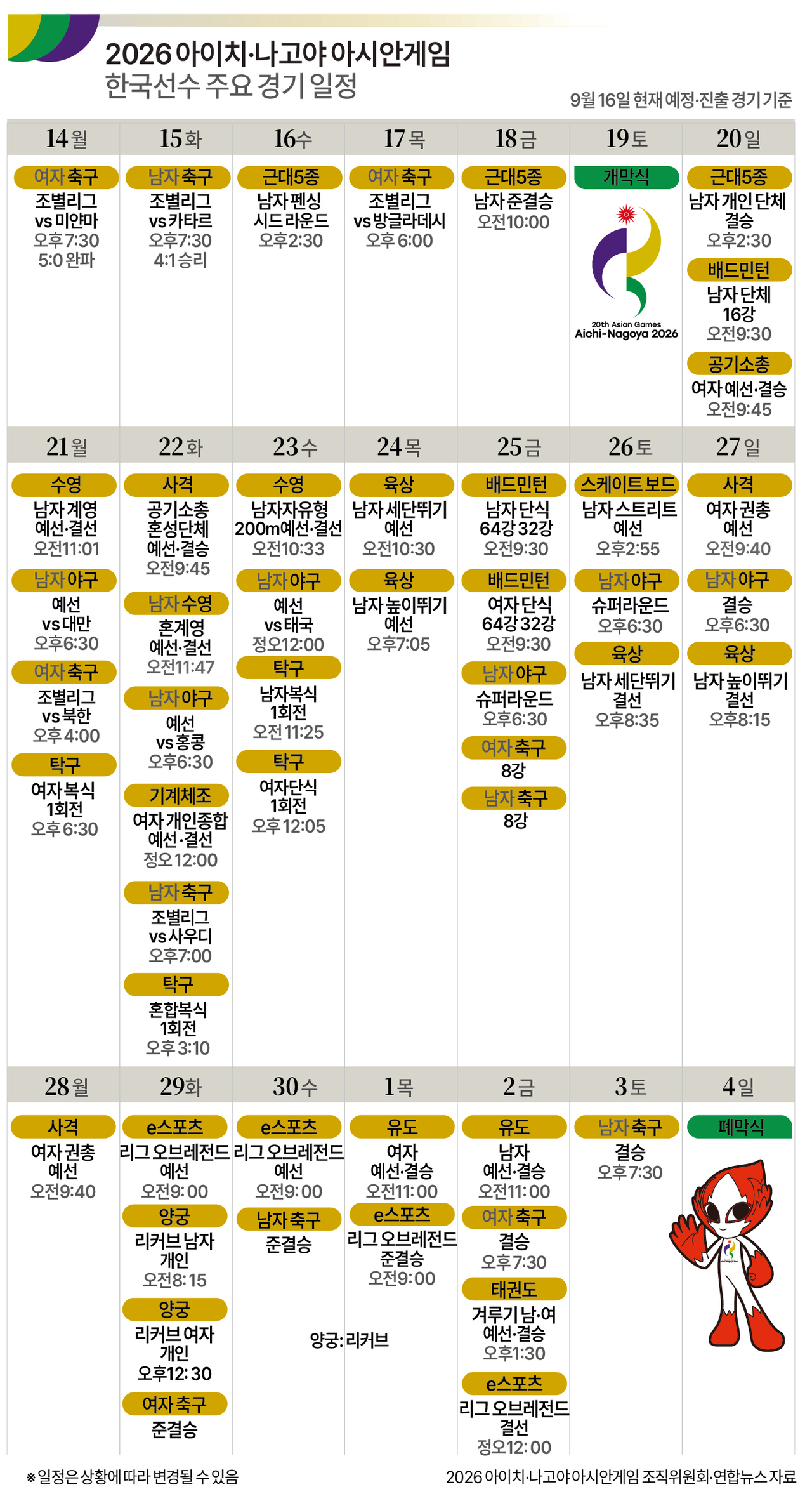
The 20th Asian Games, a festival for 4.8 billion people across Asia, will open Saturday in Nagoya, Japan. South Korea will look to defend its third-place standing in the overall medal table, led by its traditional powerhouse sports of archery, swimming, shooting, fencing and taekwondo.
The Games will kick off with an opening ceremony at Nagoya's Paloma Mizuho Stadium on Saturday and run through Oct. 4 — a 16-day competition. A total of 45 National Olympic Committees affiliated with the Olympic Council of Asia, along with a refugee team, will compete for 469 gold medals across 43 sports and 71 disciplines.
It is the third time Japan has hosted the Summer Asian Games and the first since the 1994 Hiroshima edition — a gap of 32 years. The previous 2022 Hangzhou Games were delayed a year due to the COVID-19 pandemic and ultimately held in 2023, meaning the Asian Games flame returns after just three years.
Events will be held primarily in Nagoya and across Aichi Prefecture, with some sports spread to Tokyo, Osaka and Shizuoka. Swimming and diving will take place at the Tokyo Aquatics Centre, the venue used for the 2020 Tokyo Olympics.
South Korea will send a delegation of 1,052 people, including 792 athletes, competing in 41 of the 43 sports — cricket and padel being the only exceptions. The team's goal is to secure around 40 gold medals and retain third place in the overall standings.
South Korea finished second overall at five consecutive Games from the 1998 Bangkok edition through the 2014 Incheon edition, but slipped to third behind Japan at both the 2018 Jakarta-Palembang Games and the Hangzhou Games. With host nation Japan again expected to perform strongly, how many golds South Korea can claim from its traditional medal-rich sports will be the key to meeting its target.
![South Korea's national archery team greets spectators at Gwangju-Kia Champions Field in Gwangju, South Jeolla Province, before a noise and crowd-adaptation training session on Friday. [Yonhap]](https://wimg.heraldcorp.com/news/cms/2026/09/17/rcv.YNA.20260905.PYH2026090503890005400_P1.jpg)
Leading the charge will be archery, South Korea's strongest suit. Since the sport became an official Asian Games discipline at the 1978 Bangkok Games, South Korea has claimed 46 of the 70 gold medals on offer through the Hangzhou Games.
In men's recurve, Kim Woo-jin — a triple gold medalist at the 2024 Paris Olympics — will draw his bow in pursuit of more gold. Kim failed to qualify for the individual event at the Hangzhou Games after a poor qualifying round, making this a chance at redemption. He will team up with Kim Je-deok and Lee Woo-seok to defend the men's recurve title.
Kang Chae-young anchors the women's recurve squad. Partnering with Lee Yun-ji and Oh Ye-jin, she will target gold in both the individual and team events. Kang won team gold at the 2020 Tokyo Olympics and the 2018 Jakarta-Palembang Asian Games and is again hunting a gold medal at a major international multi-sport event.
South Korean swimming will look to Kim Woo-min and Hwang Sun-woo to relive the glory of Hangzhou, where the team set all-time Asian Games records for gold medals and total medals in a single edition — six golds, six silvers and 10 bronzes.
Kim, who won three golds in Hangzhou, and Hwang, who won two, will again form the team's one-two punch. Kim will compete in six events — the 200-meter, 400m, 800m and 1,500m freestyle and the 400m and 800m freestyle relay — as he bids to win three golds at consecutive Asian Games.
In shooting, Paris Olympics gold medalists will again take aim. South Korea's shooters delivered their best-ever Olympic performance in Paris, winning three golds and three silvers. The team has set a target of five gold medals at these Games.
Ban Hyo-jin in the women's 10-meter air rifle, Oh Ye-jin in the women's 10m air pistol and Yang Ji-in in the women's 25m pistol are among the top gold medal contenders. If Ban wins the individual event at these Games, she will become the first South Korean female shooter to complete a grand slam of individual titles at all major international competitions.
![National shooting team member Ban Hyo-jin trains at the National Training Center in Jincheon-gun, North Chungcheong Province, on Monday. [Yonhap]](https://wimg.heraldcorp.com/news/cms/2026/09/17/rcv.YNA.20260810.PYH2026081014670001300_P1.jpg)
Fencing is another reliable source of medals. South Korea has won 52 gold medals in Asian Games fencing through the Hangzhou Games, surpassing China's 49 to lead all nations in all-time golds. The team has also topped the overall fencing standings at four consecutive Games, from the 2010 Guangzhou edition through Hangzhou.
The headline act is Oh Sang-uk, a two-time gold medalist at the Paris Olympics. Oh will defend his Asian Games titles in the men's sabre individual and team events. In women's épée, Song Se-ra will be chasing her first individual gold at a major international multi-sport competition.
South Korea's taekwondo team, fiercely protective of its status as the sport's home nation, is also primed for gold. The country has won 63 gold medals in Asian Games taekwondo history and topped the overall standings at the Hangzhou Games with five golds, two silvers and two bronzes. Paris Olympics gold medalist Kim Yu-jin will lead the women's side, while heavyweight prospect Kang Sang-hyeon will challenge for the top of the podium in the men's division.
![Oh Sang-uk, a two-time gold medalist at the Paris Olympics [Newsis]](https://wimg.heraldcorp.com/news/cms/2026/09/17/news-p.v1.20260916.a945b8c60cb34fe78f0570f9d30aeefd_P1.jpg)
Stars from outside South Korea's traditional medal sports will also be in action. Badminton women's singles player An Se-young, table tennis player Shin Yu-bin and high jumper Woo Sang-hyeok — all world-class competitors — will represent the country.
In professional team sports, consecutive title streaks are on the line. The baseball team, built around KBO League players, will bid for a fifth straight gold medal, extending a run that began at the 2010 Guangzhou Games. The men's football team, coached by Lee Min-sung, will seek a fourth consecutive gold dating back to the 2014 Incheon Games.
In esports, Lee Sang-hyeok — known by his in-game name "Faker" — will attempt to defend his League of Legends gold medal from the Hangzhou Games.
yjc@heraldcorp.com