Seoul franchise restaurant count drops 1,680 in second quarter
Korean-food franchises shrink 7.6%; coffee and snack chains also contract
Rising costs and falling margins push brands to exit the market
![Nearly 1,700 franchise restaurant locations have disappeared from Seoul in a year, as rising costs unique to franchisees and weakening consumer spending take their toll. Pictured is a restaurant alley in Seoul. [Yonhap]](https://wimg.heraldcorp.com/news/cms/2026/09/16/rcv.YNA.20260911.PYH2026091109340001300_P1.jpg)
A, who retired two years ago, opened a chicken franchise store in Eunpyeong-gu that same year, drawn by promises of earning several million won a month. But expenses outpaced income, and by late last year he had let go of his part-time staff. "I thought the barriers to entry were low and saw it as a second chapter in life," he said. "But I've come to realize the reality is far from easy."
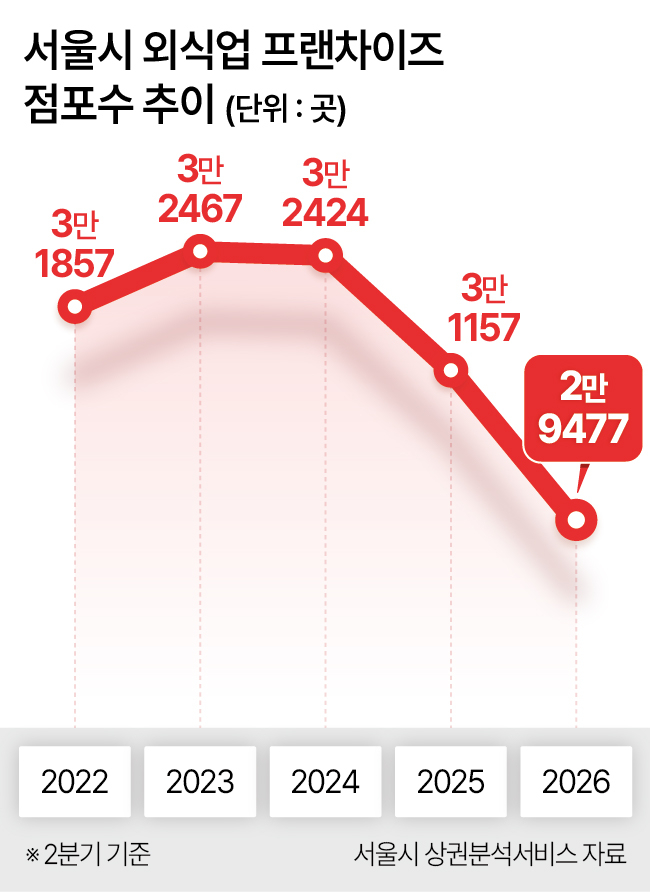
Nearly 1,700 franchise restaurant locations have vanished from Seoul in a year — a signal that even the franchise model, long regarded as a stable business option, is beginning to crack.
According to the Seoul Metropolitan Government's commercial district analysis service, the total number of restaurant establishments in Seoul stood at 153,205 this year, down 3,903, or 2.5 percent, from the same period a year earlier. Among them, non-franchise locations numbered 123,728, a decline of 2,223, or 1.8 percent. Franchise locations fell far faster, dropping 1,680, or 5.4 percent, to 29,477 — a rate roughly 3.1 times that of non-franchise outlets. Franchises account for about 20 percent of all restaurant establishments in Seoul, yet they made up 43 percent of the total decline.
By category, hansik franchise locations — covering noodle shops, gomtang restaurants and dak-galbi joints — recorded the steepest drop, falling 550, or 7.6 percent. Hansik franchises represent about 23 percent of all franchise restaurant locations in Seoul. Coffee and beverage franchises, including budget coffee chains, shrank by 318, or 4.4 percent, while snack-food franchises serving kimbap and tteokbokki fell by 206, or 7.1 percent. Chicken franchises declined by 137, or 3.6 percent, and beer-and-snack bars by 121, or 6.6 percent.
Profitability data reinforce the trend. A 2025 survey of restaurant business conditions conducted by the Ministry of Agriculture, Food and Rural Affairs and the Korea Rural Economic Institute found that the operating profit margin for the restaurant industry fell from 12.1 percent in 2020 to 8.7 percent in 2024. Franchise restaurants fared worse than their non-franchise counterparts, posting an operating profit margin of 8.5 percent against 8.9 percent. Some 94.3 percent of franchise restaurant operators cited rising ingredient costs as their top business challenge, followed by intensifying competition at 89.1 percent and higher rents at 87.4 percent.
A key factor behind the steeper decline among franchises is the cost burden unique to franchisees, particularly differential franchise fees. According to the Korea Fair Trade Commission's 2025 franchise industry report, the average differential franchise fee paid by food-service franchisees in 2024 was 26 million won ($19,200), up 13.0 percent from the previous year. Over the same period, average sales growth for food-service franchisees was limited to 6.1 percent.
Rent has added to the strain. Monthly rent per 3.3 square meters in Seoul rose 3.8 percent year on year to 147,067 won, according to the Seoul Metropolitan Government's commercial district analysis service. In Gangnam-gu the figure jumped 12.0 percent to 202,611 won, while in Mapo-gu it rose 16.0 percent to 204,082 won.
A growing number of franchise brands are also winding down their operations entirely. A review of the Korea Fair Trade Commission's franchise information disclosure system shows that 1,345 brands had their disclosure registrations canceled between January and August this year, up 3.2 percent from the same period a year earlier. Cancellation of a disclosure registration in effect means the brand has ceased its franchise business.
Recent examples include Lotte Wellfood's ice cream brand Natuur and Eland Eats' bakery brand Frangerie, both of which have had their disclosure registrations canceled. Two other Eland Eats brands — Asia Moon and Rimini — have also halted their franchise operations. Notted, a donut brand that once drew lines of customers waiting for stores to open, and Tiger Sugar, a Taiwanese brown-sugar milk tea brand, have likewise exited the franchise business.
"Food-service franchises are struggling because high inflation and high interest rates persist, and ordinary people have less money to spend," said Kim Dae-jong, a professor at Sejong University's School of Business Administration. "Competition has also intensified simply because the number of franchise operators — from chicken shops to cafes — has grown far too large."

korean@heraldcorp.com