Per-employee operating profit falls 44% in a year to 27 million won — less than half average pay
Average salary: 57 million won
Operating profit margin: 4.8% → 2.7%
Global excess capacity forecast to reach 745 million tons by 2028
Domestic capital investment backlog exceeds 4.1 trillion won
Union demands: 7.1% base pay rise, 600% bonus
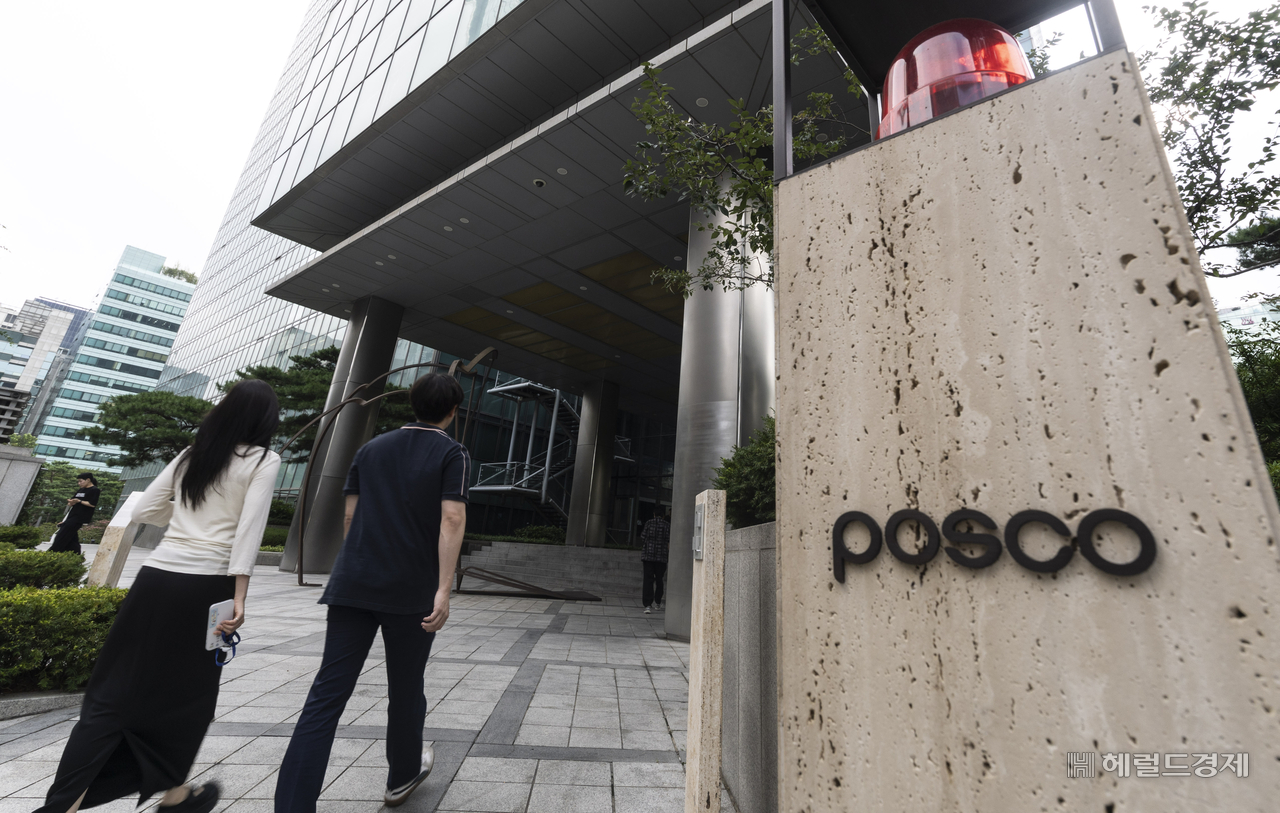
Posco is deepening its struggle with union risk. With the steelmaker's lean period expected to last at least four years amid global oversupply and sluggish demand, management and labor remain far apart on the scale of any wage increase.
According to industry sources, Posco had 18,013 employees as of end-June, up 1.4 percent from a year earlier. Yet operating profit per employee in the first half of this year plunged to about 27 million won ($20,100) — a 44 percent drop in a single year. Sales rose, but profits fell sharply, dragging the operating profit margin down from 4.8 percent to 2.7 percent.
Over the same period, average pay per employee edged up from 55 million won to 57 million won. The profit each worker generated amounted to less than half their average salary.
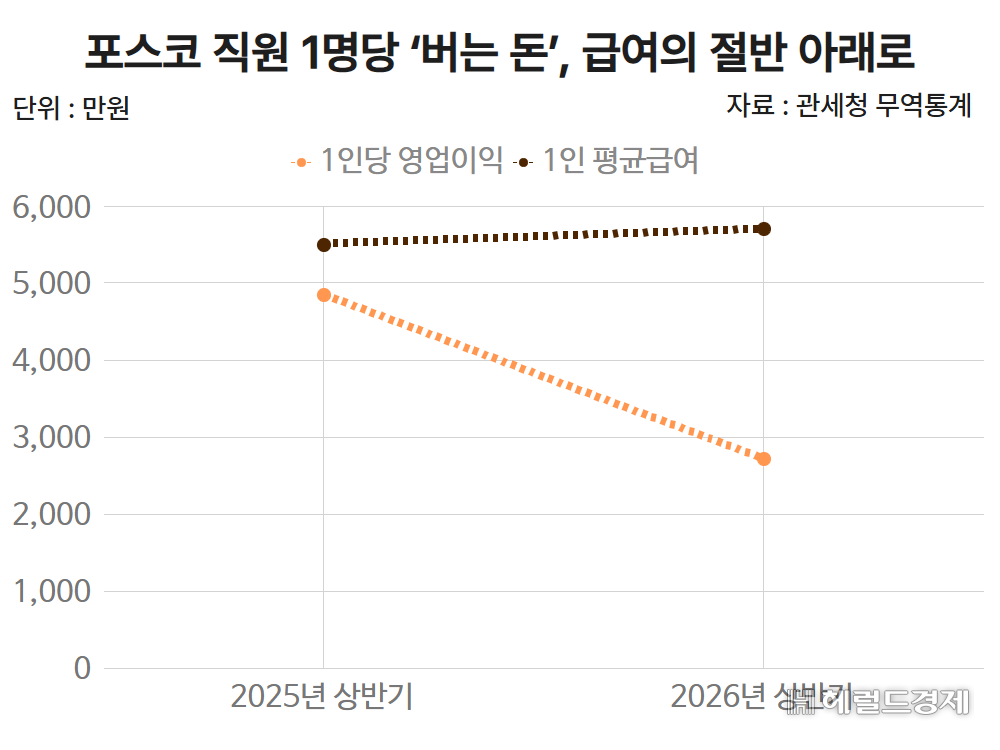
The annual trend tells the same story of eroding profitability. In 2023, per-employee operating profit stood at about 115.8 million won, comfortably above the average salary of 109 million won. By 2024 it had slipped to 82.2 million won, falling short of the 114 million won average salary. Last year, per-employee operating profit came in at about 100.9 million won, again trailing the average salary of 118 million won. This year, the gap has widened further.
Raw material costs have also climbed. The average price of coking coal Posco purchased in the first half of this year rose 32.5 percent to 355,000 won per ton, up from 268,000 won a year earlier. Nickel prices rose 23.5 percent, iron scrap 15.5 percent and iron ore 8.3 percent.
Over the same period, average selling prices moved only modestly — hot-rolled products edged up from 869,000 won to 895,000 won per ton, while cold-rolled products rose from 1.07 million won to 1.08 million won per ton.
OECD warns of deepening steel crisis as global glut set to grow through 2028
The trouble does not end this year. In its recently published Steel Outlook 2026, the OECD declared outright that "the steel crisis is deepening."
According to the OECD, global steel excess capacity reached 640 million tons last year. Between 2026 and 2028, world steel demand is projected to grow by only 34 million tons, while new production capacity could increase by as much as 139 million tons. The global supply glut is expected to swell to 745 million tons by 2028 as a result. Global capacity utilization is also forecast to fall from 76 percent last year to below 74 percent by 2028.
Demand recovery is also slow. The OECD projects world steel demand will grow just 0.4 percent this year after contracting 2.6 percent last year, with average annual growth through 2030 holding at only 0.9 percent. Combined steel demand from South Korea and Japan is expected to shrink from 100.98 million tons last year to 99.07 million tons by 2030, an average annual decline of 0.4 percent.
The production outlook is bleaker still. Combined crude steel output from South Korea and Japan is forecast to fall from 141.9 million tons last year to 132.8 million tons by 2030, an average annual decline of 1.3 percent. Even if the global market grows modestly, South Korea's steel industry is unlikely to fully share in that recovery.
For Posco, this means enduring structural pressure on its business for at least four years, through at least 2030.
China ships 131 million tons of steel abroad, claiming 41% of global exports
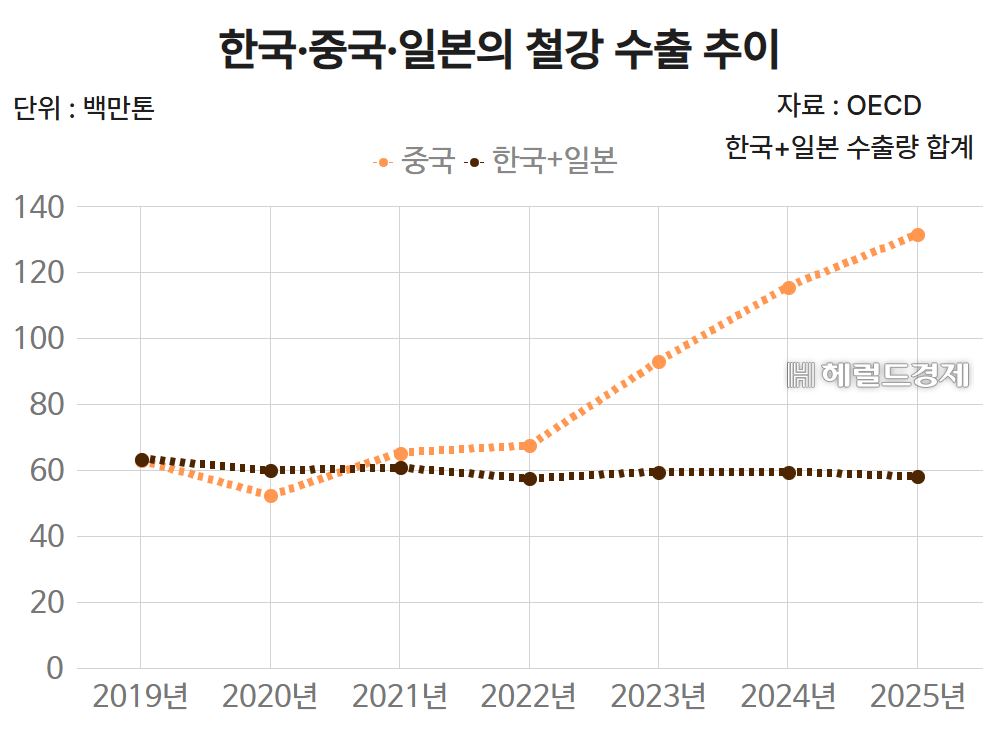
China poses the greatest threat. Chinese steelmakers exported a record 131 million tons of steel last year — a 153 percent surge from 2020. China's share of global steel exports soared from 19 percent in 2019 to 41 percent last year, even as total world steel exports fell 6.2 percent. China's own exports rose 13.8 percent over the same period.
The Global Forum on Steel Excess Capacity also noted in a June report that China's share of global steel excess capacity climbed to 56.6 percent in the fourth quarter of last year. In the first quarter of this year, China's finished-product exports fell 9 percent year on year, but semi-finished product exports rose 28.8 percent — a sign that oversupply pressure has not eased.
Protectionist barriers are rising around the world as well. According to the OECD, roughly 400 anti-dumping and countervailing duty measures on steel have been in force since 2016, with 75 new investigations launched last year alone. As measures targeting Chinese steel tighten, a spillover effect is emerging — volumes blocked from one market are flowing into others.
Earnings shrink, but trillion-won investments loom: 'Hard to keep raising fixed costs'
Posco is closing low-efficiency facilities and shifting its product portfolio toward high-grade steel, while building a 2.5-million-ton-per-year electric arc furnace in Gwangyang and pursuing a hydrogen reduction steelmaking demonstration plant, known as HyREX, in Pohang. Introducing AI-driven steelmaking and securing production bases in high-margin overseas markets are central to its survival strategy.
The remaining capital expenditure on major domestic investment projects already under way exceeds 4.1 trillion won ($3.05 billion). Posco is also participating in a fully integrated electric arc furnace steelworks project in Louisiana, committing $582 million to the venture.
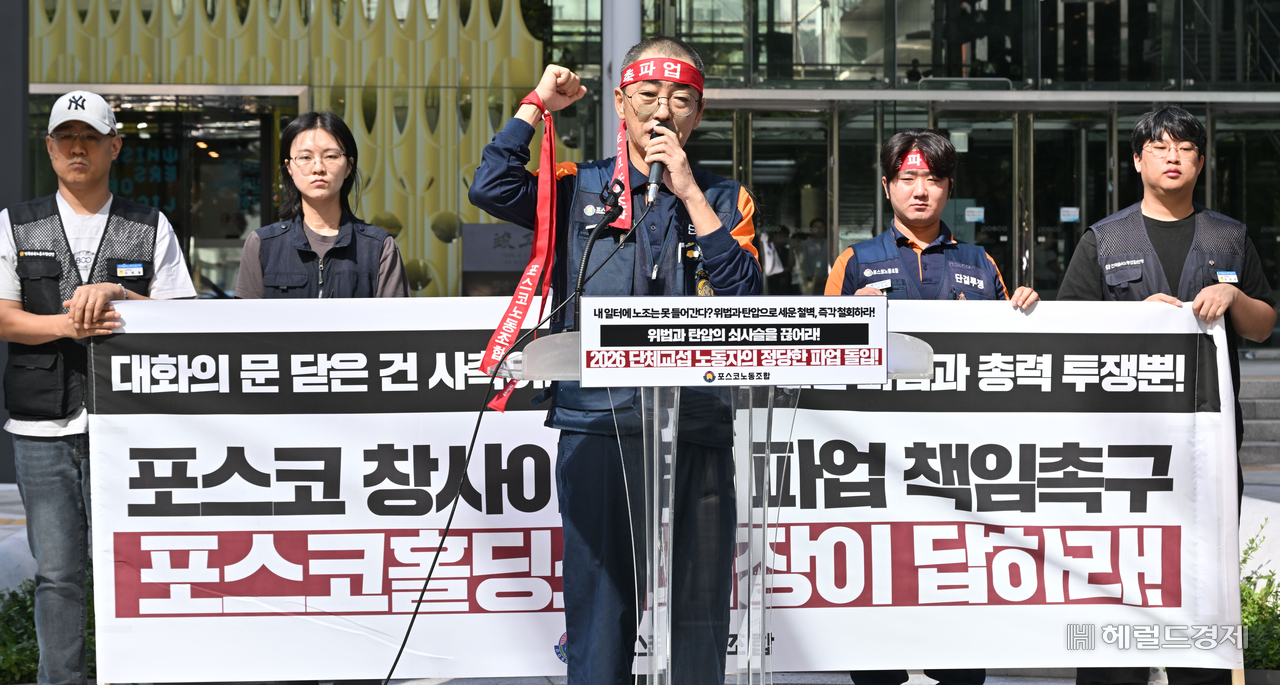
Against this backdrop, the union is demanding a 7.1 percent base pay increase, a 600 percent bonus, 50 shares of employee stock, five years' worth of seniority-based pay increments and a 200 percent holiday bonus. If all demands were met, the company estimates the total cost would reach about 1.4 trillion won.
Management has countered with a 2.0 percent base pay rise, a performance bonus of 3.5 million won and 500,000 won in local gift certificates. The company's position is that, with oversupply and the low-carbon transition set to weigh on the industry for years, it cannot afford to keep expanding fixed labor costs year after year.
"Steel is a capital-intensive industry that constantly requires large-scale facility investment, and fixed costs, once raised, are hard to cut even when conditions deteriorate," an industry official said. "Both labor and management need to consider not just immediate compensation but also the structural changes the industry will face over the next several years."
A Posco spokesperson said the company is maintaining normal production and shipments through available personnel and emergency response systems. "We are strengthening on-site management to prevent any impact on domestic demand industries, and we will do our utmost to reach a swift settlement that keeps the strike from spreading and allows labor and management to move forward together," the spokesperson said.

kwater@heraldcorp.com