Residential heat pump market stirs in Jeju
Autech Carrier selected for heating electrification project, stepping up market push
Company touts first-mover edge as it competes with Samsung Electronics, LG Electronics
"Sales reps used to go door to door. Now customers come to us first."
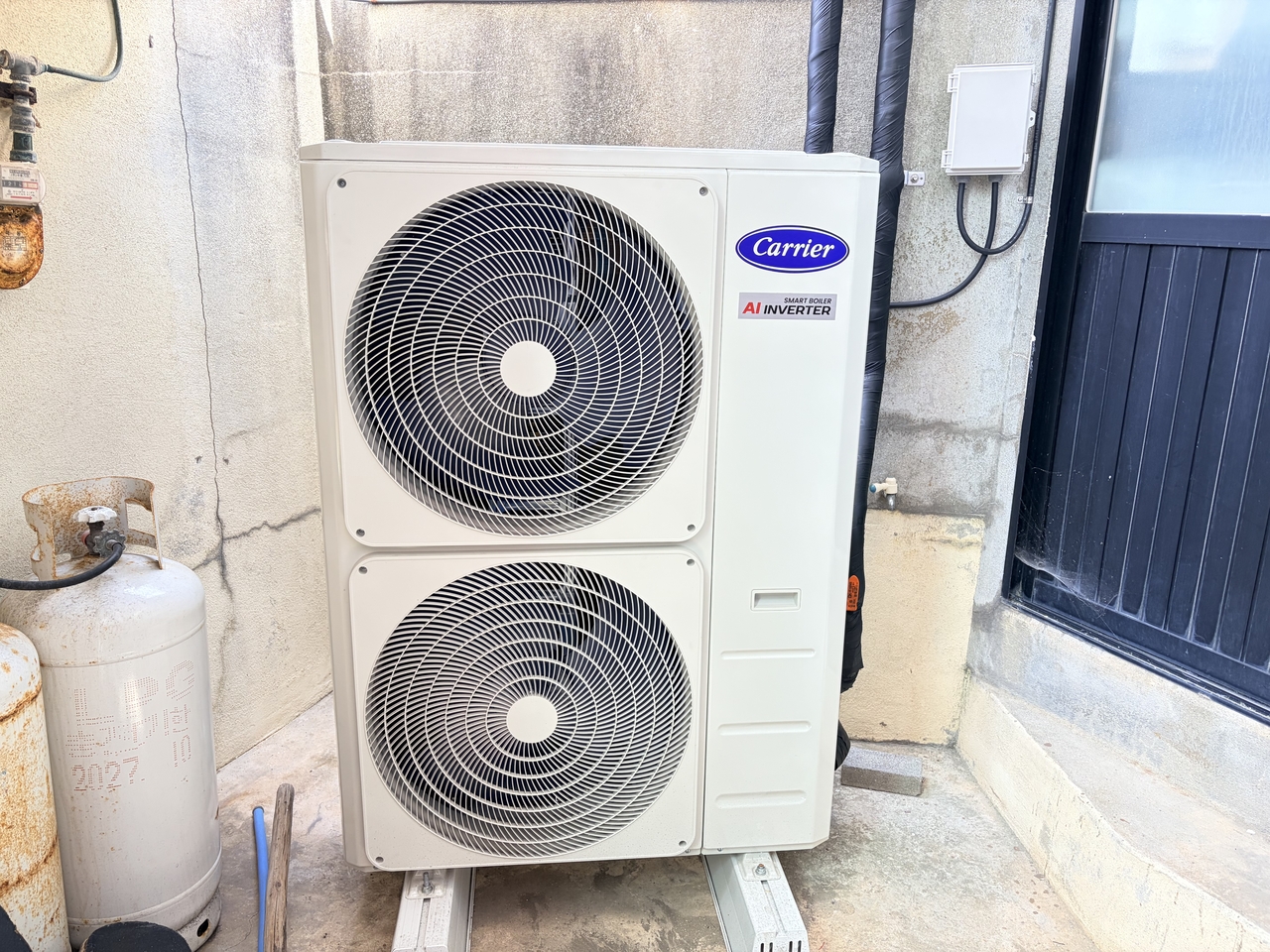
At a detached house on Dodu Hanggil in Jeju on Tuesday, a white machine resembling an air conditioner's outdoor unit sat in one corner of the yard. It was a residential air-source heat pump boiler installed by Autech Carrier. Unlike conventional boilers that burn oil or gas to generate heat, the device draws warmth from outside air to heat water, which is then used for underfloor heating and hot water supply.
Jung Seung-jin, chief executive of J&A, the local distributor of Autech Carrier heat pumps in Jeju, said the technology is easy to grasp if you think of it as an air conditioner in reverse. Where an air conditioner expels indoor heat outside to cool a room, a heat pump pulls heat from outside air to warm water.
The biggest draw for Jeju residents is lower heating bills. According to Jung, commercial facilities on the island that have already switched to heat pumps are reporting maintenance costs roughly half those of oil boilers.
"Commercial users who have already made it through a winter are saving about 50 percent on running costs compared with oil boilers," Jung said. "Some existing residential installations have also cut heating bills by around half."
Heat pumps find a home in Jeju as fuel costs bite
Jeju has emerged as a testing ground for the residential heat pump market largely because of the island's distinctive heating environment. With low natural gas penetration and a high share of detached houses, a relatively large number of households rely on kerosene or liquefied petroleum gas boilers. That backdrop has prompted the Ministry of Climate, Environment and Energy to launch a "heating electrification" initiative — starting in Jeju — to replace kerosene and LPG boilers with high-efficiency heat pumps.
As the government support program has gathered pace, consumer interest on the ground has shifted noticeably. In the second half of this year, two Autech Carrier residential heat pump models — a 14-kilowatt and a 16-kilowatt unit — were designated as eligible products under the government's second round of support for its 2026 heating electrification project. Jung said Autech Carrier has been allocated about 179 units under the current second-half program, and applications have already come in from more than 100 households. "A lot of consumers are reaching out on their own because of the burden of winter fuel costs," he said. Inquiries are concentrated among residents of detached homes looking to ease that burden.
Autech Carrier's push into the residential heat pump market is not new. The company began developing an inverter hybrid boiler in 2011, before a domestic heat pump market had taken shape, and started rolling out units in 2014. More recently, it launched mass production of residential heat pump boilers at its manufacturing base in Gwangju.
Samsung, LG Electronics head to Jeju as heat pump rivalry heats up
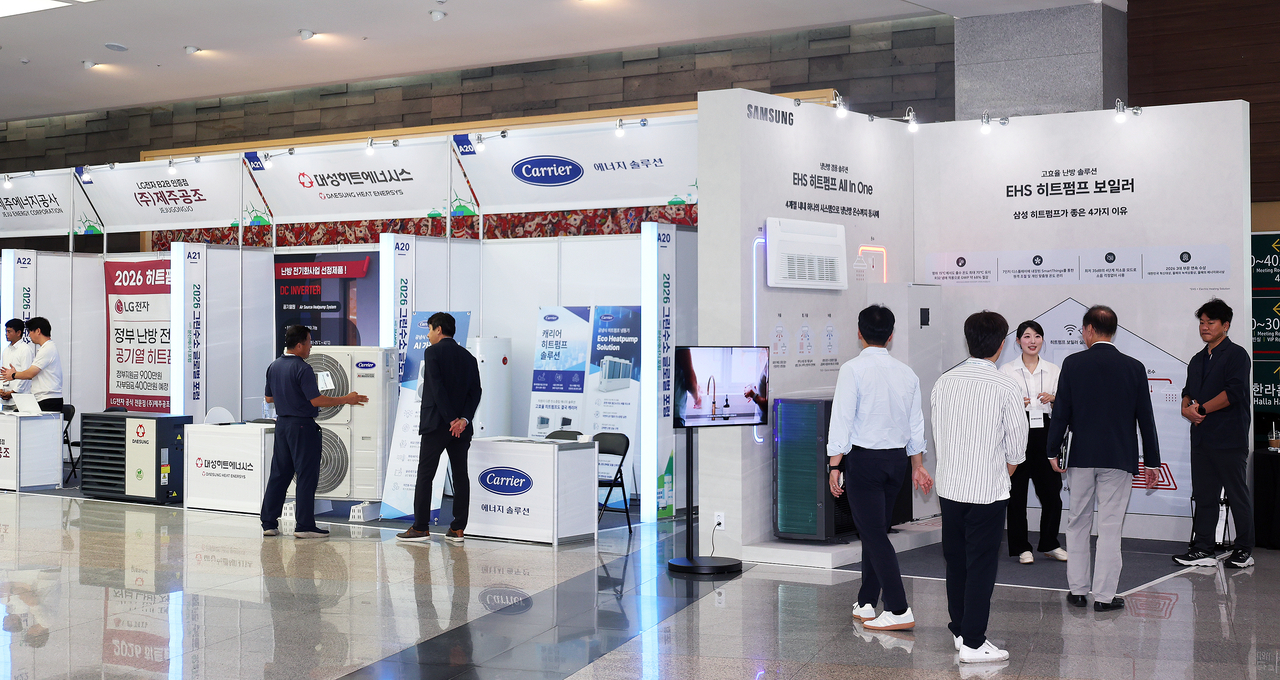
The competition among companies vying for the residential heat pump market was on full display Tuesday at the Green Hydrogen Global Forum at the Jeju International Convention Center. Autech Carrier, Samsung Electronics, LG Electronics and Daesung Heat Energys — all four participants in Jeju's heating electrification project — exhibited their residential heat pump products side by side.
At a glance, each company's unit looked much like a large air conditioner outdoor unit. The Jeju pilot program has cracked open a market that was relatively unfamiliar to domestic consumers, and the race to stake out an early position is well under way.
Kim Min-seok, head of Autech Carrier's systems sales team, said the Jeju pilot is proceeding at a scale of 2,460 units this year, with Autech Carrier joining from the second half. "We are competing on the strength of our heat pump business experience and service network," he said.
On competing with Samsung Electronics and LG Electronics, Kim said going up against large conglomerates is not easy, but the company's goal is to keep pace as closely as possible, given its roots as a pioneer in heating and cooling technology. "If the program scales up in earnest from next year, we expect the residential heat pump market to grow considerably," he added.
Electricity rates, apartment buildings stand as hurdles to nationwide rollout
For the residential heat pump market that has taken root in Jeju to spread nationwide, however, significant challenges remain. The biggest variable is the electricity tariff. Because heat pumps use electricity to transfer heat, the progressive rate structure applied to residential electricity bills could undercut the cost savings consumers actually feel, even given the technology's high efficiency.
"This is not a market that manufacturers can crack simply by making a good product," Kim said. "Because it runs on electricity, the right policy framework has to be in place — whether that means addressing the progressive tariff structure or introducing a dedicated heat pump rate plan."
Expanding the program to apartment buildings is another unresolved challenge. This year's heating electrification initiative has focused primarily on detached homes. Extending it to apartments and other multi-unit housing will require solving practical problems: finding space for outdoor units and thermal storage tanks, and integrating the systems with existing heating infrastructure.
boo@heraldcorp.com