
2026 International Naval Technology Conference
Hanwha Systems team leader Jo Gyu-seong presents
'Submarine combat systems are the pinnacle of systems integration'
'Open architecture essential to meet export customers' requirements'
'Interoperability, education and training must be part of the package'
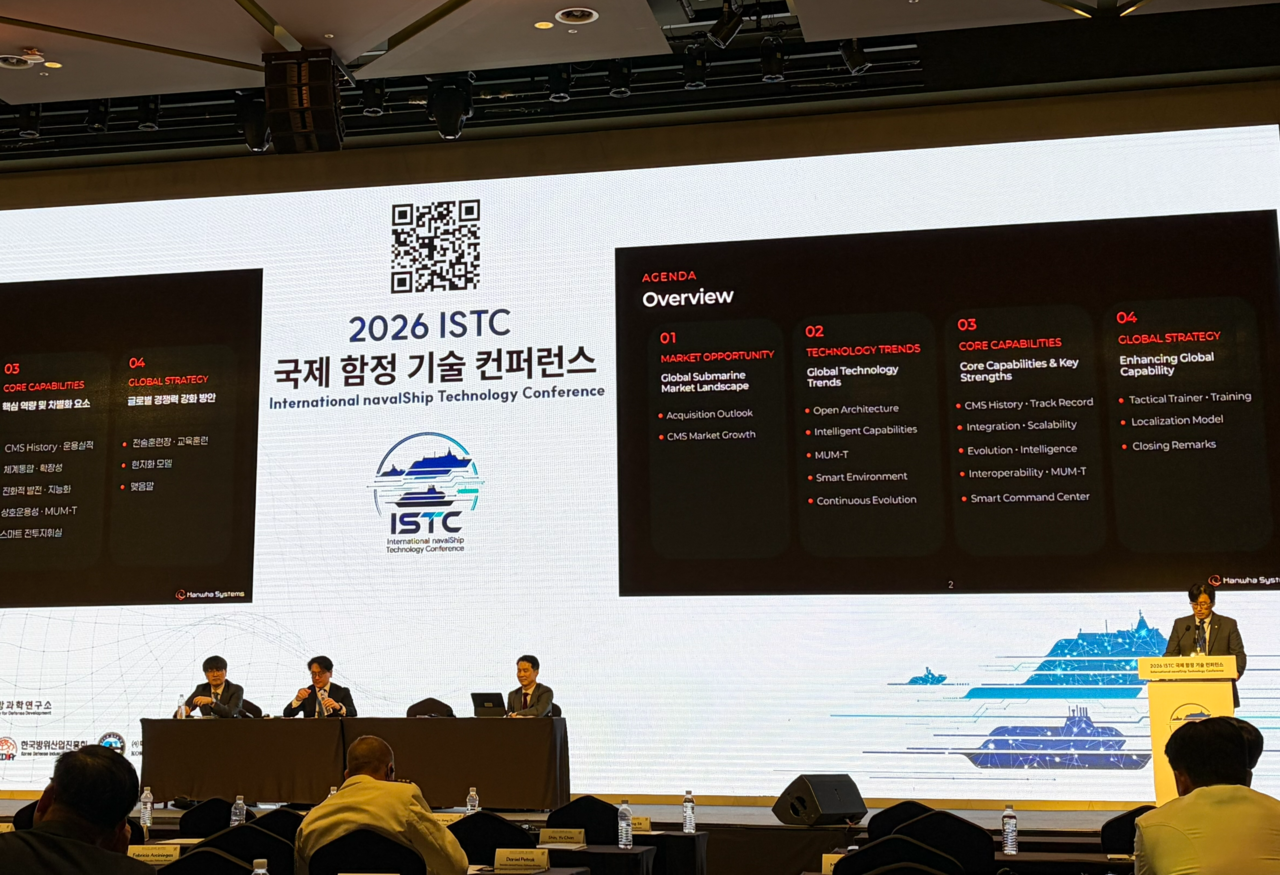
South Korea's submarine combat systems must adopt an open, evolutionary architecture built on more than four decades of accumulated systems-integration expertise to compete in the global market, an industry expert said Tuesday. The combat system market — the brain of any submarine — is expected to grow steadily as worldwide demand for submarines rises.
Jo Gyu-seong, a team leader at Hanwha Systems, made the remarks while presenting on strategies to strengthen the global competitiveness of submarine combat systems at the 2026 International Naval Technology Conference, held at Dragon City Hotel in Seoul on Tuesday. "The strategic value of submarines continues to grow," Jo said. "Even countries operating conventional submarines are expanding demand to replace aging vessels."
Jo said the submarine combat system market would grow in tandem. Citing projections from Janes Market Forecast, he said the market is expected to more than double from around $1 billion in 2025 over the next decade.
'Open, evolutionary architecture needed to apply latest technology quickly'
Jo pointed to the growing adoption of open architecture in combat systems abroad. The US Navy, for instance, previously struggled to integrate equipment developed by different vendors but has since moved to a standardized open architecture applicable across submarine classes and onboard systems regardless of manufacturer.
"A submarine combat system is not simply a collection of equipment — it is the pinnacle of systems-integration technology, fusing vast amounts of data in real time and organically linking countless systems from detection through engagement," Jo said. "The trial and error, integration experience and know-how accumulated over more than 40 years of developing combat systems in Korea are the core of that technology."
He said open architecture and scalability are essential for responding flexibly to the requirements of export customers. "By applying internationally standardized open architecture and modularizing the system, we can swap out sensors or weapons to meet a customer's needs as quickly and flexibly as swapping out Lego bricks," Jo said.
He also called for an evolutionary development approach to ensure the latest technology can be incorporated into submarines, which take many years to build. "In long-duration programs, technology can already be obsolete by the time the equipment enters service," he said. "Systems must be able to evolve continuously throughout their life cycle, and applying this to submarines allows the latest technology to be integrated more quickly while minimizing structural changes."
'Goal is an AI staff officer — a tool to support decision-making'
Jo also identified AI integration as a key challenge in making combat systems more intelligent. The French Navy's underwater acoustics test center has seen productivity improve by roughly 40 to 50 percent through AI adoption, he noted, while the US Navy is developing and validating AI-based decision-support capabilities. "The ultimate goal, I believe, will be building an AI staff officer that enhances crew efficiency and supports decision-making," Jo said. "Final authority rests with humans, and AI must serve as a tool that supports that final decision."
Jo also identified unmanned underwater vehicles and manned-unmanned teaming as future directions for submarine combat systems. Hanwha Systems is developing docking-type and multipurpose modular unmanned underwater vehicles to build the relevant technology. "Going forward, we plan to develop combined-operation technology linking submarine combat systems with unmanned systems, and to expand into the submarine manned-unmanned teaming domain," he said.
Interoperability, education and training key to export competitiveness
Jo said interoperability, education and training, and localization capabilities are also critical to boosting export competitiveness. "Our combat systems have verified their interoperability through participation in multinational exercises such as RIMPAC," he said. He added that tactical training equipment and education and training programs should be offered as part of an export package, warning that a submarine becomes useless if the purchasing country cannot operate it properly.
Jo also proposed a localization model to support the long-term technological self-reliance of purchasing countries. "Systematic education and technical support are needed to ensure smooth assembly, production and systems integration through local partners," he said. "Proposing a localization model — including technology transfer — that raises the technological self-sufficiency of the recipient country is a way to strengthen competitiveness."
keg@heraldcorp.com




