As flower prices climb, bargain hunters head to the wholesale market — and closing time is the new prime hour
"At this price, there's nothing left for me. I'm basically giving them away."
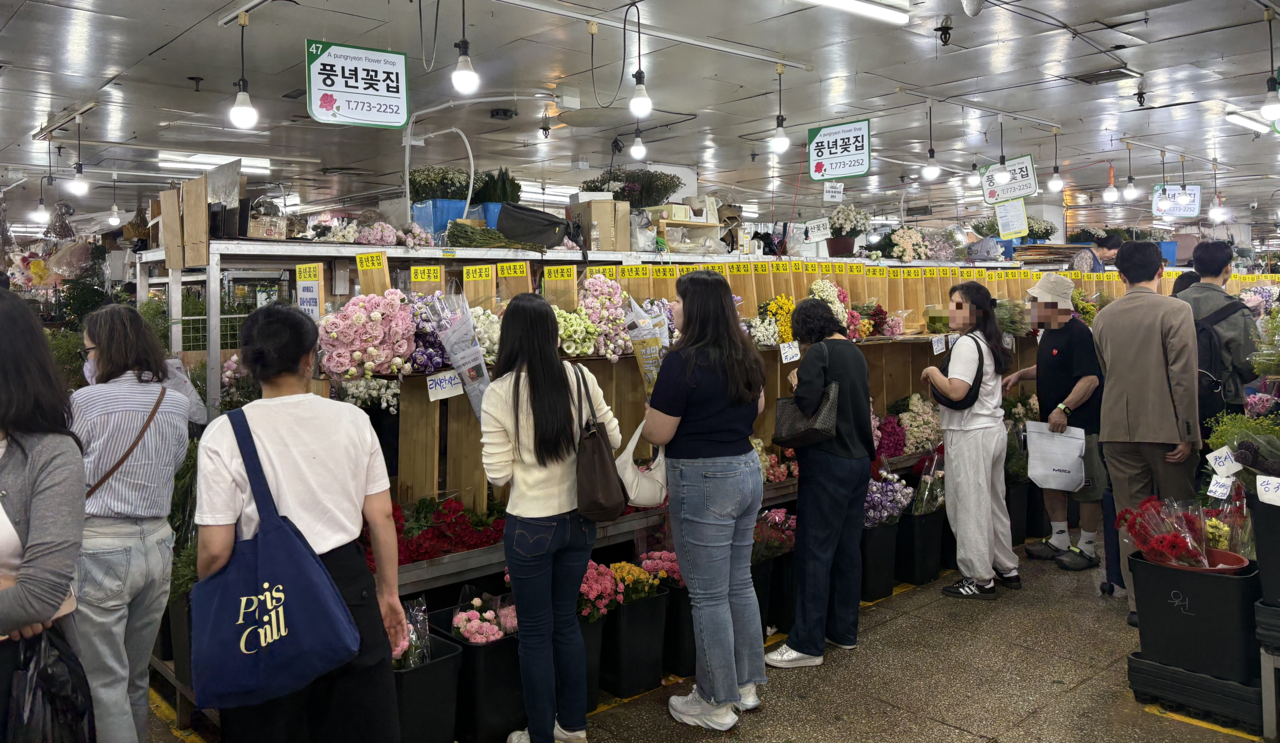
At 1 p.m. on Saturday, people trickled down the stairs of Building E at Namdaemun Market in Jung-gu, Seoul, each clutching a bouquet wrapped in newspaper. Their destination: the flower market on the third floor. With two hours left before closing, shoppers moved briskly through the stalls, filling the narrow aisles between flower shops.
Namdaemun's flower market has bloomed on SNS. Word has spread that it is one of the cheapest places to buy flowers in the city, drawing a younger crowd. Visitors ranged from men shopping alone to couples picking out bouquets to groups of women browsing together.
The selection was just as varied. Red, yellow and blue roses sat alongside white baby's breath, each shop arranging its wares in its own way. Most stalls had no price tags, so shoppers constantly called out, "How much is this one?" As closing time approached, some vendors began cutting prices, and hands moved faster. Newspaper-wrapped bundles piled up in shoppers' arms one by one.
On Saturday, 100 roses were going for 60,000 won ($45). That is roughly a third of what the same quantity — fully wrapped and arranged — would cost at a regular flower shop, where prices can exceed 200,000 won. The low prices are possible because it is a wholesale market: flowers are sold in bulk, unwrapped and untrimmed.
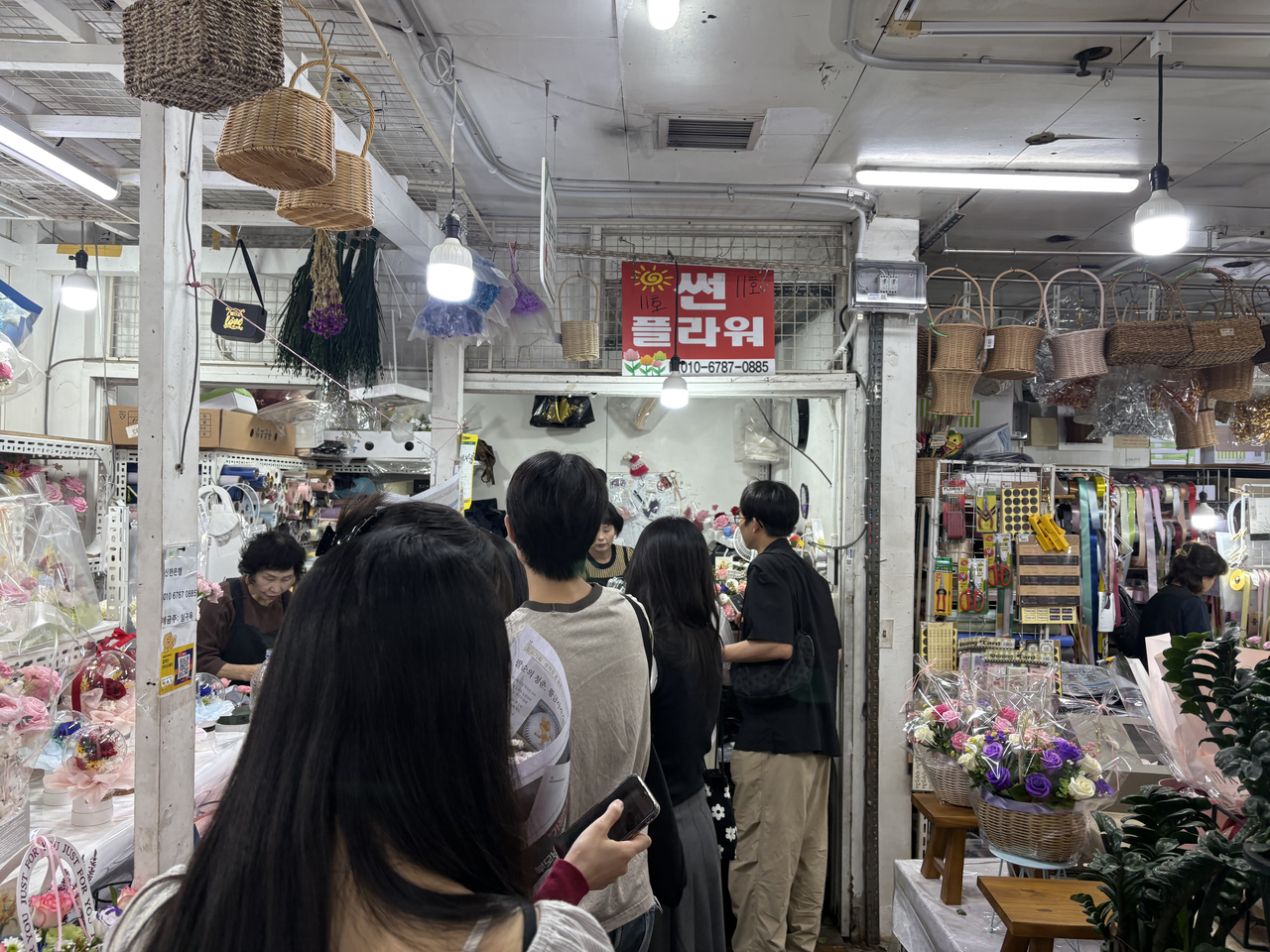
Deeper inside the market, one shop offered to assemble purchased flowers into a finished bouquet. Customers could bring their own blooms and have them arranged to order. The service cost around 25,000 won for 100 stems. At one point a line formed outside the shop, and those waiting passed the time choosing wrapping paper and ribbon colors.
Kim Yu-rim, 25, who came from Ilsan, said she had heard that visiting near closing time was the best way to find bargains. "I'm happy — I got a mood boost at a low price," she said. Jo Min-a, 26, waiting for her bouquet to be assembled, said she had stumbled upon the market while looking for a birthday gift for a friend. "I bought 10 roses for 7,000 won," she said.
Vendors have noticed the shift. One merchant said the market used to be busy in the mornings when wholesale buyers came in, then quiet in the afternoons — but lately, younger consumers have kept the afternoons lively too. The buzz on SNS has been equally striking: as of Saturday, posts tagged with the Namdaemun flower market hashtag numbered more than 15,000.
The influx of young shoppers has not translated directly into higher sales, however. Many come specifically to pick up leftover stock near closing time or to buy small bundles. Even so, vendors have welcomed the trend, given that rising flower prices have broadly dampened demand for cut flowers.
Domestic flower consumption has indeed been declining. Data from the Korea Agro-Fisheries and Food Trade Corporation's flower distribution information system show that cut-flower transaction volume at the Yangjae-dong flower auction house through Saturday totaled 470,000 bundles, down 19.72 percent from 590,000 bundles in the same period last year. At the Busan flower auction house, volume through Friday reached 100,000 bundles, a drop of 8.29 percent year on year. The Gwangju Horticulture Agricultural Cooperative recorded 50,000 bundles, down 3.15 percent.
Soaring prices are also visible in auction figures. From January through September this year, the total value of cut-flower auctions at the Yangjae-dong house rose 6.68 percent from a year earlier. Over the same period at the Busan house, transaction volume edged down 0.46 percent, yet the total auction value climbed 11.08 percent.
Choi Cheol, a professor of consumer economics at Sookmyung Women's University, said rising prices have pushed consumers to actively seek out places where they can buy products more cheaply. "As that information spreads quickly through SNS and other channels, shoppers are gravitating toward sellers with a competitive price advantage," he said.
siuu@heraldcorp.com