Hyundai raises annual pay 8% a year even as profit falls
Company cites cost overhaul to counter cheap Chinese cars
Suppliers stage protest against demand to cut supply prices
Local business group urges restraint on labor demands
Hyundai Motor, which raised pay by more than 40 million won ($29,900) per worker in this year's wage negotiations, is facing strong backlash after demanding that its suppliers cut costs by up to 20 percent as it looks to shore up falling operating profit.
Hyundai Motor's labor and management agreed this year to raise the base salary by 100,000 won, pay a performance bonus worth 400 percent of base salary plus 12.7 million won, hand out 15 company shares and provide 500,000 won in welfare points. The company's union said the combined effect of the base pay hike and other compensation amounted to a 40.84 million won increase per union member.
But calculated from the agreement, the increase comes to 48.63 million won — made up of 1.2 million won from the base pay hike (100,000 won times 12 months), 28.38 million won in performance bonuses (assuming average annual salary divided by 12 months times 65 percent of monthly base pay), a 12.7 million won lump-sum payment, 5.85 million won worth of shares (15 common shares assumed at 390,000 won each), and 500,000 won in welfare points.
The burden on the company is even larger, since the terms of the wage negotiations also apply to the pay and performance-compensation structure for non-union employees and management staff.
Hyundai Motor's union has cited the company's rising annual sales each year as grounds for its wage and bonus demands. As a result, the average annual salary for employees, according to business reports, rose from 96 million won in 2021 to 102 million won in 2022, 115.2 million won in 2023, 124 million won in 2024 and 131.14 million won in 2025 — an average annual increase of 8 percent, or 2.5 times the average annual consumer price growth rate of 3.28 percent over the same five years.
Hyundai Motor's operating margin, meanwhile, has been on a downward trend since 2023: 5.6 percent in 2021 (117.61 trillion won in sales), 6.9 percent in 2022 (142.53 trillion won), 9.3 percent in 2023 (162.66 trillion won), 8.1 percent in 2024 (175.23 trillion won) and 6.2 percent in 2025 (186.25 trillion won). Sales have kept growing, but operating profit has already turned downward.
Hyundai Motor points to the low-price offensive from Chinese automakers as the biggest reason behind the decline in operating profit. BYD, China's leading electric vehicle maker, held a 10.1 percent share of South Korea's imported car market as of August, ranking fourth behind Tesla (34.9 percent), BMW (20.7 percent) and Mercedes-Benz (13.5 percent).
BYD, which began sales in earnest in South Korea in March last year, quickly ate into the domestic market on the back of in-house production of batteries and other core EV components, low manufacturing costs and aggressive pricing. After selling 6,107 vehicles last year, BYD sold 11,675 vehicles in South Korea in the first half of this year alone. Hyundai Motor, by contrast, saw its domestic sales fall 10.8 percent on-year in the same period, with sales limited to 316,713 vehicles.
Facing mounting wage negotiation costs year after year on top of the low-price offensive from Chinese automakers, Hyundai Motor turned to an aggressive countermeasure: demanding cost cuts from its suppliers. In April, the company notified 364 first-tier suppliers to submit cost-reduction plans by next year. The targets set were up to 20 percent for general suppliers, 5 percent for body-manufacturing suppliers and 2 to 5 percent for group affiliates. Hyundai Motor has signaled it will differentiate order volumes and bidding opportunities based on how well suppliers meet these targets, putting heavy management pressure on them.
Lower-tier suppliers worry that the cost-cutting demand, given the limits of process improvements and technological innovation, will trickle down from first-tier suppliers to second- and third-tier suppliers in the form of price squeezing. If the burden of cost cuts is pushed onto lower-tier companies, their profitability could deteriorate to the point of forcing them out of business. An estimated 3,000 first-, second- and third-tier suppliers take part in the supply chain for Hyundai Motor's Ulsan factory.
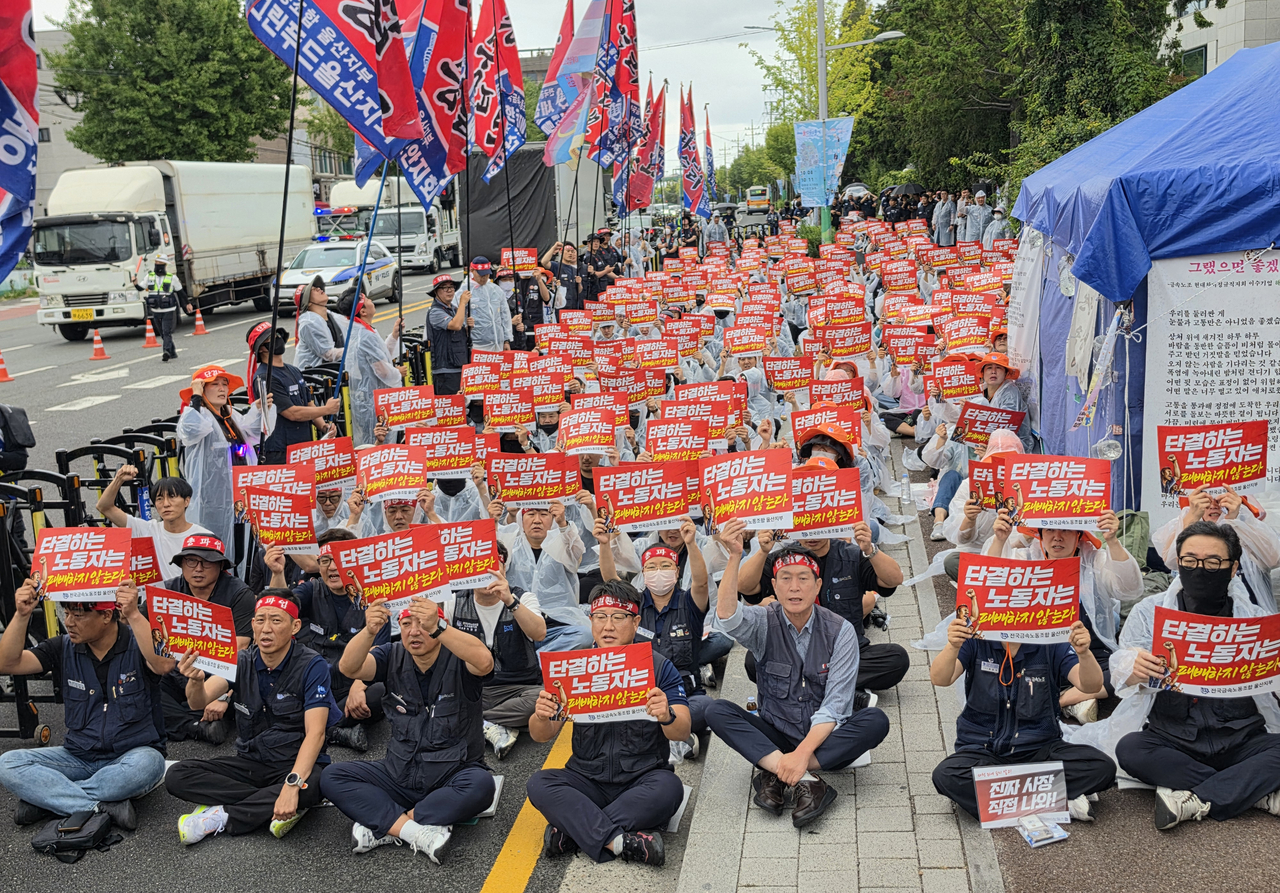
The Korean Metal Workers' Union's Ulsan chapter, representing 37 parts affiliates in the Ulsan region and led by chapter head Kim Ki-ho, held its third strike rally in front of Hyundai Motor's main gate in Buk-gu, Ulsan, on Sept. 9, demanding wage negotiations with the parent company and denouncing Hyundai Motor's demand for lower supply prices from suppliers. Union members who attended the rally said that with price cuts already underway, an additional 20 percent cost-reduction demand would lead to layoffs and worsening wages and working conditions at supplier companies, and urged Hyundai Motor to withdraw the demand.
A representative of a third-tier supplier, who requested anonymity for fear of retaliation, said, "Cost-cutting demands that start with the parent company have always been passed down to lower-tier suppliers. Our operating profit is only 2 to 3 percent, and if we have to absorb both rising fixed costs, including raw materials, and additional cost cuts, we won't be able to hold out much longer."
An official with the Ulsan Federation of Small and Medium Enterprises said, "Every time Hyundai Motor, the region's largest workplace, holds wage negotiations, small and medium-sized businesses walk on thin ice. Just as workers should show some restraint in their demands so the company can survive and jobs can be preserved, the government should also roll out bold support policies for businesses, since a thriving company means more tax revenue for the state."
cityblue@heraldcorp.com