Direction may take shape at NSC after Lee's return from France
Presidential secretary: 'Technical support possible even without deployment'
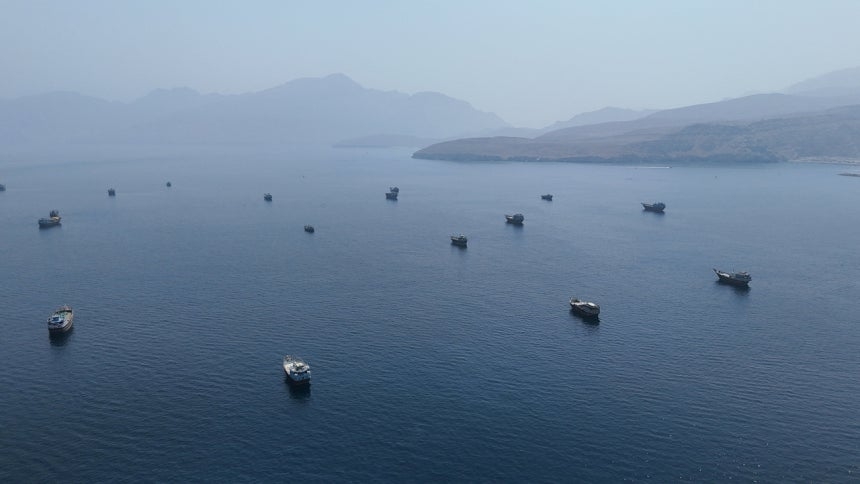
A Ministry of National Defense survey team dispatched to the Middle East to assess conditions for a potential troop deployment to the Strait of Hormuz returned home on Thursday.
According to sources familiar with the matter, the team left for the UAE last weekend and returned through Incheon International Airport on Thursday after wrapping up its field survey.
The team appears to have inspected military bases and ports of call that South Korean forces could use, as well as local logistics and operational conditions, including maintenance and supply support.
The UAE, which borders the Strait of Hormuz, hosts Al Dhafra Air Base, a key US military installation in the Middle East. The government has been strongly considering deploying a P-8 Poseidon maritime patrol aircraft to the region. The team is believed to have examined conditions for operating the P-8 out of Al Dhafra. The delegation reportedly included working-level officials from the Ministry of Foreign Affairs in addition to Defense Ministry officials.
Under the Defense Ministry's directive on overseas troop deployment operations, a survey team assessing potential deployment sites must submit an activity report to the National Security Council upon its return.
However, since this survey was conducted as a preliminary review to gauge conditions on the ground, it is not expected to lead directly to a policy decision on whether to deploy troops.
A Defense Ministry official, confirming the dispatch of the survey team earlier, said, "The field survey team was sent to assess the security situation and other conditions in the region, and this survey is not premised on an actual deployment."
President Lee Jae Myung departed for home Wednesday (local time) after wrapping up a state visit to France, raising the possibility that the direction of the deployment issue could take shape after his return.
Seong Ki-hong, the presidential office's senior secretary for public communication, said on Wednesday during an appearance on Maebulsho, a YouTube political talk show, "The president is the final decision-maker, and everything will be discussed at the NSC."
Some observers say the deployment issue could be placed on the NSC's agenda next week if discussions progress, but the government has maintained a cautious stance, saying no decision has been made yet.
Pressure from US President Donald Trump, who has publicly expressed dissatisfaction with South Korea's level of contribution to Hormuz-related efforts, is likely to add to Seoul's diplomatic burden.
Attention is also focused on how the Hormuz issue will be addressed in upcoming high-level talks between South Korea and the US. Defense authorities from both countries are reportedly coordinating plans to hold the second-half Korea-US Integrated Defense Dialogue, or KIDD, meeting in Busan next week.
While Hormuz contributions have not traditionally been an alliance matter addressed at KIDD, the possibility that the US could raise the issue cannot be ruled out.
rimsclub@heraldcorp.com