No system to counter activist funds, other outside intervention
Poison pills, other defense tools absent
US mandatory-adoption states decline as protection concerns grow
Japan abolished cumulative voting in 1974
'Without management protection systems, it's an uneven playing field'

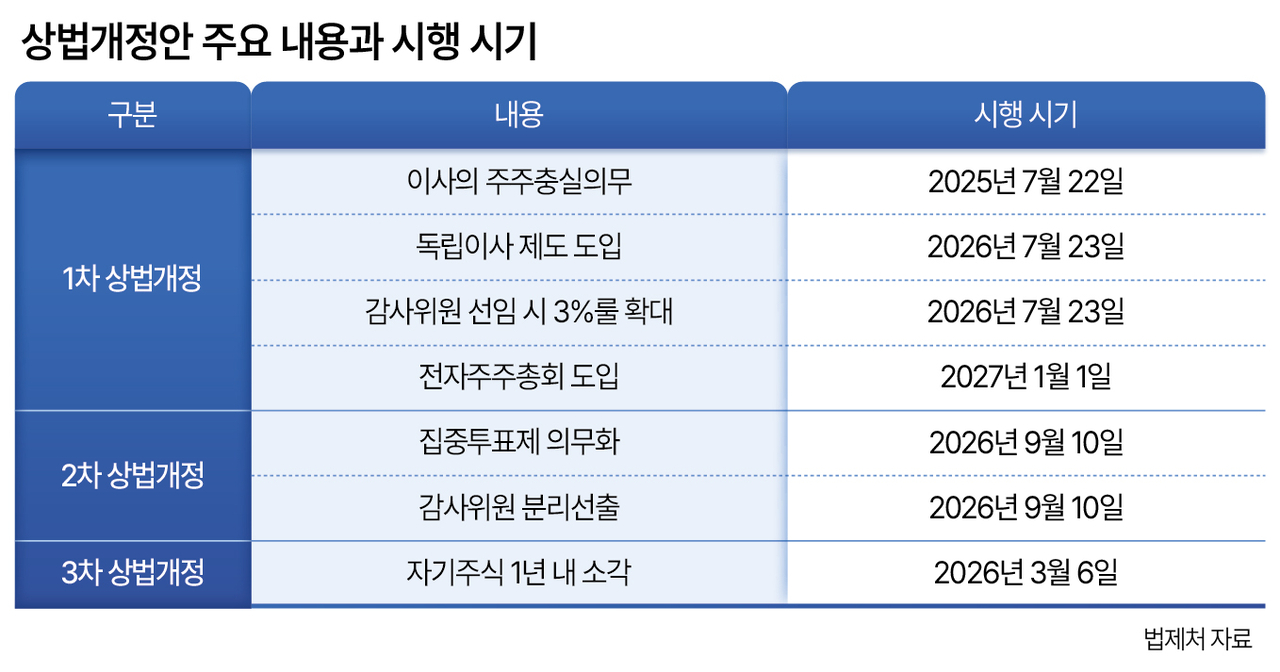
The second phase of amendments to the Commercial Act has taken effect, mandating cumulative voting and expanding the range of companies required to separately elect audit committee members. The move is stoking concerns among businesses over how to defend their management control. Companies have moved to revise their corporate charters and expand shareholder returns. However, experts say South Korea still lacks the institutional tools to counter outside forces such as activist funds and private equity funds seeking to intervene in management. While acknowledging the intent to strengthen shareholder rights, experts called for measures to address side effects, including the absence of defenses against hostile attempts to seize management control.
Cumulative voting seen shaking up firms, with no defense in sight
Hwang Yong-sik, a professor at Sejong University's School of Business, said Thursday that cumulative voting could be exploited by outside forces with an interest in gaining management control. "External investors or private equity funds could use cumulative voting to elect specific directors or audit committee members in an attempt to destabilize companies with entrenched, owner-centered management," Hwang said.
Hwang also noted that companies currently have few sharp tools to defend themselves. "Under the current system, there is no adequate way to mount a defense," he said. "Companies have no real countermeasure beyond expanding friendly shareholdings." Citing Hanjin KAL's recent collaboration with Japan Airlines (JAL) to check Hoban, Hwang said, "Systems that protect management and systems that restrain it need to be balanced, but right now, it is an uneven playing field."
In fact, preemptive management-defense tools such as the poison pill used in the United States and elsewhere have not been introduced in South Korea. A poison pill allows existing shareholders to buy new shares below market price during a hostile takeover attempt or other threat to management control, diluting the acquirer's stake. Calls for introducing such defense measures domestically have been raised consistently, but the system has yet to be institutionalized.
Debate abroad too: 'US, others wary of side effects'
Concerns over management takeovers stemming from mandatory cumulative voting have also been significant overseas. In fact, more than 20 US states, including Illinois, adopted cumulative voting in the mid-to-late 20th century. But as awareness grew that companies needed protection from speculative capital, the number of states mandating it fell to seven. Japan also introduced cumulative voting in 1950 but abolished it in 1974 after problems such as reduced management efficiency emerged.
Choi Jun-sun, professor emeritus at Sungkyunkwan University's law school, said, "Once cumulative voting is fully implemented, the number of audit committee members elected through coalitions of private equity funds and others is expected to grow, which could threaten the management rights of major shareholders who otherwise can form the board." He added, "In the US, out of concern over side effects, cumulative voting is used mainly in states with few companies, while it is not implemented in states with major global corporations, such as California and New York."
Companies are expected to step up countermeasures, including revising their corporate charters, as the new system takes effect. "Companies are expected to first revise their charters to reduce the number of directors that can be elected," Choi said. He added that firms are also likely to adopt staggered board terms, under which directors' terms expire at different times.
'Need to discuss ways to offset negative effects'
Strengthening shareholder rights is an irreversible trend, but experts say the resulting vulnerability in companies' management protection also needs addressing. Park Ji-sun, a professor at Korea University's law school, said, "Broadly speaking, given the trend toward expanding and strengthening shareholder rights, this direction was to be expected, and corporate management also needs to accept the changing tide."
Park, however, went on to say, "How to respond if this is not normal competition but an abnormal process of seizing management control is a separate issue from protecting shareholder interests." He added, "When it comes down to it, if action is taken hastily only after side effects become real, it could end up like fixing the barn door after the horse has bolted." He then stressed that a comprehensive policy design is needed. It should explain both the positive and negative effects overall and discuss policy directions for reducing or offsetting the negative effects.
keg@heraldcorp.com
yeongdai@heraldcorp.com