Cumulative voting made mandatory; separate election of audit committee members expanded
Vote consolidation grows critical as activist investor influence rises
Companies respond by shrinking boards, working to win over shareholders
Minority shareholders gain clout, putting takeover defenses under scrutiny

The second amendment to the Commercial Act, which restricts controlling shareholders' voting rights, takes effect Thursday. Under the revision, listed companies with total assets of 2 trillion won ($1.49 billion) or more can no longer opt out of cumulative voting, and the number of audit committee-track director seats that must be elected separately has been expanded from one to two. With minority shareholders now better positioned to concentrate their votes behind a single candidate and secure a board seat, companies are increasingly concerned about defending management control.
Tighter checks on controlling shareholders prompt preemptive corporate moves
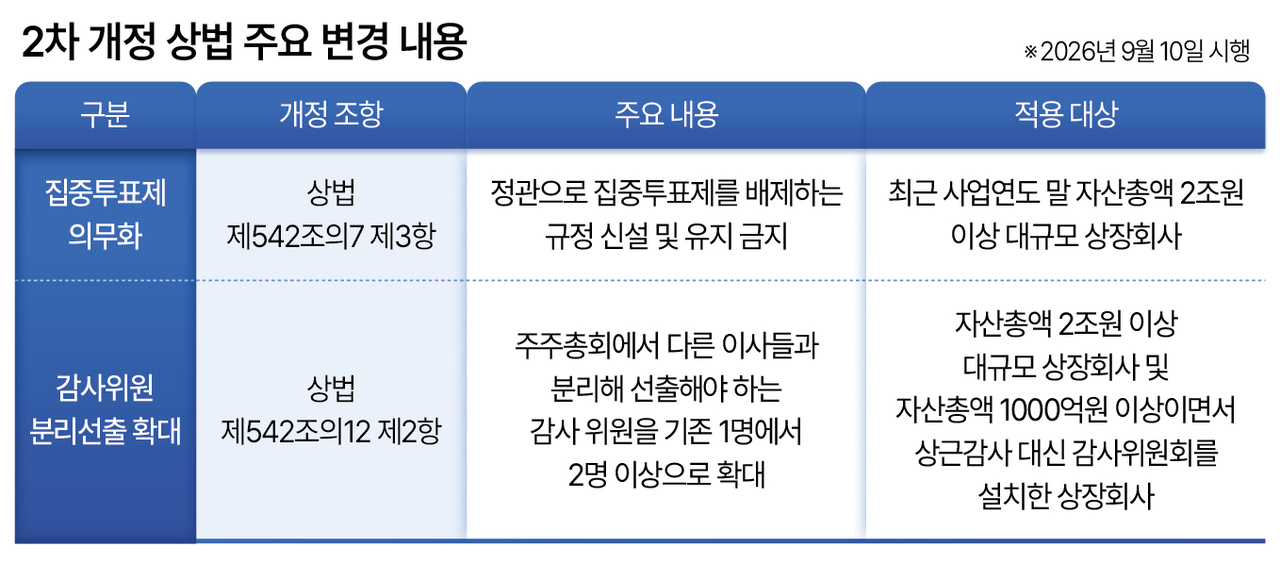
Under cumulative voting, shareholders electing multiple directors can multiply their share count by the number of directors to be elected and cast all the resulting votes for a single candidate. For example, when electing three directors, a shareholder could cast three votes per share and concentrate them all on one candidate. Listed companies had previously been able to exclude cumulative voting through their articles of incorporation, but the amendment bars large listed companies from doing so.
As a result, the key variable in director elections has shifted from simple ownership stakes to shareholder alliances and vote consolidation behind specific candidates. At companies where the controlling shareholder's stake is not overwhelmingly large, institutional investors, foreign investors and individual shareholders could rally behind a particular candidate and pool their votes. This could make it harder for the controlling shareholder's side to sweep all board seats. Activist funds are also expected to become more active in nominating director candidates through shareholder proposals and forming alliances with other shareholders.
Companies have moved early to minimize the chances of minority shareholder-backed candidates winning board seats. According to corporate analysis firm Leaders Index, 332 listed companies among the top 500 firms allowed a comparison between 2025 and 2026. Their registered executives numbered 2,328 as of the end of August, down 46, or 1.9 percent, from the same period last year. Korea Zinc's registered executives fell from 19 to 14, LS Electric's from nine to five, and Celltrion's from 12 to nine.
Some analysts interpret this as a move by companies to minimize the burden of electing additional directors under the revised law. Shrinking the board reduces the number of seats available to outside candidates. Audit committee members, meanwhile, increased from 917 last year to 926 this year, up nine, or 1.0 percent. This appears to reflect that a larger audit committee dilutes the relative influence of separately elected audit committee members.

Minority shareholder influence shakes boards, complicating takeover defenses
The expanded separate election of audit committee members, taking effect alongside mandatory cumulative voting, further complicates matters for companies. The revised law increased the number of audit committee-track directors that must be elected separately from the rest of the board, from one to two. In the separate election of these directors, the so-called "3 percent rule" applies, capping the combined voting rights of the largest shareholder and related parties at 3 percent.
The audit committee, operating within the board, oversees management's operations and accounting. If a candidate recommended by minority shareholders is elected to the committee, the check on the controlling shareholder and management could be substantial. While cumulative voting lets shareholders concentrate votes on a single candidate among several, the separate election of audit committee-track directors restricts the largest shareholder's voting rights. If minority shareholders pool their votes, the controlling shareholder could find itself at a relative disadvantage in the vote.
Companies now face a new challenge, as securing friendly shareholdings alone no longer guarantees a stable board composition. Companies have mainly managed voting rights by focusing on controlling and friendly shareholders. Going forward, the focus is expected to shift toward persuading key shareholders such as institutional, foreign and individual investors. The expertise and independence of director candidates are also likely to matter more. Some point to advance negotiations with minority shareholder coalitions and activist funds as another response option. "We are already shifting toward strategies that strengthen the protection of shareholder interests as we respond to these changes," an industry official said.
As more minority shareholder-backed directors join boards, the potential for more complex conflicts of interest within boardrooms is also drawing attention. When directors nominated by controlling shareholders sit alongside those nominated by activist investors or minority shareholders, disagreements over major management issues could become more frequent. Decision-making could be delayed on matters where interests diverge sharply. Against this backdrop, many in the business community argue that shareholder rights have been strengthened through the revised Commercial Act. They say takeover defense measures should also be introduced in a manner that ensures balance.
keg@heraldcorp.com