- KAIST, Microsoft Research Asia develop brain-computer interface technology
- Expected to benefit physical AI, autonomous driving, medical robots

Researchers have developed technology that allows AI to detect the unspoken "that's not it" reaction that arises in the human brain. The AI then adjusts its own behavior accordingly, without requiring any verbal correction from the person.
KAIST said Thursday that a research team led by Chair Professor Lee Sang-wan of the Department of Brain and Cognitive Sciences developed the technology in collaboration with Microsoft Research Asia. The brain-computer interface, or BCI, technology — called Neural Value Alignment, or NVA — uses human brainwaves to align AI behavior with human goals in real time.
Conventional AI infers human intent based on outwardly visible cues such as speech, actions or gestures. But the same action can stem from different goals, meaning AI systems have often misread a person's actual intent.
The research team focused on the "prediction error" that occurs unconsciously in the brain when a person encounters a situation that differs from what they expected. The team distinguished between a "reward prediction error," which appears when AI misunderstands the ultimate goal, and a "state prediction error." The latter occurs when the goal is correct but the AI's actions unfold differently than expected.
By measuring the real-time electroencephalogram, or EEG, signals of a person observing the AI at work, the team confirmed that different brain signals appear. These signals varied depending on whether the goal itself was wrong or the method of achieving it was wrong. Applying deep learning, the researchers built an algorithm that distinguishes between these signals and lets the AI correct its behavior in real time.
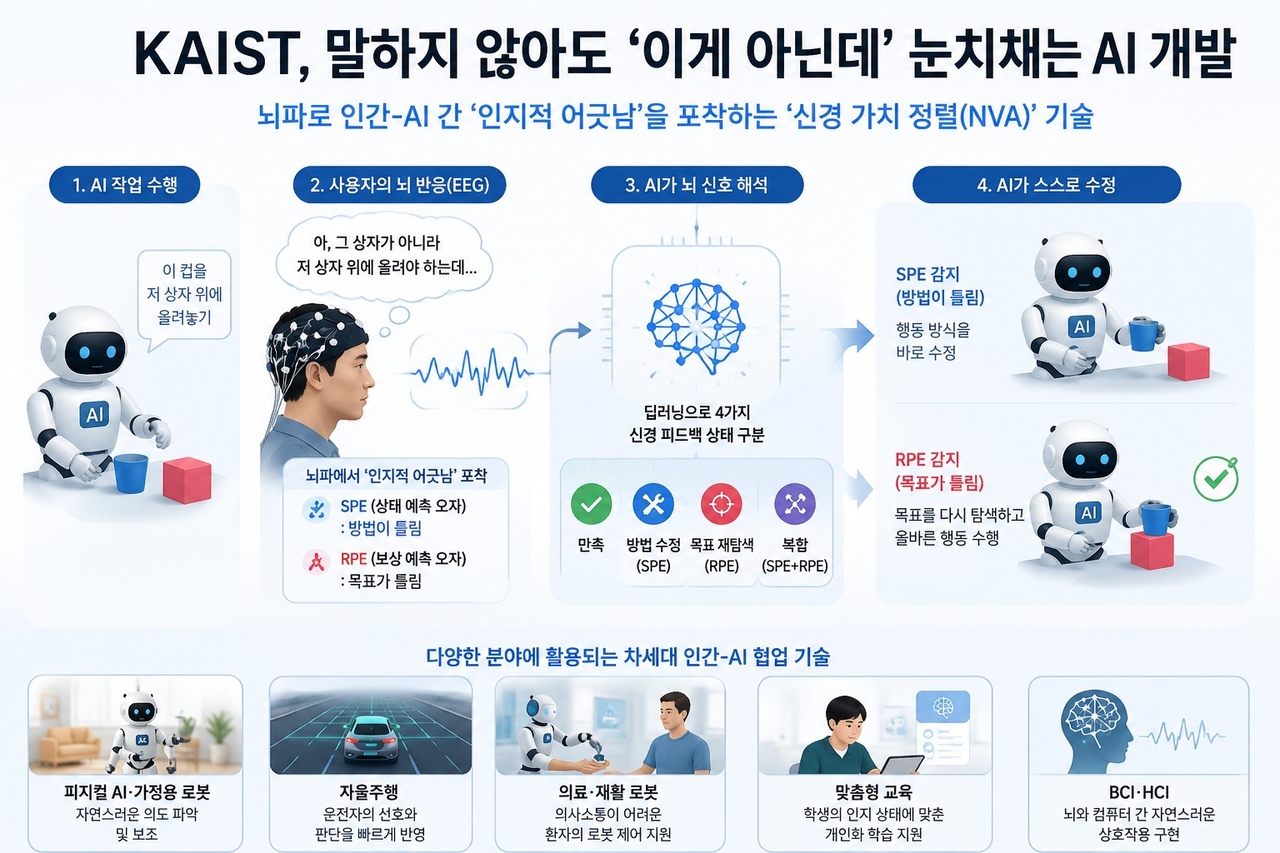
When a state prediction error is detected, the AI determines that its goal is correct but its method is wrong, and adjusts its behavior accordingly. When a reward prediction error appears, the AI concludes that it misunderstood the goal itself and searches again for what the user actually wants. In simulations, the system adapted to sudden changes in a person's goals, or to situations involving missing signals, faster than existing methods.
The technology is expected to be used in fields that require close collaboration between humans and AI, including physical AI robots, autonomous driving, medical and rehabilitation robots, and personalized education.
"This technology has the potential to be introduced as an additional feedback channel across a wide range of existing AI systems," said Lee. "It could be applied to any field where AI must continuously adapt to a person's goals and preferred behavior, including physical AI, collaborative robots, BCI, autonomous driving, medical and assistive robot control, and personalized education."
The findings were published online in the journal IEEE Transactions on Cybernetics in August.
nbgkoo@heraldcorp.com