Naver Z holds four-hour partial strike
Union threatens one-day walkout Sept. 23, then unprecedented five-day strike
Kakao and now Naver embroiled in labor disputes, fueling fears of lost momentum in tech race

The union representing employees of Naver Z, which operates Naver's metaverse platform Zepeto, launched a partial strike Wednesday after wage negotiations with management broke down. It marks the first strike at a Naver Group subsidiary since the group's launch.
The union warned that if the two sides remain apart even after the partial strike, it would escalate its action -- staging a full one-day strike on Sept. 23, followed by an unprecedented five-day strike.
The move comes after Kakao held its first strike since its founding in June. With Naver now drawn into the labor unrest as well, some in the industry worry that a wave of strikes could sweep across the IT platform sector. They fear this could slow the momentum needed to keep pace in the fast-moving technology race.
According to the ICT industry, members of Naver Z belong to the Naver chapter of the KCTU's National Chemical, Textile and Food Workers' Union, also known as Gongdongseongmyeong. They launched a four-hour partial strike Wednesday, from 1 p.m. to 5 p.m.
At the heart of the dispute is the wage increase rate. The union is demanding a 5.3 percent raise, while management has proposed freezing wages, citing the company's financial situation. Naver Z posted sales of 66.3 billion won ($49.4 million) last year, down 14.4 percent from a year earlier. The company also continued to post an operating loss, which came to 49.4 billion won.
Earlier, labor and management failed to reach an agreement through two rounds of mediation at the Labor Relations Commission. In a subsequent strike vote, 88.6 percent of union members took part, with 98 percent voting in favor, securing the union's right to strike.

The union said that if management does not approach negotiations with a more forward-looking attitude even after Wednesday's partial strike, it will raise the intensity of its actions further. That would mean holding a one-day strike on Sept. 23, followed by an unprecedented five-day strike.
"While our members endured anxiety and confusion, the company never moved to offer a responsible explanation or engage in dialogue," the union said. "This strike was not something we chose -- the company pushed us to this last resort." Naver Z's management said it would keep the door open for dialogue.
Industry watchers are closely following whether the bargaining conflict, starting with Naver Z, could spread across all of Naver's subsidiaries. The Naver chapter is currently demanding integrated bargaining covering 16 affiliates, arguing that Naver itself should negotiate directly instead of continuing the individual bargaining process each subsidiary has repeated. Some say the partial strike at Naver Z could become a turning point for joint action across the group.
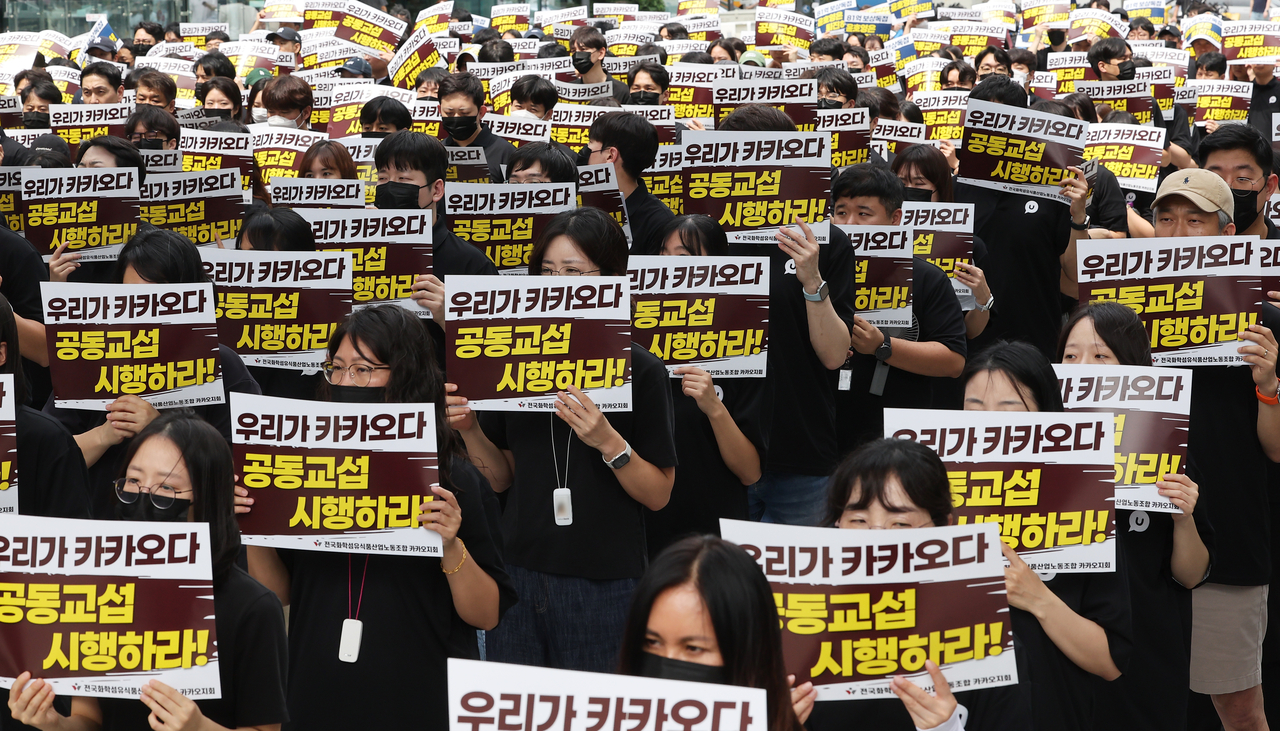
Labor-management conflict in the IT platform industry has intensified this year, escalating into unprecedented strikes.
Kakao held its first-ever partial strike on June 10, followed by a full-day strike on June 29. On Aug. 7, the two sides reached a tentative agreement on a 6.3 percent increase in the total wage bill and a special bonus of 3 million won. This wrapped up this year's negotiations, though tensions remain over issues such as the company's spinoff of its businesses.
As competition in technology such as AI grows increasingly time-sensitive, some worry that prolonged labor disputes could hold back Korean firms in the global tech race. Fast responses are urgently needed, as foreign companies such as OpenAI and Google mount fierce offensives that threaten even the domestic market.
Kakao, for its part, is betting heavily on AI following its spinoff, tasked with accelerating its AI business -- once seen as lagging behind rivals -- through a "speed war." Naver, too, is pouring its full resources into narrowing the technology gap with global AI firms, with analysts saying that time is of the essence.
sjpark@heraldcorp.com