
- Sixth-generation national supercomputer to enter full service in December with 614 petaflops of computing power
- 30 percent of resources prioritized for national strategic research, including K-Moonshot and seven SEED projects

South Korea's sixth-generation national supercomputer, a system expected to rank among the world's top 10, will enter full operation in December. The system, to be used for AI and advanced science research, boasts 24 times the theoretical computing performance of its predecessor. The government plans to open the ultra-high-performance resource widely to universities, research institutes and small and midsize businesses, including startups.
The Ministry of Science and ICT and the Korea Institute of Science and Technology Information, or KISTI, said Wednesday they are calling for applications from researchers in industry, academia and public institutes to use the high-performance computing resources of the sixth-generation supercomputer, under the "2026 National Supercomputer System 6 Innovation Support Project."
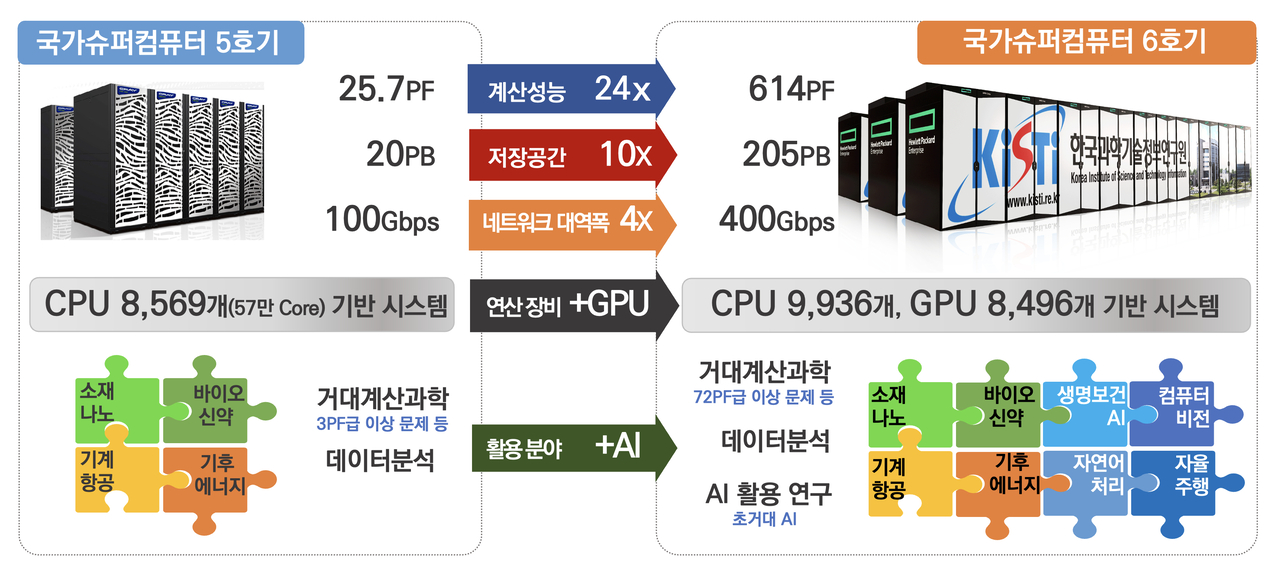
The new supercomputer is equipped with 8,496 GPUs — including Nvidia's latest GH200 chips — and 9,936 CPUs. Its theoretical computing performance reaches 614 petaflops, with 205 petabytes of storage capacity and a network speed exceeding 400 gigabits per second.
Compared with the fifth-generation system, theoretical computing performance rose 24-fold, storage capacity grew tenfold and network performance improved fourfold. Based on the recently released global TOP500 supercomputer rankings, the new system is expected to place among the world's top 10.
The ministry and KISTI signed a construction contract with HPE in May last year and completed system installation and basic inspections last month. Performance and stability testing is currently underway, with official service set to begin in December.
Once operational, the sixth-generation supercomputer is expected to accelerate the spread of AI-based scientific research in particular. Until now, domestic researchers and companies have had to either purchase costly GPUs on their own or rely on private cloud services for large-scale AI research. This has been a burden in terms of both cost and research security. The new system will provide massive computing resources for large-scale computational science, data simulation and AI-driven research.
Overall resources will be allocated with 30 percent going to national strategic research, 55 percent to R&D innovation and 15 percent to industrial innovation.
The national strategic program will give priority access to key projects aimed at securing national strategic technologies, including K-Moonshot and the seven SEED projects. The R&D innovation program receives the largest share at 55 percent and is allocated to general researchers across industry, academia and research institutes. It is further divided into "mega research" for ultra-large-scale simulations and massively parallel computation, "creative research" for computational science and AI research, and "exploratory research" for verifying early-stage ideas.
The newly introduced industrial innovation program will receive 15 percent of total resources. It is aimed particularly at small and midsize businesses and venture firms that lack their own computing infrastructure. These firms will receive not only computing resources but also consulting and technical support from KISTI.
Applications for the official service will be accepted from Sept. 28 to Oct. 16 through the National Supercomputing Center's website.
Lee Sik, president of KISTI, said, "As the national supercomputing center, KISTI is nearly ready to provide stable service for the sixth-generation supercomputer, drawing on our operational expertise. We will support the researchers and companies selected through this call so that they can carry out more active research using the supercomputing resources."
nbgkoo@heraldcorp.com




