
Split structure aims to maximize sale value by shielding core business from rehabilitation liabilities
Final rehabilitation plan includes the measure, pending court approval
Sale of 19 self-owned stores to raise 1.42 trillion won faces uncertain market
Naver, Harim and AliExpress named among potential acquirers
Homeplus, which is undergoing corporate rehabilitation, is moving to split its legal entity. The plan calls for a two-track structure: a surviving entity retaining the normally operating business, and a newly established entity dedicated solely to the rehabilitation process. The move is designed to strip away the risks arising from debt repayment in order to facilitate a merger and acquisition — the ultimate goal of the proceedings. Finding a buyer, however, is expected to take considerable time.
The final rehabilitation plan Homeplus submitted to the Seoul Bankruptcy Court includes the corporate split, according to reporting compiled Tuesday. The approach differs from the structural-reform rehabilitation plan Homeplus had previously pursued. It follows a "good company and bad company" strategy: the surviving entity is reconstituted around the core business and put up for sale, while the newly split entity takes on the responsibilities required for rehabilitation.
The structure is designed to prevent the rehabilitation process from eroding the value of the core business while maximizing the chances of a sale on the open market. The technique has appeared in large-scale restructurings before, including that of General Motors in the United States. "In a corporate restructuring, it is a way to quickly normalize the management of key operations to raise the sale value, while allowing an acquirer to take on less debt," an industry official said.
An M&A is the final destination of Homeplus's rehabilitation proceedings, and this is not the first attempt. Homeplus pursued a pre-approval M&A shortly after filing for rehabilitation in March last year. At the time, two parties — an AI platform company and a real estate developer — submitted letters of intent to acquire the company, but neither participated in the final bid, and the process collapsed. Homeplus subsequently put forward a structural-reform rehabilitation plan that included the separate sale of its supermarket division, Homeplus Express, a move widely criticized as tantamount to liquidation. That sale has since been completed.
The specific timing of the corporate split has not been disclosed. If the debt repayment process proceeds as planned and a sale becomes more concrete, Homeplus is expected to seek approval from the rehabilitation court before proceeding with the split. Kim Gwang-il, vice chairman of MBK Partners, appeared in court Wednesday in his capacity as rehabilitation administrator and said the first priority was to secure profitability through fixed-cost reductions and the closure of loss-making stores in order to repay creditors. "After the rehabilitation plan is approved, we will sell the self-owned stores and then pursue an M&A of the company itself," he said.
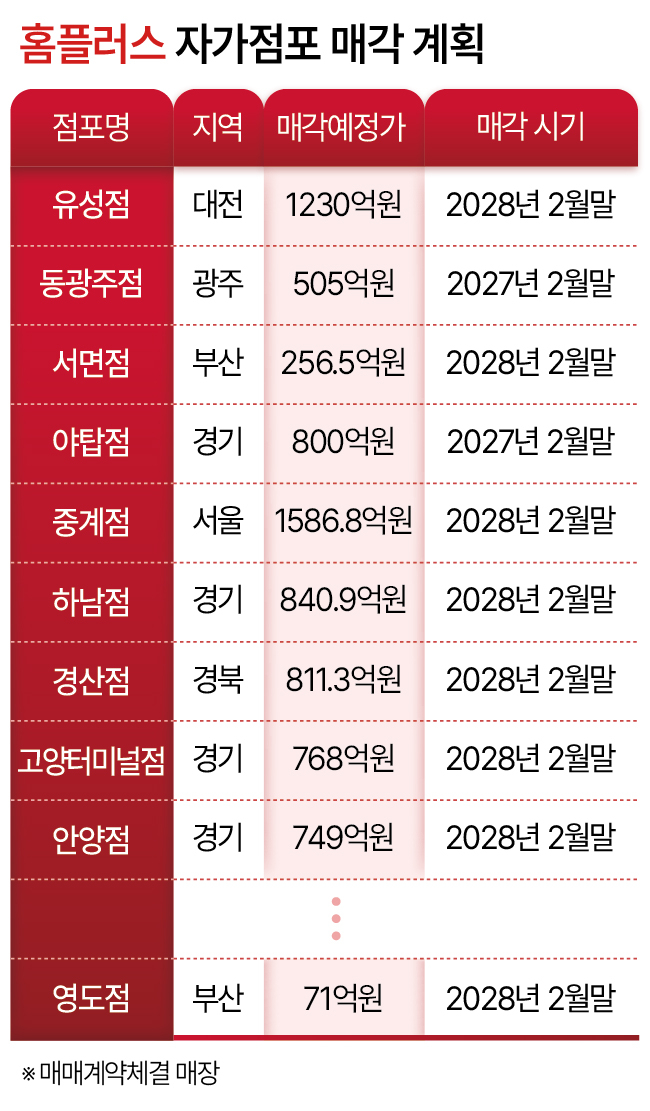
Whether this final M&A attempt will proceed smoothly remains uncertain. Homeplus faces an immediate test in completing the sale of 19 self-owned stores it has closed. Of the 19, sales contracts have been signed for the Daejeon Yuseong store at 123 billion won ($91.6 million), the Dong-Gwangju store at 50.5 billion won, and the Busan Seomyeon store at 25.65 billion won. Negotiations with a prospective buyer are also under way for the Gyeonggi Yatap store. Aside from the Seoul Junggye store, the Namyangju Jinjeop store, the Ilsan Kintex store, the Gyeonggi Hanam store and the Goyang Terminal store, most of the remaining locations are in regional cities. Homeplus plans to sell all 19 stores by February 2028 to raise 1.42 trillion won. Finding buyers willing to pay full price in economically sluggish regional markets, however, is expected to be difficult.
The outcome of the 19-store sales will have long-term implications for the M&A as well, since the proceeds are earmarked to repay senior trust-secured bonds held by Meritz Financial Group, the largest creditor. Only once that obligation is resolved can Homeplus proceed with additional real estate-backed borrowing and fulfill its debt repayment schedule, which runs through 2037.
Naver, Harim and AliExpress are among the names being mentioned as potential acquirers of Homeplus. All three are companies expanding their domestic commerce operations rather than traditional large retail conglomerates. Harim, in particular, is seen as a candidate that could generate synergies with Homeplus Express, which it acquired earlier.
The prospective candidates, however, have been cool to the idea. Given Homeplus's current financial condition, there is a view in the industry that "acquiring it is itself a risk" — meaning Homeplus must succeed in restructuring at the same time as it repays its debts. "Hypermarkets are in the most difficult position among all offline retail formats," another industry official said. "Even if Homeplus pulls off a large-scale restructuring, there is no guarantee a buyer will emerge."
soho0902@heraldcorp.com




