
Over 300 groups from Busan, Ulsan, Yeosu-Gwangyang and Incheon
say government's consolidation plan runs counter to global trends
and call for stronger autonomy for each port authority
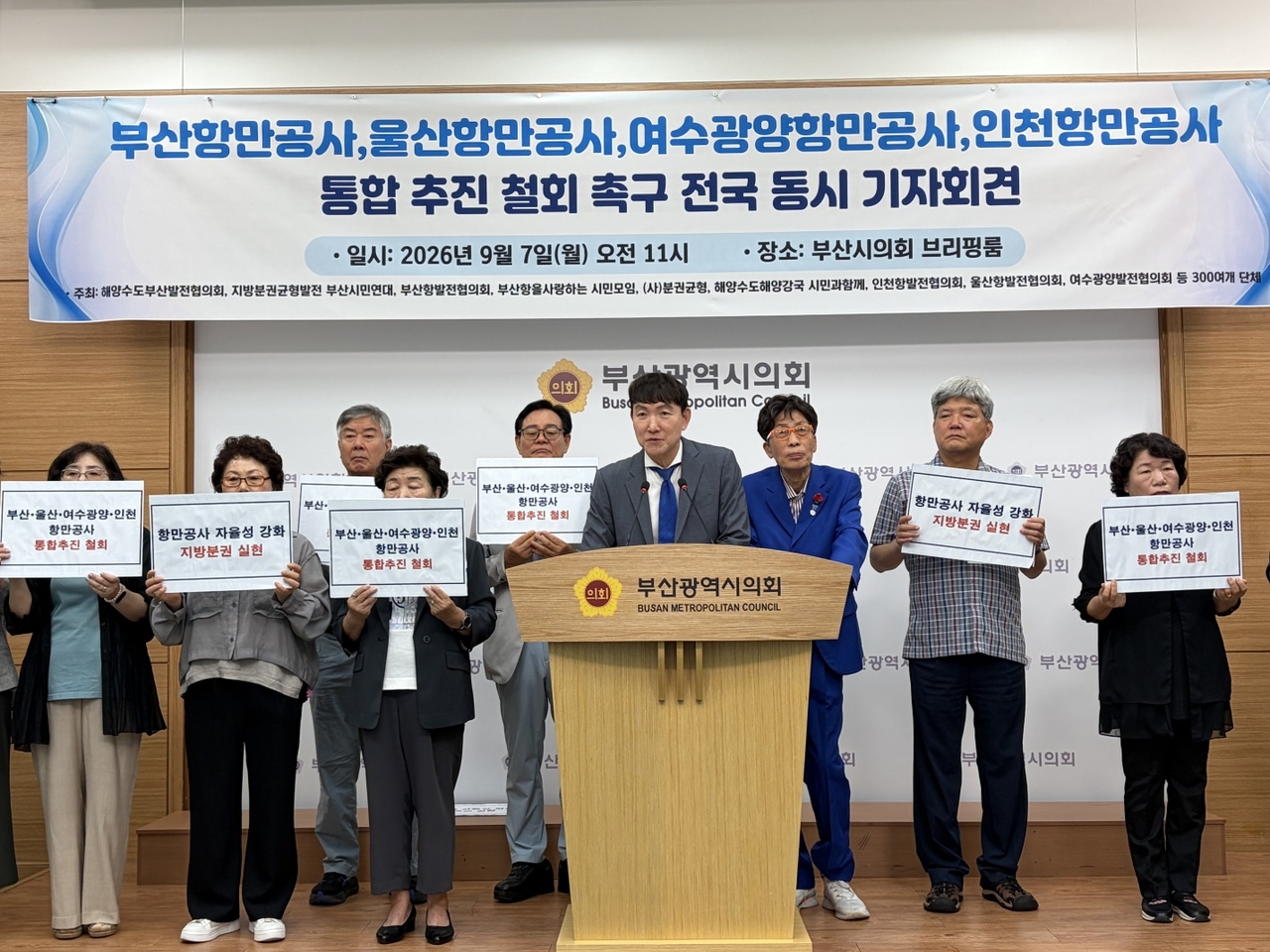
Civic organizations from Busan, Ulsan, South Jeolla Province and Incheon are demanding the government immediately scrap its plan to merge the country's four port authorities into a single entity.
More than 300 groups — including the Busan Maritime Capital Development Council, the Ulsan Port Development Council, the Yeosu-Gwangyang Maritime Association and the Incheon Port Development Council — held simultaneous press conferences Monday morning at the Busan City Council briefing room, strongly opposing the government's Sept. 3 announcement of a "public institution functional reorganization plan" that includes consolidating the Busan Port Authority, Ulsan Port Authority, Yeosu-Gwangyang Port Authority and Incheon Port Authority under one organization.
In a joint statement, the groups said the merger "is not simply a matter of reorganizing public institutions, but a critical issue directly tied to the nation's port and maritime competitiveness, the future of the shipping and logistics industry, and the direction of regional economies, decentralization and balanced development."
The groups argued that each port serves a distinct function — Busan as a world-class container and transshipment hub, Incheon as the Greater Seoul gateway for international logistics, Ulsan as an energy port, and Yeosu-Gwangyang as an industrial port for steel and petrochemicals — and that folding them into a single organization would be inefficient. They also warned that the merger would erode competitiveness by creating an unwieldy bureaucracy, slowing decision-making, generating conflicts over investment priorities among ports, and weakening port-specific strategies.
The groups pointed to major overseas ports — including the Port of Rotterdam in the Netherlands, the Hamburg Port Authority in Germany and Shanghai International Port Group in China — as examples of decentralized organizations that have strengthened each port's expertise and autonomy rather than pursuing centralized consolidation, and criticized the government's plan as running counter to global trends.
The groups called on the government to "immediately withdraw the plan to merge the four port authorities and shift policy toward strengthening the specialized expertise, autonomy and accountable management of each port," adding that "regional civic society will stand united to the end to ensure the merger is not forced through."
kaf2002@heraldcorp.com




