Party leader delivers first regular session floor speech since taking office
'Three mega projects are a project to save South Korea'
Eight-way consultative body proposed for semiconductor workforce
'Housing New Deal' to go beyond price stabilization
Constitutional reform, power structure overhaul also on agenda
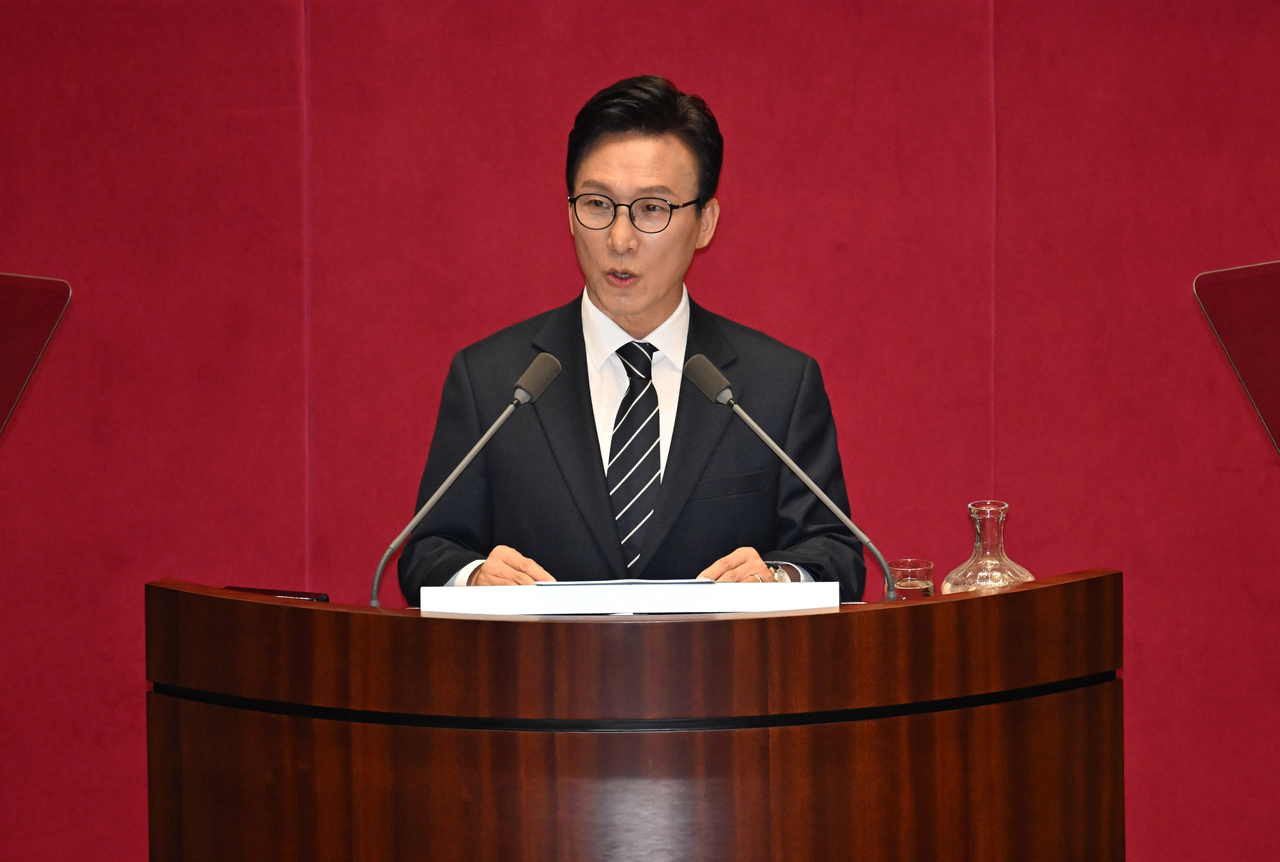
Democratic Party of Korea leader Kim Min-seok said Monday he would make passage of a special bill on mega special economic zones the top legislative priority of the regular parliamentary session, and pledged to push ahead with third-phase new towns at "unprecedented speed" so residents can see tangible results by 2030.
Kim made the remarks during the party's floor speech at the regular session of the National Assembly, describing the three mega projects as "a project to save South Korea" that would spread the semiconductor industry beyond the Greater Seoul area to the entire country, and as "a project to revitalize every region," starting in the Honam region and expanding to Chungcheong and Yeongnam.
The remarks were a direct rebuttal to criticism from some political quarters that the three mega projects amounted to "pouring money into Honam" and "twisting the arms of businesses." Kim said South Korea's major conglomerates were "neither weak enough to have their arms twisted by the government nor foolish enough to miscalculate the future," and said the Lee Jae Myung administration's region-led growth strategy "will write a new chapter in the history of periphery-led development."
Kim also said he would pursue an eight-way democratic consultative process — involving the central government, local governments, the National Assembly, local councils, universities, civil society, businesses and labor — to work out how to facilitate the voluntary and stable relocation of semiconductor workers to the regions and to develop an efficient workforce strategy to compete with rivals such as China.
On the third-phase new towns, Kim signaled a push for speed, saying the party would "stably support" government policies and supply measures already under way, including fast-tracking groundbreaking on already-announced sites. He also listed transit-oriented areas, semi-industrial zones, mixed-use redevelopment of water reclamation centers identified by Seoul Mayor Oh Se-hoon, and the lifting of height restrictions near the National Assembly and the Supreme Court as additional tasks.
Kim said the foundation of housing policy should go "beyond price stabilization to resolving the housing problem itself," and announced plans to pursue a "Housing New Deal." He called for public deliberation on gradually building a housing policy governance structure with broad participation from central and local governments, stakeholders and experts, and on dramatically expanding the housing budget, which has long depended on funds and proceeds from development and asset sales.
Kim also reaffirmed his commitment to political reform alongside constitutional reform. He said the party would strengthen ties with progressive reform parties and move forward in earnest with discussions on adjusting the threshold for recognized parliamentary floor groups. He also proposed a more modest gesture: mixing seating arrangements on the plenary floor. "If the leadership will allow it, I'd be happy to sit in the back with People Power Party leader Jang Dong-hyeok, or in the front if we go alphabetical order," he said.
On the relationship between the party and the presidential office — which had been strained under the previous leadership — Kim said he would establish "a creative, horizontal party-government relationship." He said the Democratic Party had, through experience across successive administrations, established the principle that the president participates in setting party policy and the party recommends personnel appointments, calling the president's party membership and party-government alignment "a safety valve for responsible politics and political stability."
However, the confirmation hearing process is expected to prove rocky before Kim can establish the ruling-opposition dynamic he envisions. The opposition has launched aggressive scrutiny of Justice Minister nominee Kim Seung-won and Gender Equality and Family Minister nominee Yong Hye-in, and the controversy has spread to questions about Cheong Wa Dae's responsibility for inadequate vetting. People Power Party leader Jang Dong-hyeok said at a supreme council meeting Monday that "this cabinet reshuffle is tantamount to President Lee Jae Myung declaring he has given up on the people."
Nominee Kim Seung-won faces allegations of lobbying on behalf of a new drug and controversy over a family member's employment at a welfare institution. Nominee Yong is under fire over her stated intention to retain her proportional representation Assembly seat while serving as minister. The ruling and opposition parties have agreed to hold a confirmation hearing for Kim on Sept. 15, with the Democratic Party saying it will "wait and see how the hearing unfolds." Calls for Yong to resign either her Assembly seat or her ministerial nomination remain strong.
Park Seong-jun, the Democratic Party's chief spokesperson, told reporters after a closed-door supreme council meeting Monday that "the party needs to actively respond to the negative attacks on nominee Kim," adding that Supreme Council members Han Min-su and Jeon Yong-gi, along with Legislation and Judiciary Committee member Rep. Kim Dong-a, had been formed into a single team to handle confirmation hearing-related responses.
addressh@heraldcorp.com
thanks@heraldcorp.com